
Synesthemancy
Legend
“Magic Shards are not just crystalised mana, no they are the echoing fragments of the mana seas consience—it’s former self.”
“Their main coulour swirl and residues form a storyline-stream and milestone-sigil pattern.”
Description
Synesthemancy is the discipline of decipherment of a shard’s main colour fill and its swirl shape. It’s the residual content of Void and World matter, and how other hues are spun, that forms a pattern. The skill is not just observation and the art of reading a shard’s internal structure, colour dominance, and residual orientation. It’s also understanding the history of the astral, the void, the divines, the races, our world and its history, and factors that have influenced how the shards are formed.
Synesthemancers believe the Hymn of Truenames was not just a divine confession of imperfection and all true names given but also a panicked slip of the semantic key—further illustrating their imperfection. Some are trying to reconstruct this master glyphic sequence that could unlock the Astral’s original syntax and finally shed flawless insight into the Astral.
The vast and broad information field has led to the development of a descriptive language, somewhat matching that interpreted by the findings within the shards. Mastering the language takes decades, as it’s a mix of shard analysis, history study, and symbolism indexing. The language covers:
- Chromo-symbols: The core of the language, representing main colours and their hue
- Surface symbols: Symbols describing the surfaces structure.
- Size symbols: Symbols describing the size and weight.
- Morpho-glyphs: Symbols describing the shape and structure of the swirls.
- Histo-glyphs: Glyphs representing historical periods, significant events, or major entities.
- Residuo-glyphs: Symbols to denote the abstract “tainting residues”.
Mastering analysis and proving history knowledge are the easiest parts. Describing it is a whole new level.
“To write a shard is not really hard; one though has to see the inner glee.”
—Skjald Vinotis
History
Third AgeA couple of centuries trailing their arrivals, whispers began to surface that the wanderers knew something about magic shards that none north of the rim knew. Most likely it even originated from the Vular members of the wanderers, as they realised none here knew their secret and bragged about their superiority. Although an uncertain fact, the Vularian trend is certain. Too many historical sources describe the behaviour.
Anyways, they as good as managed to keep it secret, simply because they waged war against anyone getting within miles of their lore secrets, and they had no issues even if it originated in their own mouthy spills. But a few very perceptive individuals who interacted with them in the latter years, and from information retrieved after Jomzaar raids. We learnt it was something about the magic shards.
So, some began to experiment with shards to try to figure out what would be the secret. Little could they imagine that it would take yet another half-millennium, a worldly cataclysm with the sinking of Ljostari, and two centuries of Arisen-slaying before it finally dawned on them—shards had an embedded language.
“Right before their eyes, as crystal clear as could be—it hid itself for a dozen millennia.”
—Skjald Sjerik
Fourth Age
The disastrous Deep Blue Tsunami birthed thousands of Arisen that were slain in the following years. This resulted in an enormous amount of multicoloured shards; they made most kaleidomancers and Purimancers sit with blinking eyes and mumble curses at their oversight.
The easily observed chaotic swirls of multicoloured shards sparked the idea to see if the main colours and residues had the same ‘internal dance’. It quickly became obvious that there was not only a pattern but also messages hidden within the shards, as if they carried messages. At first mistaken for a man at sea trying to communicate, but within a few centuries it was clear, due to the randomness of it all, that it had to be scattered fragments of memories, emotions, and events.
The entire community of mana manipulators, scholars, shard-slingers, and whatnots was in uproar during the aftermath of Arisen and Liches all the way up and well into the Age of Hordes. By then, almost a millennium later, several Vularian Wanderers admitted that they knew and studied this during the third age – and why they tried to seize Ljostari. Some sort of world-spanning language as defined.
“Four millennia of twisted hue whispers and arisen rainbow drops before eyes finally saw.”
—Skjald El Mary
Cartography
Synesthemancers are only found in academies and various organisations, each vying for first discovery of new landslides to share—so they can walk in front and obtain the best shards for examination and use. While academies value truth and tradition the most, organisations have several different agendas. Synesthemancers serve quietly within these institutions, and it’s a rare event when ones with different ties are discovered amongst either.
- Academy practitioners: Scholarly circles devoted to all shard types or analysis methods.
- Organisation practitioners: Talents now working on various ploys—often in secrecy.
Staying at academies generally has its advantages, as practitioners have access to a greater amount of shards and can observe the higher-tier pattern analysis their peers perform.
“Finding a pattern that can’t be interpreted is something every practitioner craves.”
—Skjald Vinotis
Organisation
Synesthemancers are at their place because they live and think their patterns, not really caring about titles as such, but for what titles can unlock and allow one to work with. Or if they end with practitioners to be taught, more eyes and minds on deciphering patterns is beneficial. What really matters to them is to analyse and unravel more of the shards’ languages.
Internally though, there’s a philosophical rift, as some Synesthemancers believe merging is an abomination and sacrilege. Which should not be undertaken before complete understanding has been reached. These purists are, by the way, those of all who take the crude shards the most seriously, as they believe these residual drops might hold the key to the locks that could bind shards.
The other group, on the other hand, works tirelessly to ensure proper merges can occur. Generally to strengthen their research, but there are also those who don’t care what shards will be used for—as long as they can work:
- Purists believe shards should only be read, never altered.
- Glyphwrights believe shards can be rewritten, restoring or even fabricating memory.
This has led to tension, schisms, or even glyphic obstructions in the past—even where rewritten shards ended up carrying false descriptions or propaganda. Some say that this ‘jesting taint’ is the work of the young divines, trying to strengthen their own realm on behalf of ‘the truth’.
“Divines, elder and young. Factions and foes. All try to taint the song.”
—Skjald Kazumix
Synesthemancy is about understanding, because even though shards do not lie, they obscure. The Synesthemancer’s task is to see through layers, peeling away divine influence, distinguishing what others cannot, and knowing what others dare not ask. So a shard of truth can be revealed and documented.
Ranks of Synesthemancy
| Rank | Title | Description |
|---|---|---|
| I | Apprentice | Notice main colour and swirl pattern. Study grimoire calenders. Write at their own biographies. |
| II | Novice | Learns basic chromo-symbols and swirl morphology. Begins documenting simple shard phrases. |
| III | Journeyman | Can interpret multi-layered glyph chains and identify historical resonance. |
| IV | Chief | Oversees pattern decipherment and shard lexicon development. Align biographies with academy lore. |
| V | Master | Constructs full shard narratives and begins predictive glyph mapping. Proofread biographical entries. |
| VI | Lord | Deciphers divine interference and chromatic bias in shard syntax. Rewise biographical misalignments |
| VII | Overlord | Reconstructs lost astral events from shard fragments. |
| VIII | Grand Lord | Can write new glyphic sequences into shards, altering their semantic resonance. |
It’s an insane amount of work, especially as a shard can dissolve in a puff; within a blink of an eye everything is gone—but the Synesthemancers live and breathe for nothing but this. They also, to ensure magic shard interpretations can be understood generations later, keep an entire bookkeeping system regarding each Synesthemancer and how they interpret.
“The most observant see the pattern with eyes looking elsewhere.”
—Skjald El Mary
Synesthemancers rely on their tools, the grimoires of patterns, glyphs, and symbols:
- Surface: Loupe, combination square, etc.
- Shape: Polyface-habit grimoires.
- Size: Ruler, crimps, caliphers; precision spring, claw, jaws, gauges, etc.
- Pattern: Several pattern grimoires
- Events: Several calendar grimoire
- Emotions: Self-Assessment chart grimoires, emotion chart-wheel grimoires.
- Pollution: grimoires about auras, dust, influence, etc.
These simple tools are determination aids; the real patternisation takes shape in the mind of the synesthemancer. As they analyse the intricate and multi-layered nature of the information, these scholars utilise a specialised deciphering language. Using this language designed to be able to describe not just visual patterns, but also abstract concepts like historical events, residual energies, and cosmic influences. They unfold their talents:
Aetherial Script: Is a script language that offers a direct interpretation of the astral realm’s fundamental truths. It utilises Chromo-Glyphics, a symbol set describing main colour with “glyphics”. It’s a technical set that emphasises the visual, symbolic nature of the language. Manaic Notation, a sort of sub- and superscript, is a more practical subset, focusing on the “notation” or documentation of mana-related phenomena.
Aetherial Script is thus a hybrid system, combining elements to describe the various aspects:
- Chromo-symbols: These are the core of the language, representing the main colours and their hues. Each colour has a symbol, but modifiers (like a dot, line, or circle) could be added to denote variations in hue or intensity. For example, a basic symbol for “blue” could be modified to represent tinted towards “violet” or “cyan”.
- Morpho-glyphs: These symbols describe the shape and structure of the swirls. They represent fundamental geometric forms (spirals, waves, and fractals) and their combinations. A specific glyph might represent a “chaotic spiral”, while another represents a “calm wave”.
- Histo-glyphs: Since the shards contain historical information, a set of glyphs represent specific historical periods, significant events, or major entities (the void, the divines, specific races). For example, a symbol might represent “the dawn of the world” or “the great invasion”. A form of condensed historiography.
- Residuo-glyphs: These symbols denote the abstract “tainting residues”—vibrations, sounds, and emotions. For example, a symbol might look like a vibrating line to represent “vibrations” or a teardrop shape to represent “sorrow”.
Here is a glyphic chart, as seen on the pages of a synesthemancer’s personal grimoire. Each symbol breathes with layered meaning, from the bold chromatic assertions of the Chromo-symbols to the faded whispers of the Residuo-glyphs. The parchments often seem to hum with memory, as the emotions run deep when describing.
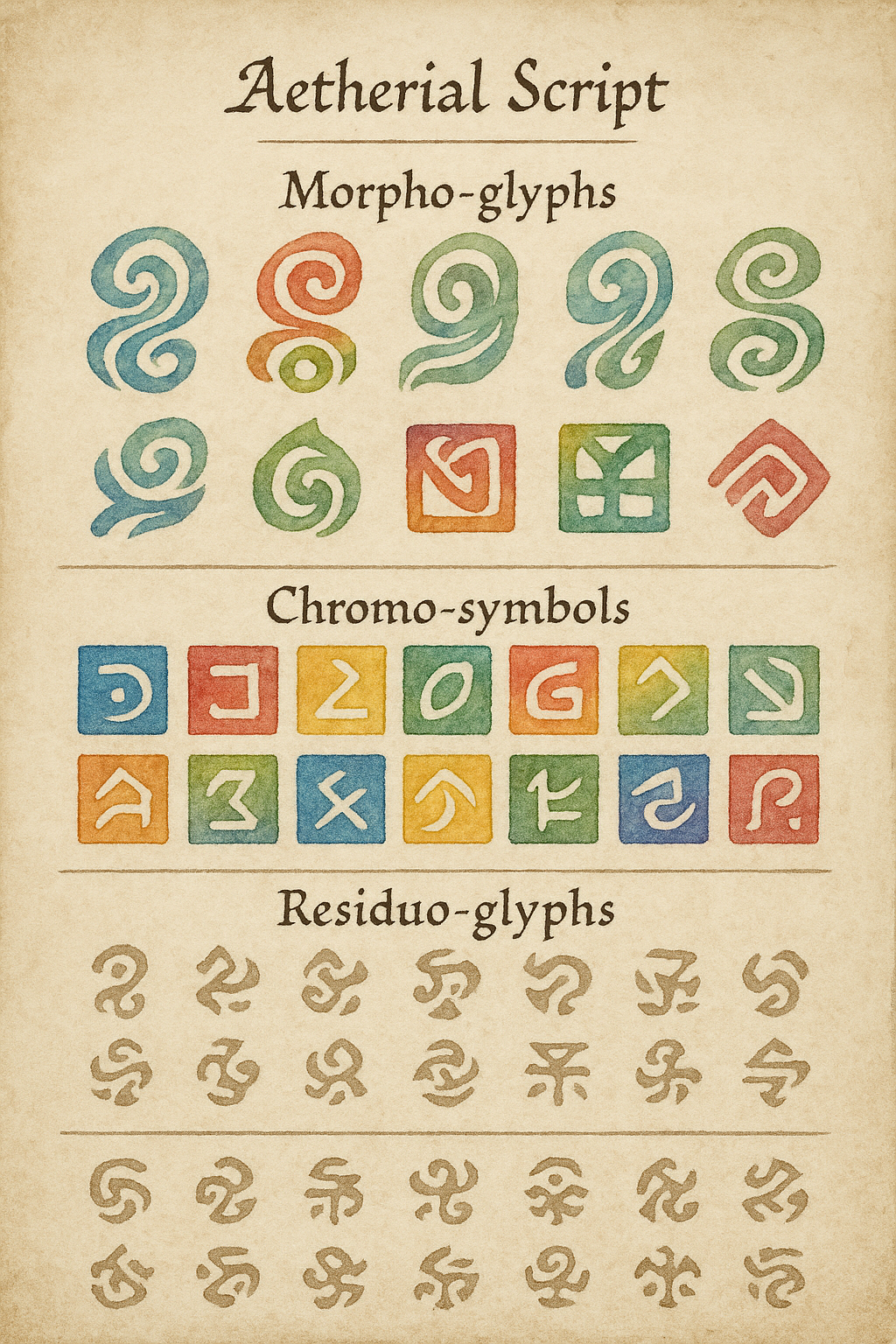
So, when a Synesthemancer describes a shard, they wouldn’t just go, “It’s a blue shard with left-spun swirls.” They would use their language to create a precise, multi-layered description. Thus, a basic description might read as: [Symbol for Blue] [Glyph for Chaotic Spiral] [Glyph for The Void] [Glyph for Sorrow]. This could be interpreted as “A shard of blue, with a chaotic spiral pattern, showing a residual presence of the Void, and imbued with the emotional trace of sorrow.”
This structured approach allows the scholars to document their findings with a level of detail and precision that goes far beyond simple prose and their own local language. The nuancheings is where Synesthemancy comes alive. The fading hues, the merging tones, the perfectioned brushstrokes—they’re not just aesthetic choices. They’re emotive fingerprints. Each glyph a reflection of the Synesthemancer’s impression, their own resonance, even their subconscious mana leanings.
It’s as if the glyphs aren’t just read—they’re felt. A Morpho-glyph painted in a trembling violet gradient might carry the weight of grief, while a Chromo-symbol rendered in bold, unblended red could signal urgency or defiance. And when those hues merge? That’s where interpretation becomes art. No two Synesthemancers would ever render the same glyph identically—and that’s the beauty of it.
This discipline where the practitioner’s emotional state isn’t a hindrance—it’s part of the syntax. Does though also birth a problematic issue. How glyphs shift over time, or how a Synesthemancer’s personal palette evolves with their rank or trauma, This living language, needs a rythm to its breath.
“Each shard its own tale, each depicting a mortals exhale.”
—Skjald Valgrif
With Synesthemancer’s tinting hues, reshaping glyph forms, as their own interpretationed vision, its became extremely important to create a Synesthemancer grimoire for each and every practioner there ever was.
The Synesthemancer Grimoire Series serve as both archive and mirror: a living repository of each practitioner’s chromatic lexicon, emotional glyphwork, and evolving mana signature. It’s not just a resume—it’s a resonance map.
These series, reside on every academy, so one can look up a Synesthemancer’s own resume, and the academy leaderships intrepretation of the Synesthemancer’s work and persona..
The Grimoire Series: Structure & Purpose
- Volume I: Personal Glyphology Each Synesthemancer’s unique glyphs, color blends, and hue transitions—annotated with emotional states, historical context, and mana fluctuations.
- Volume II: Interpretive Commentary Academy leadership and senior Synesthemancers offer layered interpretations, noting symbolic depth, psychological patterns, and potential magic-realm affinities.
- Volume III: Resonance Timeline A chronological mapping of the Synesthemancer’s evolution—how their glyphs and chromo-symbols have shifted through trauma, triumph, or transformation.
- Volume IV: Collaborative Echoes Glyphs created in tandem with others, showing how resonance changes in shared rituals, duels, or healing rites.
- Volume V: Grandlord comments Those who have been Grandlords have revieved each and every Synesthemancer grimoire and concluded on their content. This is generally done after the Synesthemancer’s death.
Institutional Integration
- Academy Archives Each academy maintains its own Grimoire Vault, accessible to faculty, mentors, and advanced students. It’s a sacred trust—part biography, part spellbook.
- Synesthemantic Council Reviews Periodic reviews by the Council to assess growth, potential, and readiness for higher glyphic rites or inter-academy exchanges.
- Public Resonance Index A curated excerpt of each Synesthemancer’s work, available for public inspiration and cross-disciplinary study—like a gallery of emotional magic.
This system elevated Synesthemancy from a personal art and secured it as a scholarly discipline, while still honoring its deeply individual nature. Individualism and academical autonomicy results in rival academies interpreting the same glyph differently—like magical dialects shaped by cultural bias.
During the great invasion, many a Grimoire Vault was attacked and plundered. Often raiders are though quickly hunted down and grimoires recovered. I managed to pull out a sample entry from a gang of Frograi I dealth with. Its about one of the most enigmatic and revered Synesthemancers of the Third Chromatic Era:
🌀 Grimoire Entry: Virelai Nocturne
Race: Human, Clovincaz
Academy Affiliation: Lysoria Academy of Resonant Arts
Rank: Chromarch of the Fifth Veil
Mana Signature: Indigo core with silver fractal bleed
Known For: Inventing the “Lachryma Spiral” glyph and pioneering grief-based resonance healing
I. Personal Glyphology
Primary Glyphs:
- Lachryma Spiral – A morpho-glyph rendered in fading indigo and translucent pearl, used to extract sorrow from the shards aura and transmute it into clarity.
- Echo Bloom – A chromo-symbol that shifts from pale green to deep violet depending on the viewer’s emotional feel of the shards state. Often used in rites of reconciliation.
- Veilfract – A jagged glyph with unstable hues, banned from below novice use due to its unpredictable emotional feedback loops.
Color Theory Notes: Virelai’s glyphs often feature non-linear hue transitions, where colors fade and reappear in recursive patterns. Her use of silver fractal bleed is considered a signature of high emotional compression—grief, longing, and memory entanglement.
II. Interpretive Commentary
Dean Solenne of Lysoria:
“Virelai’s glyphs do not merely express emotion—they extract and summon it. Using her Lachryma Spiral once caused a room of hardened Synesthemancer’s to weep in synchronised emotional understanding. She paints percieved patterns, and yet her work loosen minds.”
Council Review (Year 7 of the Third Era):
“Her resonance profile suggests a rare alignment with the Hymn of Truenames, the Swirling Spectrum. We recommend limited exposure for apprentices and mandatory emotional shielding during demonstrations.”
III. Resonance Timeline
- Age 12: First glyph recorded—Murmur Thread, a simple line of shifting blue.
- Age 29: Survived the Collapse of the Azure Vault; glyphs began showing silver bleed.
- Age 57: Created Lachryma Spiral during mourning rite for her mentor.
- Age 84: Appointed Chromarch; began teaching “Emotive Glyphcraft” to advanced students.
- Age 114: Entered voluntary silence; communicates solely through glyphs.
IV. Collaborative Echoes
- With Synesthemancer Kael Vire: Co-created Twin Pulse, a dual-glyph ritual for emotional synchronization. Often used about shard pairs to be merged.
- With the Naudagir Academy Choir: Developed Resonant Chorus Glyphs, which change color based on harmonic input. Generally used on multicolour shards, and rarely attempted on pure colour shards.
- With the Dreaming Synesthemancer Uhala Hu: Created Somnibloom, a glyph that revealed its describing hues during sleep-state meditation. Used for living, or half-living shards.
This is an example of the information a Mana Crysal Academy keep about their Synesthemancer’s.
“The Grimoire Vaults is deep, and they’re ready to hold more.”
—Skjald Ulrich
Special
Shards don’t lie, but their wisdom is thrice tainted. By the mana sea to only have the wisest interpret, by the elder divines and their world carpet filter to blur the content, and by the young divines—the gods—to tint every shard towards strengthening their aura colour the most.
“Patterns… within patterns… within patterns… are what synesthemancers unravel.”
—Skjald Kazumix
Last Updated on 2025-09-24 by IoM-Christian