
Farmstead
Legend
“Whenever a path bend, or terrain offered its soil or shelter, individuals settled and offered either lodging, services, or goods. Thus farmsteads grew forth, and landclaims were made.”
Description
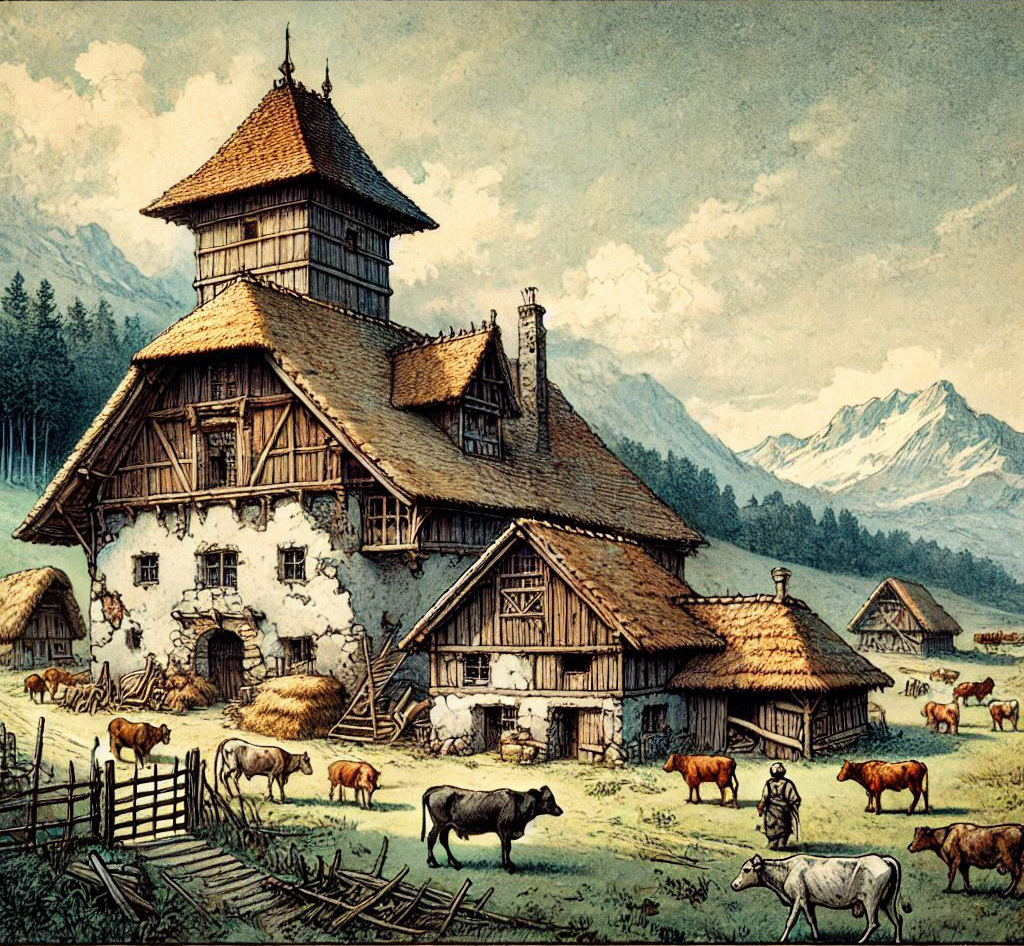
A farmstead is more than just a collection of buildings; it’s a small community, a testament to human ingenuity and resilience. It’s a place where the land provides sustenance, and the family works together to ensure survival and prosperity.
Farmsteads can vary greatly in appearance depending on the region, climate, and available resources. Some may be simple wooden structures with thatched roofs, while others may be more elaborate stone buildings with fortified walls.
Skjald Sigurd
History
The concept of the farmstead is ancient, dating back to the earliest days of human civilisation. Early humans learned to cultivate the land and domesticate animals, leading to the development of settled communities and the rise of agriculture.
In the early period, the farmstead was often the cornerstone of rural society. Feudal systems saw land divided into fiefdoms, with peasants cultivating the land in exchange for protection from their lord.
Over time, farmsteads have adapted to changing conditions, incorporating new technologies and innovations. From the introduction of the plow to the development of more efficient farming techniques, farmsteads have constantly evolved to meet the challenges of the times.
Skjald Vinotis
Cartography
A farmstead is a hut, house, workshop, or a collection of the lot, with no distance greater than 200 m between each. They are mostly inhabited by residents of a sole race.
The layout of a farmstead is crucial for efficiency and practicality. Fields are typically arranged in a way that maximizes sunlight and minimizes soil erosion. Buildings are strategically placed to provide shelter from the elements and to facilitate the flow of work.
The specific layout and design of a farmstead will vary depending on the region. Hillside farms might have terraced fields, while those on flat plains might have larger, more open fields.
- Dwelling: The main living quarters for the family.
- Barn: To house livestock (horses, cows, sheep, pigs).
- Stables: For horses and other draft animals.
- Granary: To store grain and other crops.
- Fields: Cultivated land for crops (wheat, barley, vegetables).
- Pasture: Land for grazing livestock.
- Gardens: For growing fruits, vegetables, and herbs.
- Workshops: For blacksmithing, woodworking, or other crafts.
- Well/Spring: A vital source of water.
Skjald Sejrik
Organisation
The family is the heart of the farmstead. Everyone, from the eldest to the youngest, contributes to the daily work. Tasks are often divided based on age and gender. Men may be responsible for plowing fields and tending to livestock, while women may focus on gardening, cooking, and childcare.
The goal of a well-run farmstead is self-sufficiency. The family aims to produce enough food to feed themselves and perhaps even have a surplus to trade or sell. While relatively self-sufficient, farmsteads are rarely isolated. They often participate in local markets, exchange goods and services with neighbors, and contribute to the larger community.
Skjald Valgrif
Special
Farmsteads are generally suspicious of visitors of other race then the residents.
Skjald El Mary
Last Updated on 2024-12-27 by IoM-Christian