
Enhancing
Legend
“Our crafters rival the gods in enhancing objects, which, wielded or worn by heroes, makes legend come true.”
“In his Opalizer’s armour set, Brucester’s might was boosted tenfold and could be felt from a distance.”
Description
Enhancing involves making items and objects exceptional by embedding energies from the mana sea into them, which are then manipulated to create specific boosts, effects, and wards. The benefits of enhancement mean survival when squaring off against foes and monsters or completing actions otherwise impossible. Enhancements can be of any kind, from boots increasing pace through added quickness to deadly bows of precision through added strength and agility.
- Amplifiers: Boost raw magical output (damage, range, intensity).
- Filters: Refine or redirect magic (e.g., change element, target, or effect).
- Anchors: Stabilise or protect (e.g., warding, resistance, nullification).
- Channellers: Divine-linked, probabilistic luck enhancers.
Enhancing can be done in the crafting process, generally used when mass-producing weapons and armour for armies. Alternatively, skilled enhancers, specialised in the relevant area and magic realm, can enhance the enchantment, tailoring it to the wielder or wearer. One downside is that with enhancement comes item awareness and wielding limitations far more impactful than those regarding normal craftsmen’s work. Items enhanced might suddenly reject their former wielders due to their newfound self-awareness. The wielder’s or wearer’s rejections can be mitigated or even nullified through aura-binding, a ritual or process shunned by most and considered taboo.
“As he held his ancestral rapier, it told him to sheath it, as he was unworthy. And the enchanter smiled…”
—Skjald Yell'a'Beard
History
Dark AgesWe don’t know who was the first to bind Magic Paths, add a Magic Shard, or whatever they did. But at some point in the Dark Ages, crafters realised that object creation could be enhanced in various ways. Thus, they began experimenting with controlled tainting, as they called it, emulating how a mana leak, instead of turning into a magic shard, manipulated whatever it touched. Many centuries passed, and knowledge of dos and don’ts slowly grew, and processes were discovered.
During this period, followers of the elder divine Wickeryadii, who had also been studying alongside Vornir or worked with those who had. Came to realise that many of the signs, carvings, and odd texts at their millennia-old void gardens or sacred places. Especially at those who never had any mana links or Boriac, a race of elder divines. Were in fact Wickeryadii runes protecting them against the mana sea and the ‘astral divines’, as they call Vornir and Boriac.
These began to examine and catalogise the runes and found they were keys to certain core energetic flows; one could call it the arcane core of void reactions on the mana sea. These studies ended with a triangle system, but that’s for another skjald to elaborate. All to say here is that shard dissolving and energy embedding, or the risky process of leak-dripping, had a competitor.
Then something odd happened. Many of the mana links the Boriac had created evolved from self-aware existences into mobile divines, the gods. Suddenly there was a whole new competitor, channelling the raw mana sea in regard to the energy source for enhancers. If this was a result of the mana sea learning of the runes, we will never know.
First Age
The world reform, an odd name for using the gardens of the vast void to wrap around the astral, but that’s how it is. Had a similar effect to the gods and the introduction of channelling on enhancing. As the world’s earth nodes and their interconnecting ley lines brimmed with energy, it began to sing in harmony with the mana sea spinning inside—almost like the harmony of the Stoicheian Twins of Sun and Moon.
Slowly enhancers came to realise that the gemstone ores running across ‘the flesh of our world’ soaked up certain core aspects of the mana sea. Some pondered how closely these resembled how the Vornir, a race of elder divines, had created—or shaped—mortal races. Thus, they began intense studies and attempted dialogues with Stoicheians, who eventually admitted that it was indeed their work, to sort of remedy their participation in sealing the astral.
Regardless, they figured out how to structure and work with the world’s essence. Another branch of energy source for enchanters had seen the shine of the Stoicheian Twins. This might have been – in fact, it most likely was – one reason the 1st Cataclysm broke out.
Second Age
As the world settled after the disaster where it almost spiralled to a point where the world unravelled and everything dissolved. The races had sided with vampires against the divines and their controlling and manipulating behaviour. Continued their cooperation in a secret pact, those who unwillingly had become vampires gaining divine powers, and some of the mightiest mana manipulators, enchanters, crafters, alchemists, and more. Wanted to cut off divines as an energetic source, so they began studying old lore about random leaks and taintings back in the void.
As centuries passed, it became clear that this was dangerous ground, as the strategic elder divines and whimsical younger gods—although connected to the mana sea but also detached from it due to their self-indulgence—did not at all fancy this. So being exposed could mean death. This led to the practitioners of this mental training reaching out to Stoicheian and Wickeryadii, as it had been discovered that these two elder divine races since the earliest days also had worked to lessen the influence of the ‘astral divines’.
This additional divine aid, counting vampires as such, provided more security for mentalists. And when the Boriac, considering this new approach in utilising the mana sea might reveal the missing pieces in understanding the mana sea’s memory fragments and the pattern inside magic shards, nodded approval as well. It became way safer to be a mentalist, but it has led to speculations.
Was the bullheaded god, a unified manifestation of younger divine power, a champion of gods, summoned to destroy vampires without implicating gods directly? Nonetheless, it heralded a new age.
Third Age
As such, this age brought nothing groundbreaking to enchanting; some might even claim the opposite, as the actions of the mortals of the Vular race resulted in hundreds if not thousands of grimoires, tomes, recipes, whole libraries, crafters, enchanters, and entire workshops being killed or destroyed. Thus lessening the amount of available lore and even creating the Arisen, a race of spirits yanked back into whatever carcasses remained and walking the world once more.
Should anything positive be said, it would be that the increased warfare preparing spanning all isles and races slowly saw another system grow alongside the four magic realms regarding enhancement. A system of similar items and objects, so enhancers of a realm also specialised in gloves, capes, belts, or the like. Resulting in at least 19 branches of ‘specialists’.
Fourth Age
After the Deep Blue Tsunami had settled, enchanters picked up their trade from the ruins and revitalised it. Having a golden period as both monster hunters sought their services, and they had hundreds of champions and heroes seeking them out during the Age of Hordes, where ancient rulers fought upcoming horde leaders. The rise of the Realm saw a demand for more subtle enchantments, but when the Great Invasion struck, military and combat enchantments were produced in the thousands.
“Of such greatness were his enchanting skills that he could create entire sets of divine radiance.”
—Skjald Valgrif
Organisation
Very simple enhancing can be done by self-taught ones but is generally undertaken by those skilled in several of their branches and organised in guilds. They regard these simple enhancements of complexities ranging from 0 to 49 as ragtag work.
- Apprentice (I) Apprentices are able to enhance objects with purity from 50 to 174.
- Novice (II) Novices are able to enhance objects with purity from 1 up to 299.
- Journeyman (III) Journeymen are able to enhance objects with purity from 1 to 424.
- Chief (IV) Chiefs are able to enhance objects with purity from 1 to 549.
- Master (V) Masters are able to enhance objects with purity from 1 to 674.
- Lord (VI) Lords are able to enhance objects with purity from 1 to 799.
- Overlord (VII) Overlords are able to enhance objects with purity from 1 to 924.
- Grandlord (VIII) Grandlords are able to enhance objects with purity from 1 to 1000.
Enhancers have, through time, learnt that objects can only contain or channel a certain amount of the same energy type. Thus, enhancers adhere to the Mendoza Matrix that guides not only stacking limits of one specific energy type. But it also elaborates on the narrowing of the spectrum used as it builds up. Here shown using Cyan:
[*][*][*][*][*][*][*] [*] 1 Cyan enhancement allows for full use on either side, and 1 multicolor. [*][*][*][*][*][*] [*][*] 2 Cyan Enhancements narrows the use of either side by 1 and 2 Multicolor. [*][*][*][*][*] [*][*][*] 3 Cyan Enhancements narrows the use of either side by 2 and 2 multicolor. [*][*][*][*] [*][*][*][*] 4+ Cyan Enhancements narrows the use of either side by 3 and 1-4 Multicolor.
Note that this only covers one type of Cyan energy, as one Enhancing 2 [*][*] Gems can use a [*] Rune or Pattern, etc.
—Skjald Ulrich
Enchanting realms Common for all four enchanting types is, well, for patternists the tattooing process prevents it, but embedded patterns suffer as the rest. Items enchanted might become self-aware, gain ego levels surpassing their wielders’ or wearers’, or grow sentient item moods, making them unstable. Thus there’s a tension between power and risk due to energy saturation penalties or mana turbulence when stacking enhancements—sometimes fixable with bonding rituals, but this is a path few are advised to consider, as then the item surely ends up taking over.
Linkbinders (Channelling/Luck)
Linkbinders create conduit charms that increase the chance the wearers’ favoured deities might aid, although whimsical, through a process equally as complex as the rest of the enhancing areas. The Linkbinders process emphasises the Linkbinder’s role as a mediator and the unpredictable nature of the gods’ favour.
- Acquiring a Divine Imprint: After a talk with the customer, the Linkbinder begins by meditating or performing a ritual to receive a divine “imprint” or “whisper”. This isn’t a direct message but a subtle, ephemeral sensation that signifies the presence and nature of a specific deity. This step determines which god’s energy will be channelled into the charm. The Linkbinder must be highly skilled and attuned to the “mana sea” to sense these divine influences.
- Deciding on the Charm’s Form and Function: The Linkbinder then works with the customer to determine the charm’s purpose. This is where their craft becomes most nuanced. Unlike other enhancers who imbue items with specific stats like “strength” or “quickness”, a Linkbinder’s charm doesn’t grant a fixed ability. Instead, the shape and form of the charm, while not holding any spells or stat boosts, influence the outcome as a “sort of a luck boost”. For example, a charm shaped like a lightning bolt might be more likely to encourage a deity of storms to intervene, while a charm of a closed fist might favour a god of martial prowess.
- Crafting the Charm: The Linkbinder fashions the physical charm. This could be anything from a carved amulet to a finely wrought bracelet, using raw materials that might hold a special significance to the chosen deity and the customer. This object serves as the “link anchor” that will hold the connection. The process itself is called “Linkweaving”.
- Attuning the Link Anchor: The final and most critical step is to attune the charm—and the customer who will wear it—to the divine power. The Linkbinder imbues the charm with energies from the mana sea, but they are not imbuing a spell or a stat boost. Instead, they are strengthening the “tie” from the mortal to the deity, creating a “conduit-charm”. They essentially create a “channel” for the divine power to flow through, making it easier for the god to notice and, perhaps, act on behalf of the wearer.
- The Whimsical Outcome: The Linkbinder’s work is complete, and the charm’s link is established, but whether it’s divine favour thresholds, ritual activation, or alignment-based bonuses. How and when a deity chooses to intervene is left to the gods and remains “whimsical” and unpredictable to mortals. But the aid from deities,
A final word on the whimsical energies might be in place. For instance, instead of a continued speed boost, a charm might grant a character a sudden, lucky gust of wind to avoid a trap, or instead of a static protection shield, a charm might cause an enemy’s weapon to slip from their hand at a crucial moment. Thus, many charm wielders or wearers have developed rituals, prayers, gestures, or sacrifices prior to trying their luck. And many will testament that displayed devotion, or alignment. Feels like “charging” their charms Introducing improved “luck”, where success becomes more likely after failures.
Rune Engravers (Arcane/Skills)
Rune engravers create focal energetic points when they engrave a rune and pour magic energies into it that can boost wielders’ or wearers’ skills in accordance with the fundamental energies of the mana sea. Often runes don’t appear alone but in bands, adding synergy effects when they are combined. Runes might also bring rune resonance based on wielder traits.

- Feoh (Possessions)
- Ur (Strength)
- Thorn (Gateway)
- Os (Signals)
- Rad (Journey)
- Cen (Opening)
- Gyfu (Partnership)
- Wyn (Joy)
For example, a “Rune of Ur” on a gauntlet might give a wielder a temporary boost in strength for a single powerful blow.

- Hagel (Disruption)
- Nyd (Constraint)
- Is (Standstill)
- Ger (Harvest)
- Eoh (Defence)
- Peorth (Initation)
- Eolh (Protection)
- Sigil (Wholeness)
For example, a “Rune of Ger (Harvest)” on a longsword might give a wielder a temporary boost in decapitation chance for a single powerful stroke.

- Tyr (Warrior)
- Beorc (Growth)
- Eh (Movement)
- Man (The self)
- Lagu (Flow)
- Ing (Fertility)
- Daeg (Breakthrough)
- Odal (Seperation)
For example, a “Rune of Eh (Movement)” on a pair of boots might give a wielder a temporary boost in pace for a single powerful sprint.
Gem Enhancers (Essence/Stats)
Gem enhancers deal with the most magically saturated of gemstones, found and picked from the ‘ores of world’s flesh’. The gems and energies in them are carefully selected and imbedded into items so that the wielder or wearer experiences a clean boost of their basic stat attribute. As each of the gems benefits with a ‰ of their purity, the wielder’s or wearers’ stats, skills, and whatever abilities become affected. Thus do people generally prefer gems with a purity of 1000, but so very few can make these, and items that pure might reject them. So most settle with purities around their current skill level. Here is a wheel of gem colours cut in octagon form, but cut gems come in many forms determined by the gem cutter who refined the gem.
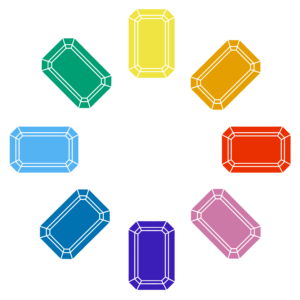
- Cyan (Zircon)
- Presence
- Green (Emerald)
- Empathy
- Yellow (Chrysoberyl)
- Intuition
- Orange (Citrine)
- Wisdom
- Red (Ruby)
- Constitution
- Pink (Tourmaline)
- Quickness
- Violet (Ametyst)
- Strength
- Blue (Sapphire)
- Dexterity
- Chaos (Opal)
- Luck
Not all gems used to enhance an item have to be the same colour; they might be boosts via purity. You might define gem fusion rules, overload risks, or colour harmonics for multi-gem setups.
Patternist (Mentalism/Abilities)
Patternmakers, or tattooists, are enhancers that create energetic paths for mental energy, either as storing energy ready for release or boosting bursts and flows. These patterns are often worn alongside or hidden within tattoos on the skin of beings. Sometimes their creators are able to create them in intricate layers. As Patternists mastered their craft, they overcame the slight interference covering patterns had, enabling mentalists to better hide from gods or agents of the divine. and it is now of no consequence if they are visible or covered. As long as they are intact, they fulfil their role as power sources for magic paths to be released or boost the outcome of abilities and static actions of the wearer.

Basic patterns are just that and aid in regard to abilities; for instance, a pattern that helps a warrior hold a mental focus for a powerful “static action” or a pattern that helps a mana manipulator store mana for an upcoming burst of energy. The complexity of these patterns is formed by merging the base patterns, and what ability they boost or add depends on the amount of energy poured into the enhancement.
- Cyan – Presence: A Cyan pattern enhances a character’s “Presence”. This can manifest as an aura of authority, making it easier to command others or intimidate foes. It might also allow the wearer to appear more imposing or to better project their will.
- Green – Empathy: A Green pattern enhances a character’s “Empathy”. This may allow the wearer to more easily sense the emotions and intentions of those around them, aiding in negotiations or detecting lies. It might also help them forge stronger bonds with allies.
- Yellow – Intuition: A Yellow pattern enhances a character’s “Intuition”. The wearer might experience flashes of insight or have a stronger “gut feeling” about upcoming events or hidden dangers. This may grant them an edge in puzzles or when navigating complex social situations.
- Orange – Wisdom: An Orange pattern enhances a character’s “Wisdom”. This could improve their ability to recall knowledge, understand complex strategies, or make sound judgments. It might allow them to find a clever solution to a problem that a less wise individual would miss.
- Red – Constitution: A Red pattern enhances a character’s “Constitution”. This could give them greater endurance, a higher tolerance for pain, or increased resistance to diseases and poisons. It is a pattern that boosts the body’s resilience.
- Pink – Quickness: A Pink pattern enhances a character’s “Quickness”. This could manifest as faster reflexes, increased reaction time, or greater agility. It is particularly useful in combat or for escaping a dangerous situation.
- Violet – Strength: A Violet pattern enhances a character’s “Strength”. This gives them a boost in physical power, allowing them to lift heavier objects, deliver a more forceful blow, or break through barriers.
- Blue – Dexterity: A Blue pattern enhances a character’s “Dexterity”. This could improve their fine motor skills, allowing for greater precision in actions like lockpicking, archery, or complex manual tasks.
- Chaos – Luck: A Chaos pattern enhances a character’s “Luck”. Unlike the other patterns, this one is unpredictable, as is the luck from gods, although this is powered by memory fragments of the wielder or wearer. It might not provide a consistent boost but instead cause random, favourable events to occur. This could be anything from an enemy’s weapon jamming to finding a needed key in a seemingly empty chest.
—Skjald Sigurd
Special
Some enchanter guilds offer enhancer training of the forbidden aura-binding techniques.
—Skjald El Mary
Last Updated on 2026-06-06 by IoM-Christian