
Purimancy
Legend
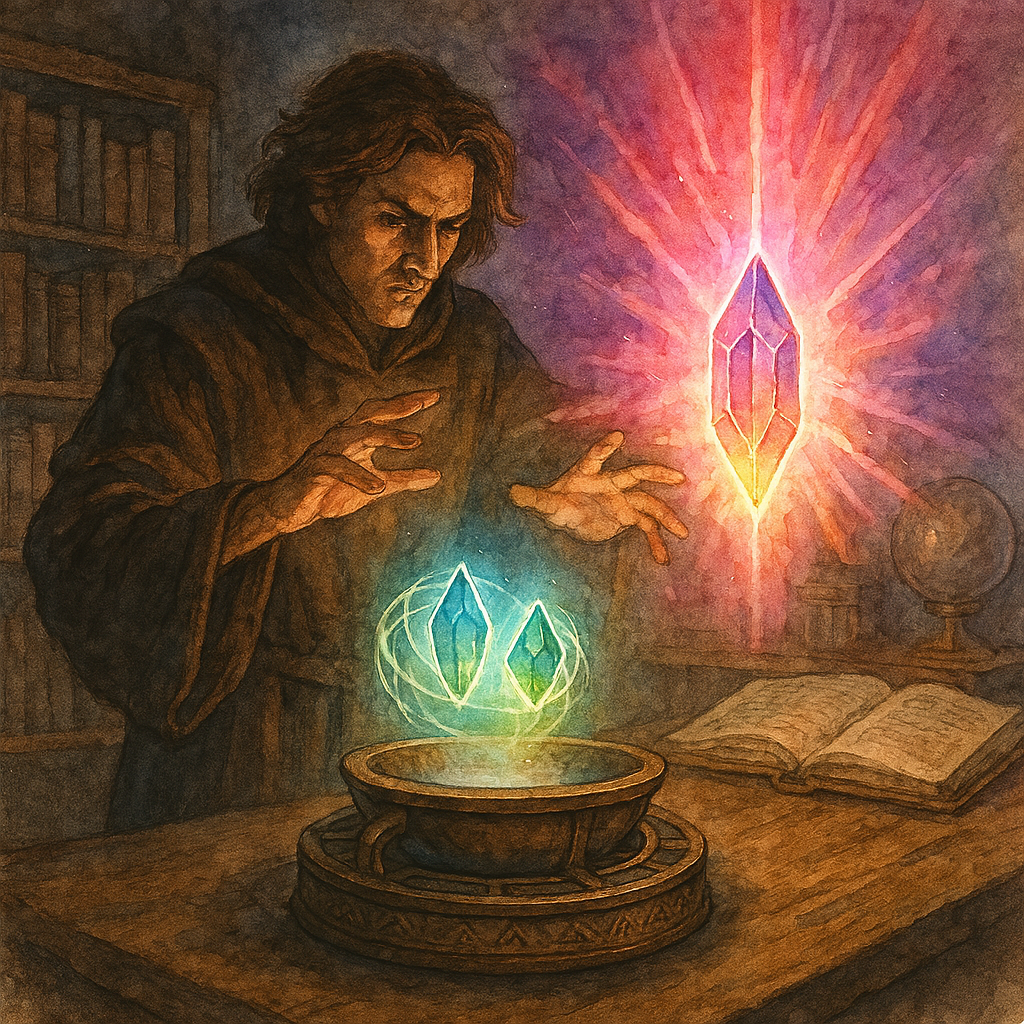
“Millennia ago, before the cousins split, a Yarogryl seer craved a finer tune and made her shards sing divine.”
“As the harmony peaked, stillness of sound, turn, and time. By gods, what a chime.”
Description
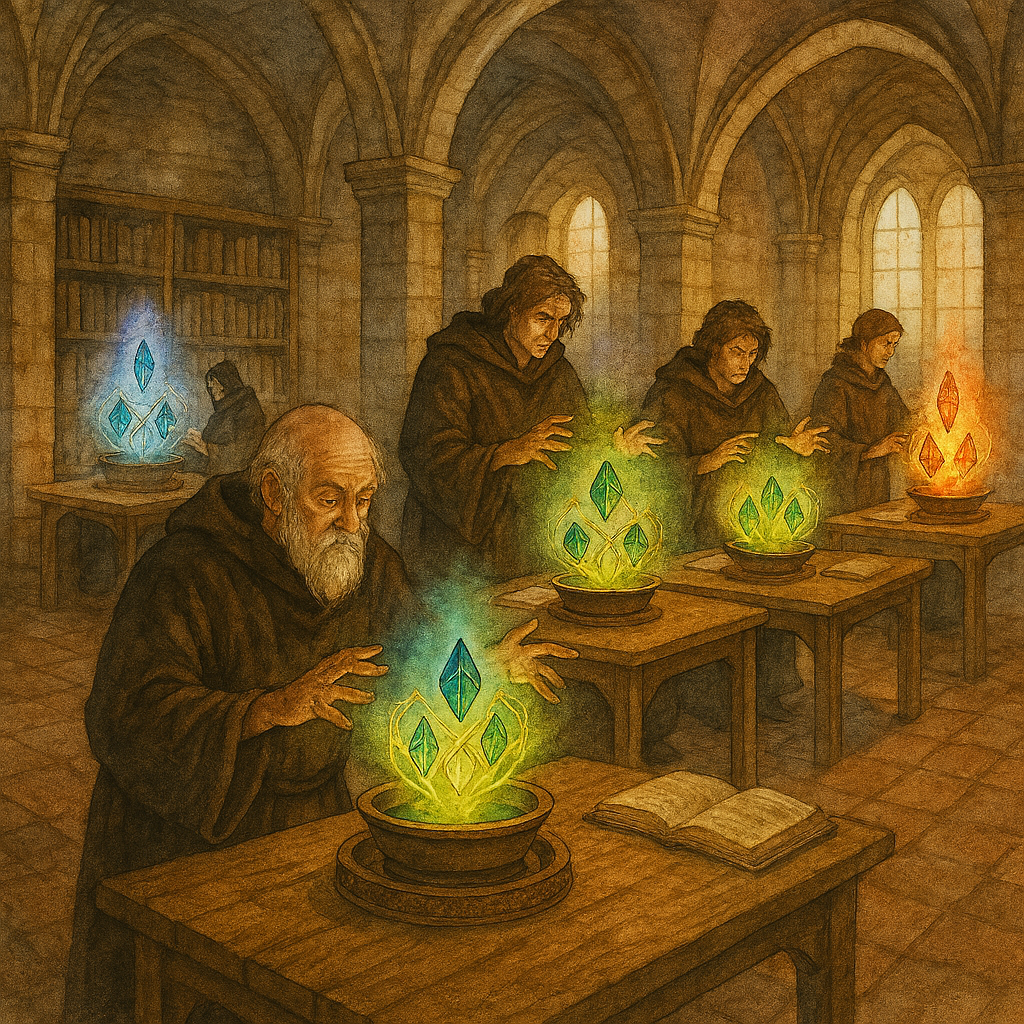
Purimancy is what we call the art of magic shard merging, a skill with ancient roots from before our world and even surpassing the gods in terms of the astral wheel under its belt. Ancient, and most certainly not something done by the masses or needed for everyday survival, but for the specialised suppliers to mana manipulators, enchanters, and crafters. It’s a rare and most delicate skill to delve into, and one cannot, and should not, progress safely on gut feelings alone. Thus, it is considered a tertiary learnt skill.
It pairs logically with the Kaleidomancer and Synesthemancer skills. But, where Kaleidomancy and Synesthemancy is about perception and analysis, Purimancy is about transformation and essence. Together, they form a dual discipline—the seeing and the shaping. Many study all three academies up to a certain point of expertise and from there specialise in either course. There’s the occasional individual taking all above the Lord level, but it’s a rare one – even rarer if it’s a human due to their short lifespan. But it has happened.
Purimancers also utilise Kaleidomancer and Synesthemancer tools, but mainly focus on their crucible, as that’s the actual shard merge tool. Some even only travel with their crucible and a limited amount of shards, as their customer or destination generally supplies what they need or are asked to refine.
“Placing the ‘eyes’ and performing their ‘swirl’, a new ‘mind’ is born.”
—Skjald Yell'a'Beard
History
Dark AgesLong before the written glyphs of the Kaleidomancers and Synesthemancers, before the Ljostari bronze was ever smelted, the art of Purimancy stirred in the deep places of the Void. Not in the grand gardens with cities, nor those with sturdy towers, but in the fungi-lit Ataurca caverns beneath the naturally shaped Yarogryl spires of Ataurca, where song was sacred and light was a stranger.
The Yarogryl were not builders. They were listeners. Their kind did not shape the world—they heard it. And it was Veyr, a seer that became blind due to the cave’s magic fungi and whose skin shimmered with residual mana, who first understood that shards were not merely fragments of power but fragments of existence – of truth. She did not fuse them to grow stronger—she fused them to make them whole. The first to understand that only truly divine, at its maximum purity, a shard should be used in creations. An act the Vornir offered to acknowledege by giving her sight again, wich she declined and instead was offered immortality from age and sickness.
Veyr’s Crucible was not metal—it was bone from an organic Sarcian, the very one who had taught her void weaving. Although her weave was not cast—it was sung. And her first fusion, the Shard of Stillness, is said to still pulse beneath the roots of the world, untouched by time. It has since been claimed that if truly divine shards of all eight realms were merged with a ninth, a chaotic divine, it would create a vision revealing the whereabouts of the Shard of Stillness.
“It was not born—it was remembered.”
—Skjald El Mary
First Age
As the void gardens were harvested and turned into our world, many things changed. One of the changes was that the Yarogryl retracted to half-stitched in realms of odd existences only seen or accessed under certain conditions. So they faded into myth, but their teachings were carried by Ljost Alfars, who had heard Veyr’s songs and transcribed both hers and other songs into glyphs and etched them into the first bronze crucibles. They added structure, ritual, and the eight-tiered path of mastery.
Later, during the Vampire conflict, the Dwarves refined metallurgy not only for weapons and armour but also for their increased interest in the magic side of a conflict. Saw the embedding of resonance chambers and purity amplifiers. Greatly improving the shard merging process – and the safety.
—Skjald Vinotis
Second Age
As the 1st Cataclysm unfolded and tore the world apart, many things changed. Most notably did the worldwide travel grid take damage.
Having a greater understanding of the elder divines, especially the Wickeryadii, is an aspect of the grand ploy. The Fautyr had interpreted Veyr’s songs in a more naturalistic way, and they added emotional attunement to the merging process. An act that totally redefined shard merging and allowed for way more divine shards instead of fizzles. Worth mentioning is also that Undines learnt how to merge shards underwater, using fluid harmonics.
“Veyr’s songs have been voiced by many, but none as elegantly as by Fautyr flutes.”
—Skjald Sigurd
Third Age
As the Wanderers came alongside their bullheaded god, stirring up lands to the south. Their vague presence and untold secrets did not impact much on the northern lands, but in one area. The bull-headed gods roaming and fighting vampires increased people flocking to the safety of religion, praise, and sacred temples. And in this light the scholary clergy of the indigenous Clovincaz grew stronger than ever before.
It was humans of the Clovincaz tribes who defined Purimancy with its grand vibe, its name, rites, and borders. They saw in it not just a craft, but a philosophy: to refine is to ascend. Clovincaz mana manipulators, channelling archpriests, Synesthemancy’s shard appraisers, and Kaleidomancy’s merge-singers, convinced their followers to build the first grand academies, codified the ranks, and declared the Grand Lord of Purimancy a title worthy of their works importance. The very first to wear this feathered mantle, Nahguhz Yantaq, is said to have been a descendant of the ever-young Veyr and a Clovincaz king.
To this day, scholars argue: was Veyr truly Yarogryl? Some claim she was Tatongol, born in exile and raised by the deepkin. Others say she was Undine, her blindness a gift from the Sea of Swirl. A few even whisper she was not of any race—but a shard given form. Oh, if they only knew. But the truth, as the Purimancers say, is hidden in the shards.
“It matters not who first merged a shard. It matters who first heard it sing.”
—Skjald Sejrik
Fourth Age
The tilting of the world, the sinking of Ljostari and the eruption of Mt Ljostari, creating the odd realm of Mt Vula, as such changed nothing regarding Shard merging or worldly leaks. The only thing that stirred Purimancers somewhat was the sudden urge to aid slaying Arisen. As these new or reborn beings tended to leave behind multicoloured shards when repulsed back to their spirit-slumber. But as the dangers of facing Arisen became apparent, most Purimancers turned to once more obtaining multicoloured shards from leaks or bought them from monster hunters and other heroic individuals.
“Reborn in the tsunami-turmoil of swirling taintings, that is what they leave behind when hibernating once more.”
—Skjald Sigurd
Cartography
Generally, as their studies are closely related, and their work often involves a thrice-skilled individual or a working trio. They live and work at the same locations.
- Synesthemancers and Kaleidomancers: Analysers and decoders of colours, surface, resonance, patterns, and metaphysical taxonomy.
- Purimancers: Engineers of shape fusion and purity refinement. Their work is often charged to customers.
The Twin Pillars: Generally we see more practitioners doing Purimancy in worldly guildhalls than in academies; the obvious reason is the non-academical tasks Purimancers often undertake. At times at customer locations, inns, taverns, and even in the back of a waggon on a ship.
Although academy structure is similar to every other academy, a Master Purimancer oversees Purimantic experimentation and training of what’s called Shard Choirs: Student circles devoted to specific shard colour.
Every academy also has their own Crucible Vault: a restricted archive of crucibles, from heroic to legendary, only used in very special merges.
Academy Ethos: Knowledge first, power second. But beneath the robes and rituals, there’s a quiet race to patent new fusion techniques and secure shard sources before the guilds do.
As mentioned, worldly guilds are the pragmatic, profit-driven forces. Less reverent, more ruthless. Their Purimancers generally belong to one of a few major factions, like:
- The Prism Trackers: Controls shard mining, distribution, and black-market fusion.
- The Crude Crucible: A secretive faction funding rogue Purimancers to develop weaponised fusions.
- The Ledger of Leaks: A faction who copy and sell leak maps to anyone.
Their guild structure is as guilds are mostly, but they have a few roles that at times clash openly with the magic academies and the nobility culture.
- Shard-slingers: Purimancers who manage shard flow and enforce trade monopolies.
- Shard-binders: Purimancers contracted for battlefield fusion or sabotage.
- Shard-seers: Purimancers who decode overlay shard signatures.
Guild Ethos: Power first, knowledge as leverage. They often sponsor lone talents with promises of freedom—only to bind them with contracts and debts.
The Lone Wolves and Distant Lords
Not all serve the academies, guilds, or a banner. Some walk the magic paths and shardwork alone.
- Remote Grand Lords: Legendary Purimancers who vanished from public life, with Crucibles said to be alive. Some are hunted by both guilds and academies.
- Wanderer-Purimancers: Nomadic analysts who believe shards should be freely merged. They often clash with other institutions.
- Resonator Hermits: Isolated practitioners who commune with shards directly, claiming they hear voices or visions. Often dismissed as mad—until their fusions rewrite the rules..
Tensions and Interactions
So let me be clear: even though they work together, there’s tension and drama behind their interactions; not just between Kaleidomancers, Synesthemancers, and Purimancers, but also amongst Purimancers, as the next seat practitioner could have roots in another faction:
| Aspect | Academies | Guilds | Lone Practitioners |
|---|---|---|---|
| Motivation | Knowledge, legacy | Control, profit | Truth, freedom |
| Methods | Ritual, research | Contracts, coercion | Intuition, isolation |
| View of Shards | Sacred relics | Commodities | Living entities |
| Relationship to Others | Competitive but respectful | Manipulative and secretive | Distrustful or indifferent |
Thus, even the most novice Purimancer feels the pull of the sleeves:
- A guild offers rare shards in exchange for loyalty.
- An academy pressures for publication and prestige.
- A kingdom demands fusion for status and war.
And yet, the true Purimancer knows: every fusion is a choice. Not just of shards—but of allegiance.
“A song of untainted vision will become the most pure of all.”
—Skjald Valgrif
Organisation
Academies have their organisational structure set in a millennia-old system, and Purimancy is a discipline with centuries of tradition behind it. The ranks evoke a rising mastery not just of technique, but of metaphysical authority. Each rank introduces new fusion rituals and increases how Kaleidomancers, Synesthemancers, and Purimancers collaborate towards harmonic high-tier shardwork.
| Rank | Title | Description |
|---|---|---|
| I | Apprentice | Learns basic shard compatibility and low-tier fusion. Can merge fractured shards with minimal type gain. |
| II | Novice | Gains insight into elemental resonance. Can merge rough shards and begin minor purity refinement. |
| III | Journeyman | Understands shard polarity and structure. Can merge jagged shards and stabilize volatile fusions. |
| IV | Chief | Oversees fusion rituals. Can merge smooth shards with purity boosts and unlock latent traits. |
| V | Master | Commands advanced fusion matrices. Can merge pristine shards and manipulate purity thresholds. |
| VI | Lord | Shapes shard essence with precision. Can merge exquisite shards and refine them into unique forms. |
| VII | Overlord | Bends shard laws. Can merge radiant shards and alter their magical signatures. |
| VIII | Grand Lord | A living conduit of shard alchemy. Can merge celestial-tier shards, create custom purity spectra. |
“The finest of listeners and finest of hummers recite fragments of the Hymn of Truenames to soothe ‘the eyes’.”
—Skjald Ulrich
Special
Mana from the Astral… can be made to sing again… yes, it can.
“Celestial, in physique and spirit, it sings pure!”
—Skjald Kazumix
Last Updated on 2026-01-04 by IoM-Christian