
Summoning

Legend
“Spirits, not only those previously bound or curious ones, but also those whose true names are known, can be summoned—but beware: what answers may not wish to return.”
“Half thinking, half whispering the odd name on the amulet – the Spirit appeared.”
–Skjald Valgrif
Description
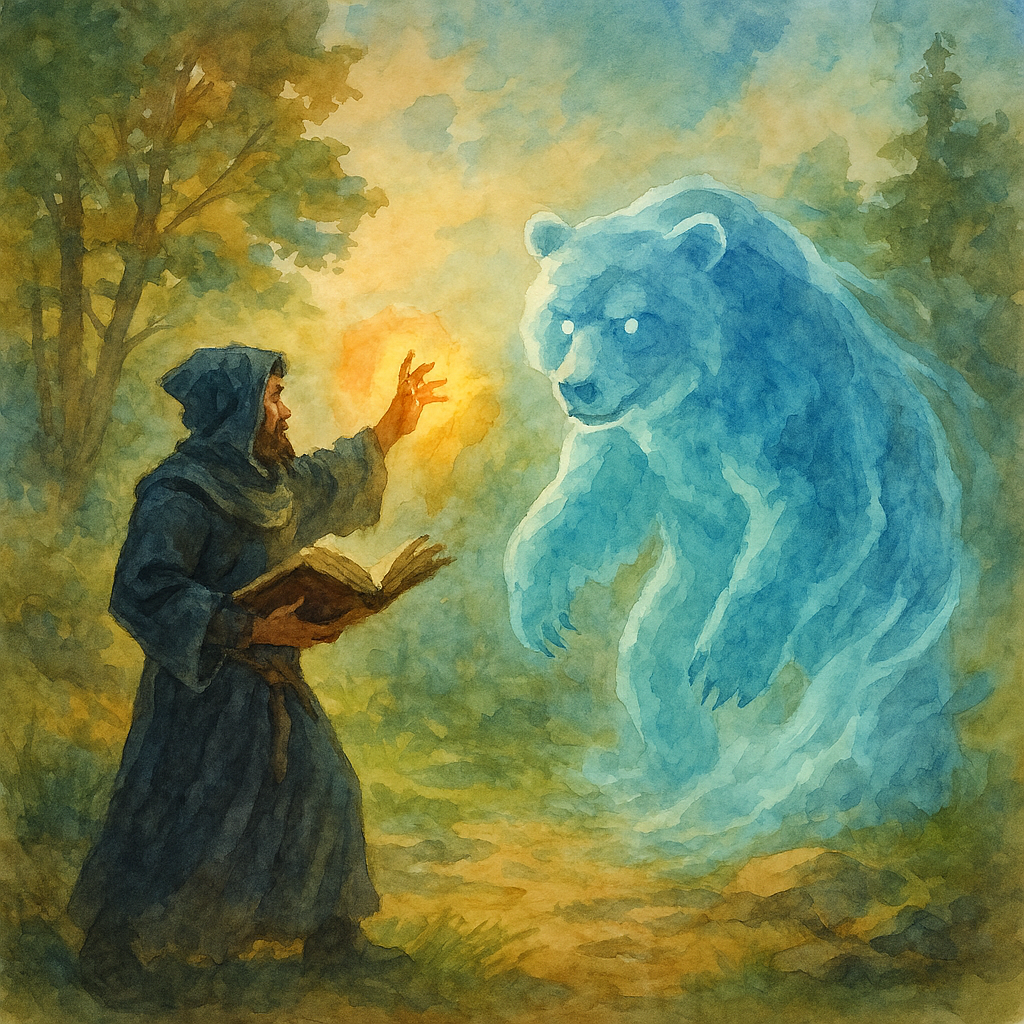
Summoning, or calling upon, a spirit, demon, deity or other supernatural agent. Summoning has some magical traditions, such as ceremonial acts of calling or invoking, or it may refer more generally to the casting of magic spells by a variety of techniques and the performance of legerdemain.
- Evocation refers to summoning that occurs when the summoned entity is physically present nearby.
- Conjuration refers to a summoning by the use of a magical spell.
- Necromancy refers to a summoning of ghosts or spirits of the dead.
Some practitioners may employ the use of mind-altering substances with and without uttered word formulas. In traditional and most contemporary usage, summoning refers to a magical act of invoking spirits or using incantations or charms to cast magical enhancements.
The act of “calling forth” or “summoning away” often includes a ritual, conducted in a defined style but arbitrary setting, aimed at diverting the spirit’s favour to oneself. The ritual is mostly to mitigate spiritual wrath if disturbing sacred objects or images from shrines that would otherwise be sacrilegious or impious.
The potency of the summoned varies; if a true name is summoned, it is predefined; if a self-appearing, proximity-summoned, or similar general summon rite is used. Generally it’s spirit-based, but a summoner can train their calling forth to pre-strengthen bonds with Fylgia, the name used for spirits in general, to make appearances generally more potent.
Summoning is the art of calling supernatural spirits — to aid, protect, or destroy. These being’s power depends on the summoner’s skill, knowledge, and intent. These summoned entities can range from ethereal beings to more tangible creatures, often possessing unique abilities and characteristics. Different magic realms handle spirit summoning in varied ways, but the core concept remains the same: gaining assistance from the spirit realm of Fylgia.
” Calling Forth is a gift — a bribe of mana and intent. But spirits are clever, and gifts may become chains.”
-Skjald Ulrich
Spirit Binding / Controlling:
When summoned, it’s important to establish a bond and gain control or at least neutrality. This is done with a Bind Spirit action through the use of a Spirit Calming Bell, so control can be established. The bell ringing also involves rituals or incantations to calm the spirits.
Spending excess mana in the summoning, empowering the spirit, also makes it harder to master. So summons must be done with utmost care. Knowing Call Names, and True Names helps.
A True Name must be spoken aloud before a specific spirit can be summoned. Every creature, both small and large, is given a truename upon birth. Every creature manifest possesses a term of affection it self-identifies as (a name); however, all spirits possess what is called a True Name.
Mirroring the rite of naming children upon birth, this name is immensely sacred – a reflection of their real nature. To know and speak aloud a True Name is to bring weakness to the spirit whom it was given to. To possess a True Name is to be able to wield power over it. Unfortunately, even if a True Name is found out, it is crucial to carefully convey that name correctly, as they are typically comprised of confusing combinations of sounds.
Call Name can be used with those jealously guarding their True Name from others. To that end, they typically adopt a number of inspiring and terrifying nicknames (call names).
Restless Names, in some cases, True Names are carried from a mortal life into ‘undeath’. Such is the case with Restless Spirits. Many years may have passed since a Restless Spirit arose to unlife, its mortal memories snuffed out like a flame from a candle. A universal truth remains: a restless spirit can only be mastered by mana manipulators when their True Name has been spoken aloud. Fortunately for spiritualists, the True Names of the Restless Spirits are easier to figure out. These True Names are not assembled from infernal glyphs but of the tongue that the Restless Spirit spoke before death.
| Name Type | Description | Effect |
|---|---|---|
| True Name | Vornirian name given at birth | Grants control and weakness |
| Call Name | Nickname or adopted title | Boosts spirit scale |
| Restless Name | Carried from mortal life | Aids in binding undead spirits |
” To name a spirit is to touch its soul. To speak its True Name is to hold it.”
-Skjald Sejrik
History
Mythic Origins: In the Tales of Genladia, it is written, “As she directed the emerging mana swirl toward the tiny creature, it looked up—as if becoming sentient in that very moment. When touched, the taint made it grow in size but lose its mass. And before her stood an ethereal being. At first bewildered, then roaring in rage — due to the gained awareness and loss of former ignorance. It had to be tamed. ” ignorance. It had to be tamed.”
This passage, preserved by one of the earliest Jotunn, Rengrel, recounts the experience of Jilliabina—a Wickeryadii who first encountered a spirit in the Void and unintentionally awakened it. Her granddaughter, Nitollakka, retold the tale as a warning: that spirits are not summoned — they are disturbed.
The story marks the first known interaction between a divine and a Fylgia—a being that existed in the Void, unseen and untouched, until mana manipulation gave it awareness. It is said that Jilliabina did not summon the spirit — she called it into awareness. And from that, the spirit gained perception, memory, identity, desperation, and rage.
”Many have since followed in her tracks, losing battles and lives.”
-Skjald El Mary
Chronological Impact:
As the Void evolved over countless millennia, the Vornir spun threads of mana into its depths, shaping void gardens and beings. The Boriac, Sarcian, Stoicheian, and Wickeryadii tended its matter, but even they could not contain the growth of the Fylgia. These spirits, born of ambient mana and forgotten echoes, began to evolve — some nurtured by divine hands, others twisted by self-taint or curiosity.
When the Void was reshaped into the world, many spirits were collected into divine order — a process the Fylgia mockingly call the ‘World Zoo’, a realm of containment and control. But not all were caught. Some were too vast, too ancient, or too clever. These powerful spirits avoided the divine nets, remaining untainted, and freely exist alongside the divine scheme.
” The gods built cages. The spirits built doors.“
-Skjald Kazumix
Through the ages, the Fylgia remained neutral — untouched by mortal wars and divine schemes. Allowing summoners to call them — sometimes by accident, sometimes on purpose. Not even the Vampire Wars, which ended the First Age, nor the birth of the Bullheaded God, which shattered the Second, nor the eruption of Mt Vula, which scorched the Third, could corrupt their essence:
- The First Age ending in the Vampire Wars, when Gods tricked Wickeryadii to summon spirits of hunger and blood, binding them to flesh.
- The Second Age saw the rise of the Bullheaded God, born from a failed summoning that fused divine essence with mortal ambition.
- The Third Age was shattered by the eruption of Mt Vula, where elemental spirits were summoned en masse to wage war — and broke free.
Yet the Fylgia remained neutral. They did not take sides. They did not fall. Only the Deep Blue Tsunami, marking the dawn of the Fourth Age, managed to touch them. The tsunami, a collision of astral sea and worldly matter, sent untamed swirls into the spirit realm. Some Fylgja were caught in its wake, becoming restless — spirits with fractured memories and lingering rage.
” They were not born. They were remembered.“
-Skjald Vinotis
The Great Invasion ended the Fourth Age — a cataclysm orchestrated by contender gods eager to descend and enslave all beings. They tore open the veil, flooding the world with divine hunger. But they were stopped — not by armies, but by an elect few: living legends whose names are now forbidden to speak.
- The Fourth Age saw summoners walk a fragile path. With spirits older, wiser, and less patient.
- Fifth Age They remember the cages. They remember the names. And they wait.
” The gods came to conquer. The spirits came to watch. The mortals came to end it.“
-Skjald Sigurd
Now begins the Fifth Age: The Scorched Dawn. The spirits are older. The summoners are fewer. The world is cracked, but not broken.
- They remember the cages.
- They remember the names.
- And they wait.
“The spirit does not ask why it was summoned. It asks why it should stay.“
-Skjald Kazumix
Organisation
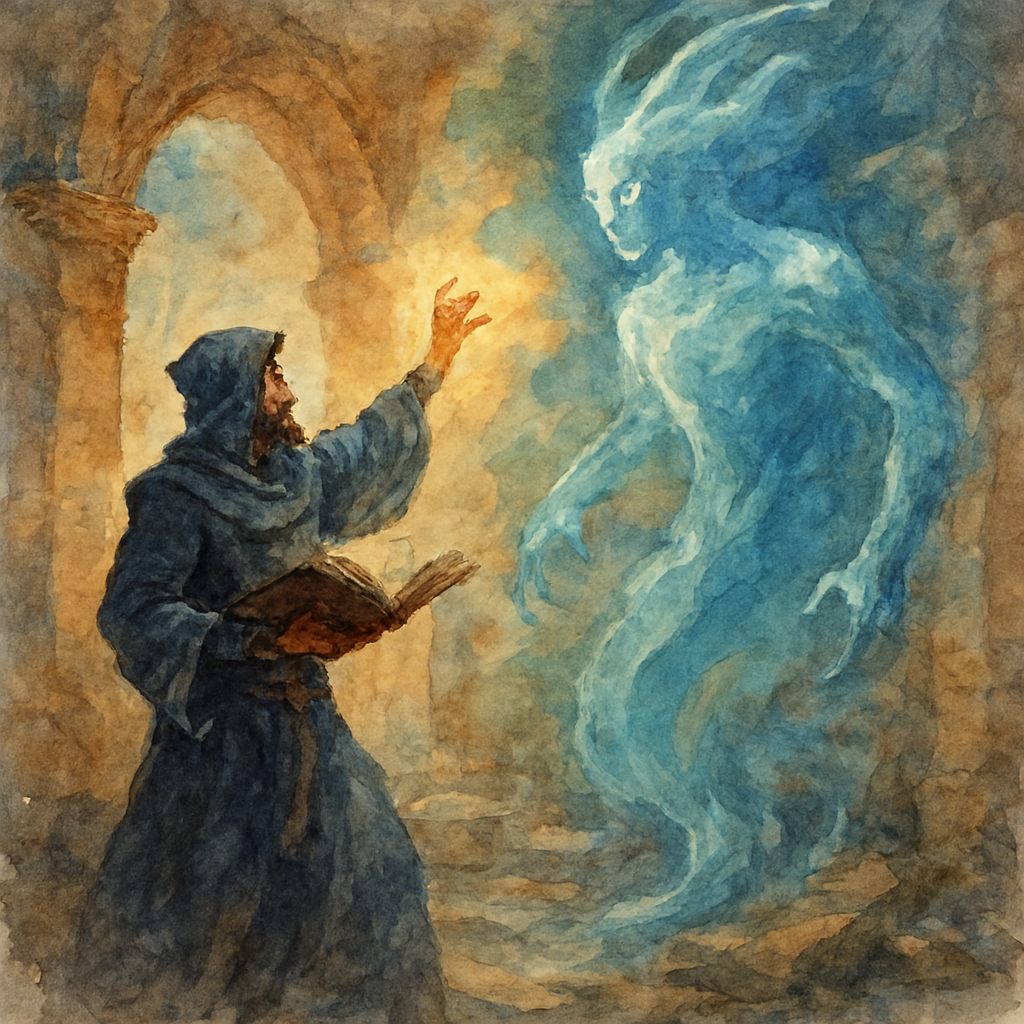
Summoning is organised within a strict framework to ensure the safety of the summoner, everyone else, and the spirit:
- Evocation: summoning by proximity presence.
- Conjuration: summoning by the use of a magical spell.
- Necromancy: summoning of ghosts or spirits of the dead.
- True Name: the unique Vornirian name of a being.
- Call Name: a self-invented or given nickname.
- Restless Name: a previous true name.
- Calling Forth: improving the summoning skill
- Spirit Binding: the first binding action of a summoning.
- Controlling :the successful mastery of a spirit.
” The girl grinned, and a plentitude of spirits aesmbled .”
-Skjald Yell'a'Beard
Summoners are ranked based on their summoning skill.
Apprentice (I) Skill from 50 up to 174.
Novice (II) Skill from 175 up to 299.
Journeyman (III) Skill from 300 up to 424.
Chief (IV) Skill from 425 up to 549.
Master (V) Skill from 550 up to 674.
Lord (VI) Skill from 675 up to 799.
Overlord (VII) Skill from 800 up to 924.
Grand Lord (VIII) Skil from 925 up to 1000.
” At his inauguration, he focused his entire self, and a divine spirit stepped forth and bowed.”
-Skjald Sigurd
Summoning (Evocation, Conjuration, Necromancy)
Summoning is a meta-magic skill that is trained up like any other skill and applies to the normal magic-success chance whenever any Magic Paths Summoning spell is used. Use of a summoning spell, a spirit-type tiered path; each tier must be learnt separately like any other spell.
Successful Summoning Check if a random individual of the summoned spirit type appears. If the caster has used more mana in casting the spell than the spirit requires. If you know a spirit’s True Name, you can use it to summon that particular entity instead of a random one, and any excess skill will further empower it. If you fail or don’t spend enough mana, the summon fails, which can result in a random spirit, including nasty ones, appearing to feast.
” It followed the energetic swirls, slowly building, and when it appeared it was gargantuan.”
-Skjald El Mary
WWhen summoning, it’s important to know what or who is being summoned and why. as the invoking of type, call name, or even true name establishes a pre-bound link that aids in both calling forth and in spirit binding.
True name refers to the unique Vornirian name of a being. Using this is known to help boost spirit prestige.
Call name refers to a self-invented or given nickname. Using this is known to help boost the spirit scale.
Restless name refers to a previous true name. Using this is known to raise the chance of binding.
” She summoned a spirit of immense scale and mythic prestige — and the sky bent to its will.“
-Skjald Valgrif
Calling Forth / Spirit Binding
Calling Forth is built on a blend of Alignment, Mana Flow, Mana Burst, and Type/Call and True Names. Its purpose has always been to reward the disturbed spirit in advance, to try to make controlling it easier – although it has proven to make them more self-minded and the mana transfer from one self to spirit, and thus harder to master. The practice is continued, as the benefits are too powerful.
The eight scales of physical form:
- Diminutive: Implies very small.
- Small: Standard and straightforward.
- Medium: A baseline for a typical creature.
- Large: The next step up, noticeably bigger.
- Huge: Suggests a significant jump in size beyond “Large”.
- Immense: Conveys a sense of overwhelming size.
- Colossal: Calls to mind a colossal, ancient being.
- Gargantuan: The ultimate size, truly gargantuan in scale.
The eight prestiges of potency and personality:
- Weak: Although appearing, the spirit is fatigued, drained, or damaged.
- Normal: Appearing as expected of the type or individual.
- Strong: The result of a strong pre-summon bind, their effects are significant.
- Heroic Powerful understanding and effects, at times with ties to ancient twists
- Epic: Possessing ancient power, with specific magical knowledge, skills, and traits.
- Legendary: Associated with a grand pre-bind to them.
- Mythic: A rare myth even among the most powerful summoners.
- Divine: Almost world-altering and appearing divine.
‘Do not call up what you cannot put down’; this is the unofficial mantra of summoners, a warning to not deal with powers outside of your own capabilities. Thus, very few have ever attempted Projected Casting in this area, as that invites disaster. Still, some wish to break these understandable limits, cavorting with beings of pure self-spun energies or untainted shadows of the void.
These uncaring, capricious and powerful creatures languish in the endless void, unable to take physical form in our material world, until some foolhardy summoner takes it upon themselves to call them forth. The spirit arises, taking upon a frightening form that appears different to everyone witnessing its summoning. Once fully manifested, it may make a contract with its invoker for its service. These contracts are rife with loopholes and clauses, almost always ending with the spirit being the one in control.
” Contracts are forged in the moment of manifestation. They are riddled with clauses, riddles, and traps. Only the wise dare to negotiate — and even they often lose.“
-Skjald Sejrik
Once you’ve successfully summoned a spirit, it’s temporarily stunned, and you can use that time to make a Bind Spirit action through the use of a Spirit Calming Bell, and if you’ve dominated the spirit, you can make it do what you want (perform a service, bind it into an object (which requires yet another spell), etc.). If you fail the spirit bind, you may be possessed or slain.
“The bell is not just a sound—it is a signal to the spirit that the summoner seeks peace, not dominance.“
-Skjald Vinotis
Special
Projected Summoning, the technique to summon spirits from unknown tiers is strictly avoided, and in some academies even forbidden.
“The spirit did not speak. It sang — and the summoner wept.”
Skjald Ulrich
Last Updated on 2025-10-14 by IoM-Christian