
Gaji-Kulat

Appearance:
Built:
From muscular to bulky
Height: (cm)
Females: 305-355
Males: 330-380
Weight:
Females: 370-450
Males: 395-490
Lifespan:
Females; 350-390
Males: 345-370
Skin:
Shades of brown, some even dark orange
Hair:
Mostly brown
Eyes:
Any
Language:
CulturesLegend
“In the Dark Ages these beings evolved into trunk-faced powerhouse humanoids, ruling parts of The Void.”
“In our World they splashed onto Armelien, and ruled once more.”
Description
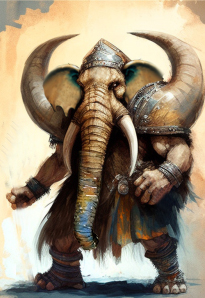
They are easily recognised being 3 to 4 metres tall, having a large trunk in the middle of their face, and two very large ears as well as two long curvey tusks. Even T'Aurs, and Ye'Til look small in comparison.
As they live across the entire continent of Armelien, from the Sunlands in the north to the southern Shadowlands, The sunland ones are without fur, their thick skin fully visible. The mildland ones have increased fur covering and thickness. The shadowland ones have more, and in frostlands their fur is a thick full cover.
Besides skin or fur variations we noticed variations in tusk size and shape, some are even tuskless and seemingly Spirit meddlers. Another variation, is the size of ears, those with small ears tend to wear shoulder-enlarging armour in the form of horns or spikes, seemingly as visual compensation.
“Strangely enough vanity runs deep in these behemothian giants.”
Skjald Vinotis
Despite climate zones and origin they either favour urban, or nomadic cultures. They are fierce Warrior's, Hunter's, and Beastmaster's accompanied by mechanised animals and beasts.
They all share two cultural traumas, one starting when the Vampires was born. To a race that defines itself by its massive physical presence, its warm blood, and its connection to living beasts, the concept of a “leech” is the ultimate heresy. Thus they share a deep, ancestral animosity for vampires, and when the Arisen and Liches came to be it grew into hate of them all.
The other trauma originated after the Vampire War, when Fylgia-possessed beings were encountered for the first time. As the Fylgia-possessed makes Gigans’ loose control, charge in a frenzied state, and stampede mindlessly until the target is but a silenced pulp. The aftermath, when Gigans’ have gained their wits and perform their cleansings, can be quite spectacular.
Skjald Yell'a'Beard
History
Dark Ages
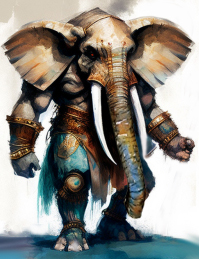
How they evolved, is beyond us, but according to their legends, they were a favourite of the ancient void divines and thus nothing scares them. They lived around ‘Void-Wells’—massive geothermal springs that dotted the voids growing megajungle under a perpetual, humid twilight created by mana leaks. In this era, they were known as the Gaji-Kulat.
They all where adapted for a world of infinite resources, although the void also had strong cold storms, so their primordial anatomy was such that they all possessed shimmering, silver-grey wool that acted as a thermal regulator, keeping them cool in the humidity but capable of retaining heat during the rare “Great Rains.”
Their tusks, shovel-shaped and wide, were used for clearing massive paths through the undergrowth and “singing” by scraping them against the Iron-Bark trees. In this “Silver-Back” era, the trunk was their primary tool for beast-speech. A low-frequency infrasound language they shared with the megafauna of the world.
During the Unified Verdancy—when their environments was one, they were the “Architects of the Wild.” Spending centuries moving massive stones to line their World-Wells, and acting as Shepherds, protecting smaller species from the voids apex predators.
As centuries passed some became more interested in moving stones, slowly building methods, rites, and legend for their craft. To them, a stone not moved was a stone wasted. This is the origin of their architectural obsession. Others became more interested in the smaller species, and slowly went from shepherds to “masters” of smaller animals and beasts. This is why they split into those of the Gilded Jungle and those of the Emerald Cities.
As both groups had to defend their constructions or minions, they grew to ignore any danger or disasterous odds and became quite capable fighters, and shamanistic Mana Manipulators. The knowlede of the beastmasters, found its way to the stone movers as well, as some of the animals and beasts provided benefits. Slowly they began to develop roles and classes within each tribe. Some became scouts, others warriors or beastmasters, and some shamans or chieftains.
“Gaji-Kulat, the masters of stone and flesh.”
Skjald Valgrif
First Age
When the divines splashed them onto the world in what is known as The Great Thinning. Although the world had but one climate then, as they were thrown them on two separate islands of pre-Armelien; Ragdim and Ocilia. Those of Ragdims northern area, generally became a forest and jungle culture. Lingering in the cool shadows of trees, they didn’t need cooling so their ears began to shrink. Attuned with their pets, animals, and beasts, they began equipping these with armour and equipment to undertake certain tasks.. Meanwhile those of Ragdims southern plains wandered the vast plains under the sun, and their ears grew larger and served as cooling part as well as mood indicator.
Those of Ocilias northern parts adapted the same culture and traits as their cousins at Ragdims southern parts. But further south, in the roughlands and foothills, they mostly became an urban culture, residing in large cool stone cities, and relying on protective armour. Thus their ears also began to shrink.
Both isle populations kept sharing one myth: Mahata-Gajdi, the First Bull who walked the void when it was flat and green.
- At isle of Ragdim they saw Mahata-Gajdi as a Great Spirit who became the island.
- At the isle of Ocilia they saw Mahata-Gajdi as a Great King who brought law to the chaos.
Slowly they grew accustomed to the new world and their distinct cultures evolved. Then, in 3967, came the Vampire War, and with it several great impacts upon the Gaji-Kulat.
“The trunked kin, although divided for ages, still united by Mahata-Gajdi.”
Skjald El Mary
Second Age
Following the Vampire War, the Gaji-Kulat had to adapt to the “Tilted World” with its altered climates, and the surfaced lands connecting Ragdim and Ocilia, and Ocilia and The Rim, creating the gargantuan peninsula-continent of Armelien. This seabed raise reunited their factions, in a midlands merge as northerners wandered southwards, and southerners wandered northwards, eventually leading to bareskinned and furred with various ear sizes.
Because of the planetary shift the “World-Jungle” began to die at the Rim but thicken towards the north. This forced a biological and ideological choice:
The Sunlands: A large group stayed despite jungle and forests thickening. They found that as the climate grew warmer the air grew thick, and the jungle turned into a suffocating, competitive labyrinth, their fur was a hindrance so they began to shed it. In the south, bordering the mildlands, the jungle thinned, then died.
Seeing the death of the World-Jungle as a test of the soul. They leaned further into Spiritual rituals. Some even allowed moss and vines to grow on them, seeing themselves as part of the ecosystem rather than its masters. A mindset—harmony, of the belief that they are the “Living Shrines” of a dying, sacred world.
The Mildlands: Two large groups entered into the newly raised lands between Ragdim and Ocilia. Eager to discover what it offered, the two factions finally met again after thousands of years of separation. Ocilias southerners saw Ragdim northerners as “feral heathens” or “boiled barbarians” who had forgotten their dignity. The northerners saw the southerners as “hollow statues” who had traded their spiritual connections for inorganic protection—rigid, arrogant beings who tried to cage the world in iron and stone, abandoning their ancestral dignity.
Time merges, mends, and heals. Now fur amounts, ear sizes, and lamellar gold armor, heavy jewelry, vast stone citadels, the law, combat herbs, tamed beasts, and machines is what they all praise. Representing the strength of the tusks; they became the administrative and military spine of the continent.
The Shadowlands: A large group stayed meanwhile watching the treeline recede toward the south, they rejoiced over the vast plains and steppes. They found that as the climate grew cold and the air grew thin, their furs thickened.
Some followed the receeding trees south into the new freshly raised lands, building a new nomadic lifestyle,.
The Frostlands: Some even came there voluntarily, all the way to the jagged peaks of The Rim. Thus, a few Frostland tribes came to be as well.
Regardless of place, all experienced that their ancient “Beast-Speech” failed, animals and beasts grew wild and feral. So, rather than shepherd it, they began to subjugate fauna. This birthed an new mindset—order, conquest, and the belief that the world must be bound in gold and iron to keep it from falling apart. Thus, some began utilising heavy metal armor to protect against the now-hostile megafauna.
“It’s strange that even the mightiest, fall for selfmade superstitions.”
Skjald Sejrik
They also had to deal with something totally new to them, the ‘ Fylgia. Sprung from Vornirs eye fragments in 3967 first age, these husk invaders had impacted them as nothing before. Let me tell it as their Legend of the Silent Calf and the First Cleansing is shared by all their cultures, as they tell it equally in all their different tongues.
In the year 77, in the era of the altered verdancy, after the world tilted, when the two shepherd tribes of the World-Jungle was becoming three. There was Bahlai-Matas, a matriarch whose infrasound song was so powerful she could still tame any beast, even soothe the Great Drakes of the sulfur-pits. She led the first Great Migration into the Shadowlands, in a caravan of peace where even the beasts followed Bahlai-Matas like children follows a light.
Among the herd was a calf named Anu, who was born on a night when the moon flickered—a sign of the first “Rain of Spirit-Tears” of Vornir origin. While the herd rested, a Fylgia—a “Lost-Spark” from the Vampire War’s astral divines—fell from the sky. It had the shape of a teardrop, and a hunger for a husk. It did not choose a warrior; it chose the calf Anu. The next morning, Anu stood up, but he did not feel well. To the Gaji-Kulat, who “hear” the heartbeat and the soul-hum of their kin through the soles of their feet, Anu was a wierd, walking silence.
Bahlai-Matas approached the calf to nudge him toward the river. When her trunk touched his hide, she did not feel the warmth of a child. She felt a High-Scream. It wasn’t a sound of the ears, but a vibration that tore at the marrow of her bones. It was the “Discord”—the sound of a spirit forced into a shape it didn’t belong in. The Fylgia within Anu looked up with the calf’s eyes, but the pupils was like cracked glass. Then it spoke, not in the low rumble of the Gaja-Kula’s “Beast-Speech”, but in a thousand chattering voices of the “Small-Folk” who had died in the Void.
The “noise” was so agonizing that the entire herd—creatures of immense poise and slow wisdom—collapsed into a Primal Rage. They did not see a calf. They saw a “Rift.” The pain in their heads became a white-hot fire. Bahlai-Matas, the gentlest of Shepherds, was the first to roar. It was a sound that shattered nearby Iron-Bark trees. 5hen she charged, not out of hate, but out of a desperate, need to make the screaming stop. The herd followed. Six hundred tons of meat and bone descended upon Anu, the Silent Calf. In seconds, there was nothing left but a red stain on the primordial moss.
Even with Anu dead, and the Fylgia gone, the “smell” of the silence remained. The Gaji-Kulat stood over the site, trembling, their trunks coiling in horror. They realized that their world was no longer “Safe.” There were things that could steal a body and turn the “Song of the Earth” into a “Astral shrieks.” Bahlai-Matas began to scrape the earth with her tusks, trying to dig out the very soil the calf had touched. The others joined her, using their massive weight to compact the ground until it was as hard as iron, hoping to “seal” the breach. Later others became possessed as well, and as they did dnot know the origin of Fylgia, the Gaji-Kulat believed the seal had not been proper.
- The Sunlanders say Bahlai-Matas failed because she was too loud; therefore, they use Rhythmic Gongs to “smooth out” the air. To them, the legend is a warning about Harmony.
- The Mildlanders say Bahlai-Matas failed only to realise that it was not her seal, that was broken, but to realise what Fylgia is.
- The Shadowlanders say Bahlai-Matas failed because she used only dirt; therefore, they now use Iron to ensure the seal is permanent. To them, the legend is a warning about Security.
“When a habitat changes, its residents, size unimportant, must adapt as well.”
Skjald Ulrich
The Gaji-Kulat do not bury their dead in the ground. They fear that a body left whole is an invitation to the Fylgia. The Mildlanders cremates them in great bronze kilns; the Sunlanders submerges their dead in meat eating fish ponds, and the Shadowlanders lowers theirs into boiling acid-pools near volcanic vents to ensure nothing remains.
As the Fylgin possessed created a disturbance making Gaji-Kulat loose control and charge, stampeding in a frenzied state until the target was but a pulp. The Gaji-Kulat has developed a visceral, deep-seated allergy for the Fylgia-possessed. Yet, the infrasound “Song of the Earth” is so vital to them that they try to uphold it if they can. So, their punishment is not death if they can avoid it, but “The Silencing”—where a possessed’s tusks are shattered and they are banished into the Anti-Magic Equatorial Belt, where the wind is so loud and the earth so cold that they can no longer hear the heartbeat of the world or the astral shrieks of their fylgia.
Although the Romasai and Hutankai hunted them in rituals, or for thropiess, and vampires came and claimed lands. They became the key factor in Armelien, having a very strong grip on Southern Armelien where they fully dominate the area known as Uestu. They built three large distinct realms, in Ragdim, Ocilia, and Uestu.
“Maybe they see all mortals as tainted, and thus their hostility.”
Skjald Valgrif
Third Age
The Third Age came late to them, but with the Bullheaded God came a tsunami of “Small-Folk” as well as an increase in “Spirit-Tear” rain. These “Small-Folk” became the prey of the Gigant Probomoth, as the vular named the Gaji-Kulat.
The armoured knights and war engines was the hammer in the Small-Folks ferocious fighting back. So, the Gigan becan capping their tusks to penetrate metal armours worn by both Vular, and the Jomzaar, which arrived soon afterwards the Vular. They also began carving both their amount of prey felled, as well as their names and ancestral origins into their tusks, so they could be proper handled if killed.
“In unknown territory, masks easily falls, and a beings true nature runs wild.”
Skjald Sejrik
Fourth Age
According to Yell'a'Beard, the saying in the northern parts of Outlands was that Gigan’s had killed or exiled most, if not all Fylgin in Armelien. But he was not down in their own part of the Outlands, so he hasn’t seen for himself. We believe, it was the returning Vular that eventually made Gigan come here in the great invasion. And we don’t know if fylgin was their target, but they surely lost control when they landed, as we had so many fylgia.
How they dealth with vampires, arisen, and liches, we don’t know about. As such we dont care either, as we consider them evil invaders. But we do know that when they came here, in the early weeks, they were a trusted faction of invaders council, then something happened that seemingly ripped open ancient feuds with Romasai, and Pigryn. Making them depart the great invasion and just hunt fylgin. Its even said that some were slain by Romasai, either hunted down or when they attacked Romasai camps.
Although not totally isolated during the great invasion, as Ye’til and Anurai both collaborated with them. They weren’t as such fully part of the invaders agenda again, before the battle of unnumbered tears, were they stampeded through legions of Dwarves, Ljost Alfar, and Humans. We all know, and cherish that battle-outcome, and since we saw their ears from behind as they managed to escape, they are but seen hanging as thropies displaying a successful cleansing crusade.
“Although unlikely, the Gaji-Kulat dread a transform into Arisen or gaining fylgia.”
Skjald Ulrich
Fifth Age
Just as they did to fylgia husks, we did to them. Our Isles should be rid of Gaji-Kulat, and hopefully those that managed to escape, stay at outlands doing whatever they. We have heard rumors though, that they already are plotting some sort of revenge.
“Let them come, this time we know their weaknesses, and will oblitterate their kin.”
Skjald Kazumix
Cartography
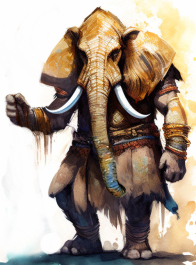 In the great continent of Ragdim, the Gigan Prot’s lives in isolated settlement each one of their cultures, although with their own governing bull. Here they merely stampeded around, hard to catch. killing every fylgin they found. But lets focus on their homelands, as we gained quite a lot of information from ‘talking’ with captured invaders.
Due to them being spread across several climate zones, not only does their looks vary. So does their norms and behaviour, and its but a few things tying them together.
The Sunlands: Their tusks are often stained with dyes (indigo, saffron, or cinnabar). They bore small holes into the ivory to hang prayer-ribbons.
The Mildlands: Their tusks are often engraved with long lists of their ancestors’ names or specific laws they have sworn to uphold.
The Shadowlands: They bore small holes into the ivory to hang bells. When they move, they chime.
In the Northern Sunlands of Ragdim, the sun never sets fully; it just circles the horizon, baking the world. The constant fog and mist streaming down from the boiling Nolands seas create a “Green Hell” of hyper-growth. Although cooled, to survive the “Boiling Mists,” their skin lost the ancestral wool, and grew thick and leathery to shed against the constant scalding rain. They became Aquatic Architects. They built their cities—like the Great Meru of the Mist—high above the forest floor on massive stone stilts, mimicking tiered temples. This allows the heat of the ground to rise past them. With Bamboo silks, and painted skin they see themselves as “Living Temples.” snd believe divinity flows through the trunk; they are the most agile and spiritually “light.”
They dominate “Fog-Crawlers”—giant amphibians that thrive in the humidity.
They view the New Gods as the bringers of the Sun-Fire, and reason for the “Rain of Spirit-Tears”. They see their life as a “Sacred Perspiration,” a constant cleansing of the soul through the steam.
In the Midlands they wear gold-plated armor for protection, The metal is enchanted or polished. They have come to disbelieve both old divines and new gods. They rely only in the strength of their own might.
In the Shadowlands the Probos’ still have Thick furs, and have rune-carved tusks, In the Southern shadowland climate, the world is a relentless, wind-whipped desert of ice and rock. The sun is a distant, weak eye that barely provides warmth. Here lives true Mammoths. These Gigan’ kept the ancestral silver wool. They also wear heavy, gold-plated armor but not just for protection, but as thermal batteries. The metal is enchanted or polished to catch every stray beam of southern light and hold the heat against their bodies. They are subterranean masters, carving vast, halls into the frozen cliffs to escape the “Frost-Winds.” Their cities are lit by massive bronze mirrors that funnel sunlight deep into the earth.
In a environment of scarce food, they became masters of Apex Predators. They lead prides of sabre-toothed tigers and massive, fur-clad boars. To them, the beast is a tool of the Empire—disciplined, collared in jewels, and lethal. They view the Old Divines as the architects of the cold, silent order. They see themselves as the “Keepers of the Hearth,” the only ones strong enough to endure the encroaching frost of the Void.
In the Frostlands, the “Anti-Magic” Equatorial Belt of south Armelien actually have a few tribes of Gigan’s as well, wandering south as the trees dissappeared they ended at the Rims ragged spires. They consider themselves the “Old Blood,” surviving the harshest cold and acting as the memory-keepers of the race. Because magic is “dead” or “unstable” there, none can use their traditional spiritual or alchemical powers none fel the fylgia possessed ones that arrives
Sunlands view: Vampires are “Rot-Spirits” that bring the stagnant death of the swamp.Mildlands view: Vampires areShadowlands view: Vampires are “Blood-Thieves” who steal the precious warmth of the living.
Although they have somewhat grown accustomed to what the Vulars called them, each of their cultures might shorten it as follows:
-
The Ragdim (Sunlands): Might shorten it to The Gaji. It sounds more fluid, melodic, and focuses on the trunk—the limb they use for spiritual “Breath” and intricate temple work.
-
The Ocila (Midlands): Would likely use the full formal title, Gaji-Kulat, emphasizing the “Gigan” to assert their dominance, discipline, and “Gold & Iron” status.
-
The Uestu (Shadowlands): Might grunt it down to The Kula or The Gakula. In the harsh cold, shorter words are more practical, and “Moth” evokes the ancient, hairy titans of the frost.
“They try act differently, but deep within their primal rage lingers strong .”
Skjald Ulrich
Organisation
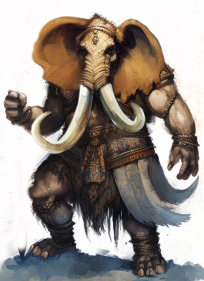 Exactly how they are organised at home we are unsure of, but we do know that all encountered in The Great Invasion were males and most often encountered alone. No females was seen here, so we only have Yell'a'Beards words for how their femalles looks. They were dispersed around The Realm in clan-like groups, doing random damage as they saw fit. Each group led by a leader who decided everything—until they are slain in battle or assassinated. We have never seen one betray its kind or surrender willingly.
From ‘talks’ with prisoners or wounded ones prior their deaths, we learned something about their organisation.
The Sunlands
A a vibrant, tropical direction focusing on their role’s in spiritual and jungle life.
- Intricate wood carvings, tiered temples (Candi), and vibrant textiles.
- Gaji-Kulat are the “Living Temples” of the jungle.
- Using birds of prey or giant insects to scout through dense canopies
The Mildlands
The most regal direction, focusing on immortalising their heroes in stone reliefs. The northern ones don’t build cities; they follow the migrations of even larger beasts. They use massive, oversized composite bows and move in thundering herds.
- Highly organized, imperial, and ornate.
- They decorate their tusks with gold bands and wear scale-mail armour.
- They command smaller faster creatures as outriders for their slow infantry.
The Shadowlands
The Gaji-Kulat with heavy fur for yhe cold climates, and rugged survival. Given their size they needed massive amounts of food. So their shadowland empire have incredibly large irrigated farms to feed their legions.
- Tribal, runic, and stoic.
- Wearing furs and boiled leather, they are about individual glory.
- They tame prehistoric megafauna such as giant wolves.
The Frostlands
None was taken captive nor did anyone else elaborate on them, but we did encounter a few so wollen in fur, that they had to be from there.
“White or light beige, these large powerhouses aided in the Grimsborg siege.”
Skjald
As the Gaji-Kulat perceive the world through the “Song of the Earth.” and are able to feel the heartbeat of a being from a kilometer away, and feel their spriit auras harmonic chiming. A Fylgia-possessed being doesn’t just feel “off”—they sound like a astral scream that never ends. Disrupting their communications through low-vibrations that travel through bone and earth, it blows their minds, and makes them charge on sight.
A Fylgia-possessed husk is a biological contradiction. The husk says “this,” but the spirit-echoa says “Something Else.” To the Gigan’, this creates a psychic dissonace—a grinding, high-pitched “ringing in the ears” that physically hurts them. Their charging isn’t just a tactical choice; it’s an attempt to stop the noise. They smash the husk to “silence the feedback loop” that the loose spirit is creating in the local atmosphere.
Ancient legends tell of a Gaj-Kula “Beast-Speaker” who tried to commune with what they thought was a wounded animal, only for a Fylgia spirit to leap from the animal’s husk into the Speaker’s own mind. Because their race is so large and powerful, a “Possessed Gigan” is a comunity-ending catastrophe. They have a cultural mandate: “Kill the Spark before it finds a Mountain.” They see a possessed “small-folk” as a flickering match that could start a forest fire. While they charge on sight due the noise, they justify it through their specific cultural lenses:
The Northern Jungle-Dwellers: View the Fylgia as “Parasites of the Mist.” In the humid, boiling North, rot is the enemy. A spirit living in a husk it doesn’t own is seen as a form of “spiritual mold.” They charge because they believe the Fylgia will “infect” the sacred beasts they shepherd, or them. To them, smashing a possessed human is spiritual hygiene.
The Mildland Imperials: View the Fylgia as “The Uncounted.” In their rigid bureaucracy of life and death, everything must have its place. A loose spirit is a “tax-evader of the soul.” It is an affront to the Order of the Old Divines. To them, charging is a civil service—deleting an error from the world’s ledger.
The Shadowland Imperialis:
We have no information about this.
The Frostland Refugees:
We have no information about this.
“It must be their void-roots that makes them so allergic to ‘Vornir’s eyes’,”
Skjald Yell’a’beard
As all their cultures try to keep their dignity even in the fray of battle, making battlefields orderly ‘tasks’. They have a problem with their acting if fylgia possessed opponents appear, as Gigans go berserk and charge in to stomp them to silence. This creates the “Rashness” Paradox, bringing shame following the charge as all their cultures pride themselves on being “The Architects” or “The Guardians”—beings of immense poise and ancient wisdom.
To the Sunlanders, the violence of the charge disrupts the “Sacred Harmony” of the jungle. They see the bloody mess they’ve made as a failure of their Shepherd’s vow.
This is why they hate the Fylgia-possessed most of all: not just because they are “wrong,” but because they force the giants to remember they are monsters.
To the Midlanders, the fact that a tiny human spirit can make a 4-meter-tall Noble lose his temper and “stampede” like a common beast is a source of deep cultural embarrassment. It proves they aren’t as “ordered” as they claim.
To the Shadowlanders, we don’t know how they stand.
To the Frostlanders, we don’t know how they stand.
“They clearly show, that cultures can be a mask.”
Skjald Vinotis
To mitigate the impact Fylgia has on them, each culture handle the “Shriek-Stomp” problem using specific aesthetics:
The Sunlands: “The Resonant Harmonizer”
They view the fylgia noise as a “discordant frequency” that unbalances their internal spirit. They wear intricate, hollow bamboo or silver filigree ornaments on their ears and trunks. These are tuned to a specific holy frequency. When the ethereal shriek hits, the Gigans strike these chimes. The “pure” tone of the chimes creates a counter-vibration that “smooths out” the ethereal noise before it reaches their psyche. It turns a battle into a rhythmic, meditative exercise rather than a chaotic brawl.
The Midlands: “The Gilded Dampener”
The Ocila solve problems with engineering, gold, and iron. They would treat the shriek as a breach of discipline to be suppressed. Their massive helmets are lined with layers of lead and wool, but more importantly, they use enchanted gold leaf etched with legalistic runes of “Silence.” These helmets act as a Faraday cage for sound. It dulls all noise, forcing the Ocila to rely on visual signals (flags and heliographs) to maintain their “orderly task.” If a Gigan can’t hear the shriek, he can’t be provoked by it.
The Shadowlands: “The Bone-Hummer”
The Uestu live in the harsh south; their solution is more primal and “Jotunn” in nature. A small device carved from the bone of an ancestor, worn inside the mouth or against the jaw. The Uestu bite down on it, producing a low, constant sub-vocal hum that vibrates through their entire skull. This “internal drone” occupies their auditory nerves. It’s a sensory-overload tactic—by filling their own heads with the “hum of the ancestors,” there is no room for the fylgia’s shriek to take root. It makes them appear eerily calm and silent as they march through the noise.
The Frostlands:
Don’t really care due to The Rim’s effect.
If the berserk catches them, they “purify” the ground after they’ve crushed one of these husks
The Sunlanders: The Ritual of “The Living Hum”
The Brahmin Beast-Speakers and the Gong-Strikers surround the site of the kill. Then they begin a “Cleansing Hum.” This is a deep, low-frequency vocalization coordinated with the slow, rhythmic striking of bronze gongs. The vibration is so intense that it causes the mist to ripple and the mud to dance. They aren’t trying to trap the spirit; they are trying to shake it apart. They believe that the correct frequency of sound will shatter the Fylgia’s “echo” into a thousand harmless pieces, which the humid jungle can then absorb and “digest.”
1. The Mildlanders: The Ritual of “The Golden Seal”
For them, a Fylgia is a “breach in the wall of reality.” Once the possessed husk has been reduced to a pulp beneath their feet, they treat the site like a crime scene or a structural failure. The Magus High-Priests step forward. They don’t use water to wash the ground; they use molten gold or lead. They pour the liquid metal into the indentations made by their feet and the remains of the husk. As it cools, it “caps” the spiritual leak. They believe that by “pinning” the spot with heavy, precious metal, they are literally nailing the loose spirit back into the underworld.
“Indignified they have a odd way to clean their messes.”
Skjald Sigurd
Special
They have the ability to bind with others Fylgia, thus being able to see ‘visions’ revealing their prey.
“Experiencing their berserk, and a memory for life is born.”
Skjald Sejrik
Last Updated on 2026-03-02 by IoM-Christian