
Sang Marsol
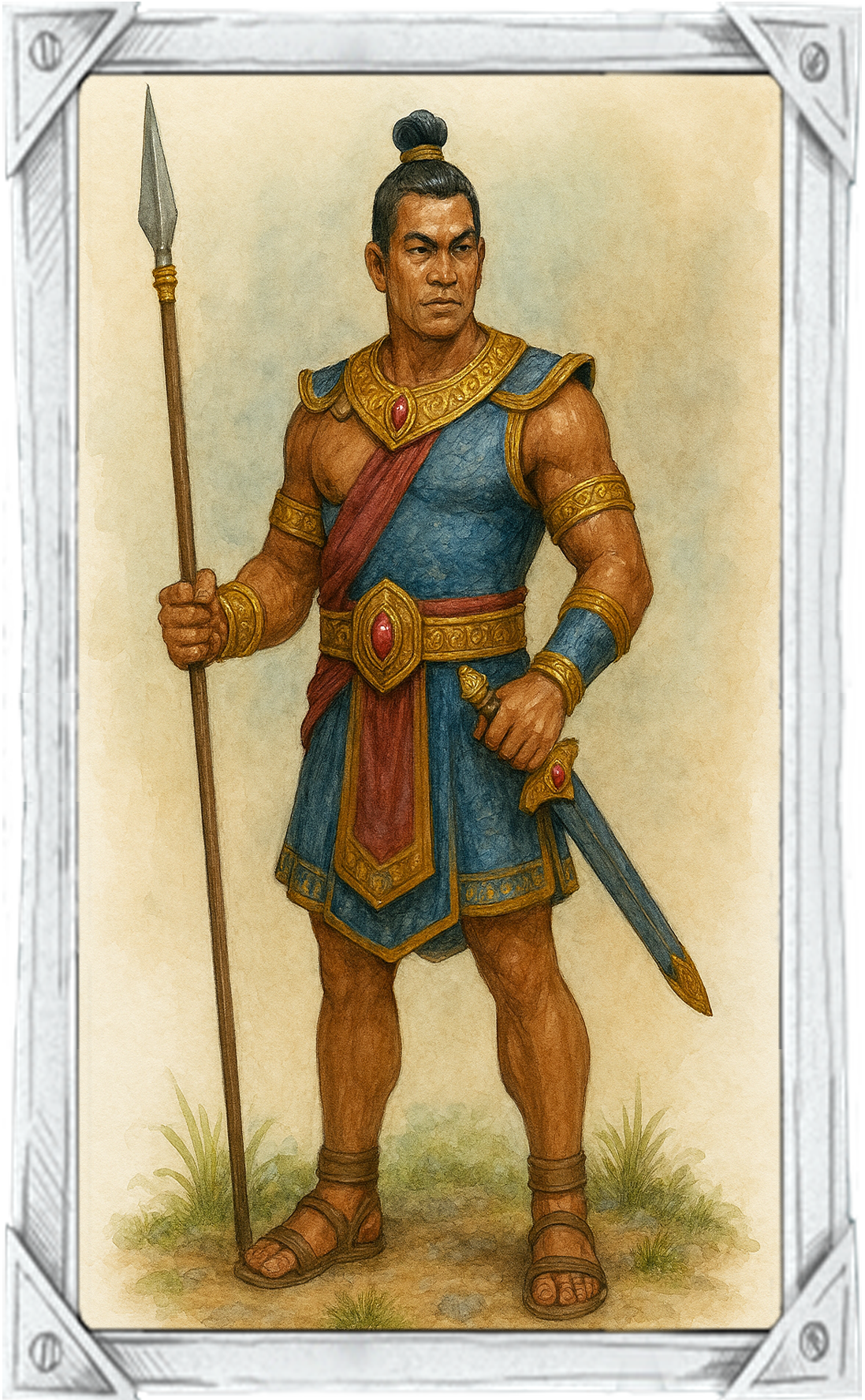
SANG MARSOL
- BORN: 9/11 1145 in FA
- Utari, Inosio
- RACE: Scion
- REALM: Channelling
- AURA: Orange
- HEIGHT: 203 cm
TITLES
AWARDS
Legend
“A scion appraiser… shining like a gemstone… or a mana leak… of times ancient. “
“Shard-guards seldom walks… more skilled… than Mighty-Marsol.”
Description
Sang Marsol’s presence is defined by his colossal frame, broad, low-slung shoulders, and extremely dense build. He is a striking physical blend of his diverse ancestry. A scion of mixed bloodlines, his Kobold heritage manifests in an exceptionally heavy, stone-like skeleton and thick bone structure, giving him a low centre of gravity and unnatural physical strength. His Fautyr ancestry blends smoothly, bestowing him with an athletic, spring-like agility despite his bulk. Yet, the dominant Apoyaori traits make him look human.
Despite his physique, which is that of a man built for heavy quarry labour, cliff scaling, and tight-quarter wrestling, he still possesses agility. He radiates a low-slung, unbreakable stability; his dense frame makes him seem almost rooted to the earth, giving off an air of deliberate, unshakeable calm rather than aggressive intimidation. He carries himself with a composure that reflects both his massive physical strength and his mechanical mind. He rarely wastes motion—he manoeuvres across rugged terrain with the quiet, effortless grace of a born wilderness scout. He exudes a confidence that reassures allies while unsettling potential adversaries.
His features carry a rugged charm shaped by a youth spent under the harsh sun and winds of the pass routes. His eyes are very expressive and have a sharp, calculating spark in them. He is slow to anger and prefers non-lethal leverage over brute violence. When he is focused or channelling, an orange aura often shimmers around him.
He carries a massive, custom-crafted halberd across his back, complemented by a sword at his waist. Over his broad chest rests a distinctive, heavy brass-trimmed lockbox, and at his back hangs a locked brass cylinder—salvaged mechanisms that hint at his knack for magic shards.
Demeanor
Pragmatic, observant, and fiercely independent, Sang approaches challenges like an engineer and a survivalist. He values discretion and foresight over reckless action, preferring clever leverage and non-lethal subduing to unnecessary violence. However, when pressed or threatened by greed and tyranny, he stands unyielding; what he builds or protects with his own hands, he guards fiercely.
Habits & Traits
-
His Kobold heritage provides him with an intuitive grasp of mechanics, tension, and leverage, making him practical and methodical. He approaches obstacles as physical puzzles to be solved efficiently rather than with reckless aggression.
-
He continuously harvests, refines, and experiments with combat herb pastes, salves, and powders to speed recovery, hasten travel, boost stamina, and sharpen eyes—and minds. He carries leather kits for small tools and these formulations wherever he travels.
-
He has a restless habit of seeking high ground, often scaling sheer cliffs or dangerous ledges to search for rare gemstones or herbs and read the surrounding wind, terrain, and weather—or simply to gaze out toward the open horizon.
-
Raised with strict lessons on secrecy to avoid tempting treacherous strangers, he is naturally watchful and alert to his surroundings. He is especially watchful when examining magic shards for evaluation, merging, or appraising gems.
-
Taught early on that unnecessary blood spills bring chaotic retaliation, he utilises a low-centre wrestling style. Utilising his incredible density and grip strength, he subdues opponents with joint locks, momentum-redirecting leverage, and quick immobilisation.
-
Trained to fight in tight, subterranean spaces, narrow passes, and dug-down town alleys, he weaves his blades with compact, devastating efficiency, making every inch of his massive reach count.
“What mortals create by their own hands, no other may forcefully take.”
Skjald Valgrif
History
Fourth AgeBorn in 1145, in the halfway dug-down rough land town of Lakige, with its characteristic square, flat-roofed houses and towers marking the entry to the pass from Inosio into Leitan. His parents were both more human in their heritages, but in Sang, the Kobold, Fautyr, and Apoyaori traits ran strong. The blend made his delivery difficult and contributed to his rapid growth as a child quickly outgrowing the other kids. The kobold manifested not only in a dense skeleton and stout build but also in a hankering for mechanisation. The Fautyr and Apoyaori blended into a favour for nature and an adventurous urge.
His parents soon replaced his childhood play with field trips to the wildlands, where they searched for minerals, gems, and combat herbs. Their finds often resulted in large amounts of coin due to the caravans constantly passing through. From an early age, he were taught that secrecy and precautions were essential. As valuable displays might tempt strangers to gain a bargain for free with only the sellers’ blood being offered.
So at an early age he began to train tumbling, wrestling, and other strengthening skills. At 10 he was one of the strongest lads in town and often helped when building blocks were to be rolled from the nearby quarry or hoisted up for battlements or roofs. His kobold heritage manifested not just in brute power but also in an intuitive grasp of torque, tension, and pulleys.
While other teens relied purely on muscle, Sang, in 1158, began suggesting modifications for the quarry gears. He also designed custom counterweight rigs and block-and-tackle systems that allow two workers to move what once took eight.
For his family, he created hidden, mechanically sealed caches along the pass routes—stone compartments hidden behind false rock faces, counterbalanced rocks, or deadfalls. If his family were pressed by bandits or suspicious caravans, they could drop their loot into a hidden chute and retrieve it days later.
Around 1160, as his dense Kobold skeleton thickened and his Fautyr agility matured, Sang began to train bladeweaving and developed a unique fighting style suited to tight, dug-down spaces and rocky passes. The towns‘ buildings inspired him to develop a “sinking” wrestling style: rather than high throws, his low centre of gravity and bone density made him virtually impossible to uproot. He became an expert in leverage, joint locks, and using short-range momentum—perfect for when he had to subdue aggressive caravan guards or raiders without spilling blood.
As his tracking, hiking, and climbing skills matured, he became the family’s vanguard watcher, scouting ahead of his parents’ expeditions. Thanks to the urge for nature that had honed his skills, he now naturally read terrain, wind, and animal behaviour, spotting ambushers long before they spotted his family. Eventually the scouting began to bore him, and his mind often wandered, just as when he had worked in the quarry or with the masons.
Sang had also grown tired of simply selling raw herbs and uncut gems to pass-through merchants for base coin. He felt that their family should improve their efforts to benefit the more. So, he suggested that they should not only do raw foraging but also delve into fabrication, and selline refines. So he began to use his mechanical skills to build portable presses, crushers, polishers, and distillation kits.
He experimented with some of the combat herbs they harvested to make pastes, potions, and powders that accelerated muscle recovery, stopped deep bleeding, or dulled pain during heavy physical exertion. This not only gave him an edge in strenuous labour and skirmishes but also made his family’s goods significantly more valuable. But in doing so, they overlooked the reactions of the herbalist and healer guilds and the combat herb distributors.
In 1166, the powerful merchants and syndicates eventually realised who had been harvesting, refining, and selling the new high-grade combat herbs, and they tried to force Sang’s family into a contract. All it did was trigger the Fautyr spark inside Sang; what he, and his family, had built was theirs. Sang, with a customer from afar, Bear-Varg, and his son Bull-Varg, stepped up as the family protectors and enforced a perimeter of operation. In doing so, he created some very high tensions but also a friendship from shores far away.
By the summer of 1169, Sang’s dense kobold build had fully set into broad, low-slung shoulders and stone-hard bone, while his Apoyaori and Fautyr blood burnt in his chest like an unquenched hearth. Lakige—with its flat-topped roofs, half-buried basalt walls, and predictable parade of dusty caravans—felt less like home and more like a stone crypt built to keep him in. So he had begun climbing steep sides and ledges where none had gone for centuries, just to look for some sort of adventure.
He did find rare combat herbs, rare gemstones, and other minerals. He even encountered what could be considered monsters, growing an urge in him to encounter a proper monster or a hostile army patrol. The breaking point arrived not with a massive monster or an invading army but with a crack in the granite far above the pass known as The Vulture’s Tooth.
During an unseasonable cloudburst, a mudslide sheared off a cliff face high above the Leitan entry road, and while the town guard scrambled to secure and clean the main trade road, Sang’s Fautyr curiosity urged him straight up the steep rocks. Using his low centre of gravity and unnatural grip strength, Sang reached the uncovered area and saw it had unearthed an ancient subterranean vault—a dwarven or early-era waystation long forgotten under tonnes of scree.
He breached into the half collapsed vault; hours inside, he didn’t just find dusty relics; he found a complex series of ancient water-driven counterweights and pressure-plate locks controlling a massive subterranean sluice system. His Kobold mind mapped the gears instantly: if the heavy rains filled the upper basin, the jammed sluice gate would burst, sending tens of thousands of tonnes of mud and boulders directly down onto Lakige’s sunken plateau.
Sang raced back down to warn the town elders and the head of the local Merchant’s Guild, Kaelen Vane. But as he mentioned gem seams, Vane—a greedy, pragmatic broker who visioned the ancient vault’s potential for high-grade gem seams—refused to evacuate or blast the rockslide. Vane accused Sang of fabricating the danger to claim the salvage rights himself, sending two heavily armed guild mercenaries to lock Sang up, away from the site, until a guild retrieval team could be assembled.
Knowing time was running out as the mountain runoff accelerated, Sang used no blade but relyed entirely on his low-centre wrestling. He easily subdued the two guards without spilling a drop of blood—pinned them in leverage locks and bound them with heavy winch rope. Sang ran through the rain and returned to the Vulture’s Tooth under the cover of the torrential dusk. He entered the vault once more, armed only with a heavy iron quarry crowbar and a pouch of his homemade combat herbs.
For three brutal hours, he fought the ancient machinery. Muscles tearing and Kobold-dense bones aching against the massive resistance, he manually rigged a crude block-and-tackle bypass using his crowbar as a pivot. With a deafening crunch of metal and stone, Sang forced the ancient sluice gate open. The trapped water surged harmlessly sideways into a deep canyon fissure, saving Lakige and the trade road below from complete destruction.
However, the sheer pressure of the diverted flood began to collapse the vault’s entry arches, Sang managed to breach the crumbling entrance before it collapsed and buried the gem seams—and Vane’s projected fortune—forever under fifty feet of solid rock. By dawn, the danger had passed, but Sang’s position in Lakige was shattered.
Kaelen Vane was furious over the loss of the gemstone vault. While the townspeople knew Sang had saved their homes, Vane made it clear that Sang’s family would face crippling trade tariffs and legal harassment if the “subversive boy” remained in Lakige. In saving the town, Sang had also displayed terrifying strength, his mechanical genius, and his ability to outmanoeuvre armed men.
The strict secrecy his parents had taught him was broken; he was no longer just a local strong quarry lad but a target of interest for passing caravan scouts and syndicate agents. That night, on the flat stone roof of his family’s dug-down house, Sang packed his gear: his custom-counterweighted grappling rig, a leather kit of refined herbal pastes, and a heavy brass compass, a odd locked chest-bag and a locked brass cylinder taken from the ancient sluice room.
His parents did not stop him. They knew the valley was now too small for a young man whose blood called for the open horizons of Inosio and the wild expanses beyond. Before the first sun struck the towers of the pass, Sang Marsol walked out of Lakige, turning his back on the sunken stone to test his strength against the world. And as he walked out, that summer day in 1169, he knew exactly where he was heading.
He didn’t want to wade through the burning sands, so he headed southeast and went into Leitan. At last, he found himself in the enchanting setting of “earth’s mouth”, which was produced by the mist from the rivers. Lush jungle, high-grass meadows, and a plenitude of wildlife. The vibrant colours and total change lifted his mood as he travelled south. At first he had slept under the open sky, but the wildlife was a tad too wild for his taste.
So he changed into a rest stop, a town inn, and city taverns. In the ‘Sprawling Spider’ he sat, ordered a meal, and again began to study the cylinder he had salvaged. When he heard a dancing voice, “That’s a mighty fine tube.” As he looked up, a young, captivating, black-haired beauty pulled out the opposite chair and took the liberty to sit. As she grinned, she grabbed his ale, gulped a large portion of it, presented herself as Siim Svollur and asked what he was.
Sang was amused by her freshness and told her that he was a scion—at least, that’s what people say because of some old N-erectus blood—but essentially, he was just himself, travelling far south. And this – I have no clue what the tube is, and it’s strangely locked. Over the next week he learned that Siim was a dervish, heading for the capital to find a grand master to study. As they reached the point where south was no longer the direction of the capital, they parted ways.
While travelling, Sang had nearly forgotten the troubles of his cradle and enjoyed each and every day on the road. He reached the border to Remas in the spring of 1170 without noticing a season had passed, as in the sunlands winters are mild, but as he travelled through it, he could feel the northern warmth on some days when the wind was southerly.
At some point he met a strange tribe of Moss'Ari in Piequil, calling themselves Altwalders, with odd dryad-praise rituals. He stayed a while with a couple, a female beastmaster and a male enchanter. He stayed there for a month. After that encounter he visited a kobold tribe, and there he finally learnt that the locked brass cylinder was a kaleidomancy kaleidoscope and even an outstanding one at that. The locked chest bag was a shard satchel, which was also an exceptional one. Regarding the heavy brass compass, they had never seen anything like it before and were equally puzzled about its constant needle spinning.
After a week he paid the Kobolds with some large uncut gems and left. When he reached the shore in Maqakan, he hired himself as a guard on a ship bound for Naldar. When a pirate ship attacked them—or, if you prefer, they assaulted a pirate ship—the journey became quite thrilling. Sang came up with a scheme. As the pirate ship got closer, Sang used his strength to angle their four guns extremely high, despite the master gunner’s objections. Then, to prevent their four cannons from crashing through their deck, they fired each one individually.
The loud pirate howls and grins of the non-damaging shots from their target suddenly halted as the lobbed balls came down. Three of the lobbed balls went straight through the deck and hull of the pirate ship, producing loud, sharp sounds. Looking around, the pirates suddenly found themselves sprinkled by the new fountains. And as their ship closed in, the crew on Sang’s ship extended long poles of heavy timber, preventing the pirates from closing in and boarding them. Slowly the pirate vessel sank, with the pirates crying for mercy and begging rescue. As if they would have given any, Sang’s ship sailed onwards.
When they landed in Yanagata, a bustling trade harbour in Karoly, he safeguarded the unloading of cotton and cloth and a trade with a tailor from the court of the N'Aldaan clan of Quasaki. The tailor had brought his family for the exotic trip, and Sang met the 2-year-old Jocky Chan. Sang found the little, big-cheeked kid quite amusing, as he reminded him of one of the orange gemstones he had salvaged. Thus, Sang gave Jocky’s mother the orange jade gemstone and told her that she should give Jocky this when he came of age. Eventually, all cargo was unloaded, all trades were completed, and Sang began to travel southwards into Waitan.
He reached the border in the spring of 1171 but was halted by border guards preventing him from entering, as he did not have any travel permits. So he had to go back to Aharanoto and get papers. Instead, he told the guards that he could just as well spend that travel money on their guard station and paid each 2 silver nuggets, and he was free to pass. His parents’ teachings in mind, he noticed the guards’ eager eyes and prepared for the worst. It came late the next day when five N’Aldaan robbers suddenly attacked him.
Unfamiliar with the slim swords of Naldar, it almost became a fatal experience. Not because the robbers as such outskilled him, but the blades were extremely durable and sharp. Had it not been for Ye-Asperr and Bosatsu Hoxi, who were travelling back from the border of Karoly and stumbled upon the assault, he might have succumbed to the handful of “Naldarian Nails.” As they were travelling towards Seviels, Bosatsu was extremely intrigued about the ancient kaleidomancy kaleidoscope, and Ye-Asperr was impressed about the obvious purity of the shard satchels’ cartridge content; the trio continued together.
As they reached the border, they helped him clear the crossing, and their ways parted. Sang then travelled along the road, and once more he felt the townsfolk’s hushed whispers and the stares directed at him as his towering figure waded into settlements. Sat on a street food stall and, on squeaking wood, ordered a meal.
Even when sitting, he towered above the lot, and at times local rascals approached him to either intimidate, scare off, or outright attack. But the training Ye-Asper and Bosatsu had given and the two blades he had kept evened the odds, and his strength tipped it every time.
In early spring of 1172, winter’s chill could still be felt in the morning mists. Sang had just finished a bowl of noodles and had dealt with four rascals who had tried to rob him. As he was paying the owner for damages, a voice said it was a mighty fine display of brute force, but it lacked finesse. It was Trikzy Kizvik, a monster hunter with excellent acrobatics, brawling, and bladeweaving skills.
They took a quick practice duel; the crowd cheered, and some stall owners offered food for the known monster hunter. Sang munched along, and then they travelled together for the rest of the year. Sang frequently mentioned Bosatsu, which led Trikzy to decide that he would go there to see the beauty for himself; as a result, they parted ways.
Sang went south, and with a note Trikzy had written, he easily passed the border, and then he went south across Ruburma, where, in the last week of 1173, he again hired himself as a guard on a ship to Dalip. It became something of the oddest sails Sang ever did. They met a pirate ship, but as it neared, Sang suggested the same defence as last time. The pirate ship turned. Sang grabbed a spyglass from a bystander and, studying the pirate crew, noticed the captain staring right at him through a spyglass. He frantically yelled to his crew to turn the ship around. Sang let out a hearty laugh and then recounted the tale.
The next day the weather worsened, and the deep blue became the most hostile Sang had ever seen. They lost a few crew, some cargo, a mast, and half the sails. But finally the weather stilled, and they slowly made it to Dalip just after New Year in 1174. As he landed in Kalyngbi in Amrad at Dalip’s northern shore, he knelt and kissed the ground and heard a voice, “Was the trip that rough?”
It was Maili Brija, an herbalist that was at the docks to see if anything interesting had landed. Appreciating the company, Sang said he was hungry and offered to pay for a mug of ale and some meat in exchange for information about the land. They talked for hours, and as both were herbalists, they decided to travel together southwards, as she had found the herbs she needed.
A few weeks later Maili departed as she was heading northeast. Sang travelled south across the rugged land and was beginning to dislike the growing chill of the shadowlands. But the landscape, flora, and fauna were captivating in their own way. A couple of times he hired himself out as a guard to make some local coinage, as he would rather not spend his precious gemstones or shards. He even slightly regretted parting with the orange jade a few years earlier.
Crossing into Zakoro, the land flattened and was dominated by vast pine woods, and the wildlife he met was indeed wild: bears, wolves, boars, moose, and other crazed animals, beasts, and monsters that attacked him. At least he ate well, and although some skinners complained he had ruined the raw materials and resources, he managed to change them for warmer clothing. So in 1175, as his feet finally stepped into Øsken, Bear-Varg’s and Bull-Varg’s town.
He was told that Bull-Varg had created the Rough Vik-Wanderers and moved to Ri-Vik last year. Sang stayed for a couple of weeks, then left for Ri-Vik. The reunion with Bull-Varg brought back memories of Sang’s first real fights securing his family. Bull-Varg did, though, think, since Sang’s most advantageous stat was strength, that he should focus on either a two-handed weapon or a spear.
Thus, Sang trained with the Rough Vik-Wanderers using spears, two-handed swords and enormous hammers. But despite his ability to wield them easily, they lacked the swiftness of his current blades. So he began considering a weapon that combined elements of both types, which he believed would be the best fit for him. During his stay he had heard about Frazier, a famous crafter up in Midgard, and in the spring of 1176 he travelled north into Aaspani.
One day, while taking a pause at rest stops and taverns, he met the young artisan Fintisia Suzz sitting outside a rest stop at noon. Passing her, he noticed she was drawing, and he halted. Looking at her art, he became impressed and asked if she would draw an image of him; wanting to pay properly, he even let her pick among his gemstones. Smiling, she picked a large sunstone, then took a smaller one and looked at him. Sang asked why the swap, and when she said it was too large, he insisted she pick what she preferred. Thus, another gemstone swapped ownership.
They travelled the roads together for a while; Sang discussed the world he had seen, and Fintisia began drawing what she envisioned he had seen. A few times Sang commented with corrections, but mostly he was simply impressed by the art she made. Eventually Sang’s path led further north than Fintisia was going, so they parted.
When Sang walked through Rypern in 1177, he welcomed the climate change, from the shadowlands’ chill mornings to the slightly warmer embrace of the temperate blows from the sea up north. He frequently ventured into the forest’s periphery to look for any combat herbs that Maili had guided him to find.
However, luck was not on his side, and the coin pouch started to feel empty. Instead of selling his gemstones, Sang began to offer strongman wrestling at the markets he passed. And, as he had been observant throughout his travels, he always paid a share to the guilds and groups of each town. At the docks of Alyztrop he hired himself as a guard on a ship about to set sail the next day.
So Sang spent the evening at a harbour tavern, rolling dice and having fun when he noticed a small-statured warrior or soldier who kept glancing at his kaleidoscope tube. Eventually, Sang got up, walked to the strangers’ table, introduced himself, and asked about their curiosity. It was Mizaz Muzliz, a Scion of Drakk Alfar and Mawmen origin, who had seen such objects before and had kept wondering how this towering giant had gotten hold of a Drakk Alfar artefact. Sang then said it was a Dwarven, not a Drakk-Alfar, object.
As they talked it turned out Mizaz was going to Midgard on the same ship. So the travel became filled with talks about N-erectus heritage, lore, and craft—the little they knew about them. The trip was only interrupted once, and much to the captain’s, crew’s, and Mizaz’s surprise, the pirates suddenly turned around and fled. Sang didn’t even care to look, but he certainly had a hunch about who the pirate captain was. When he told the story, everyone laughed, and the captain praised his hiring luck to such an extent that it ended with Sang giving him a look and a smile for so long that, to the roaring laughter of everyone else, the captain paid him double his salary.
Jests aside, the captain held no grudge, as the story was simply worth it: Sang, the ‘Pirate’s Bane,’ had been on his ship. And when they landed in Midgard at the harbour of Nanaga in Ikarato, Mizaz travelled onwards, but Sang stayed for a few days, as he needed to rest, mostly his ears, as he later admitted. While he sat munching on a grand meal and enjoying some quality wine, a stranger approached and asked if he could join him.
Looking up, Sang saw an N’Aldaan, shorter than Mizaz, and feared another talker. But the stranger just sat and ate his food in silence, meanwhile studying Sang’s kaleidoscope tube. When done, he finally spoke. I’m Jakki Yingki, and I wonder if you just carry that or actually are an evaluator. Since Sang had no idea what Jakki meant, Jakki plucked a magic shard from his shard cartridge, which looked as pristine as the ones in Sang’s shard satchel.
Then Jakki said that it was most likely far more pure than he could figure and that he was looking for someone to help him ascertain its purity. Sang admitted his odd tube had never been opened by him or those he had met, but as there was something about Jakki, he was welcome to try. Jakki gladly accepted, and after a short examination in hand, he unlocked the ancient artefact.
After studying his shard and becoming convinced of its purity, Jakki was given one of Sang’s shards to examine and was stunned by what he saw. It most certainly outranked his shard regarding purity. Then as Sang studied both shards himself, Jakki explained what one was looking for and how the kaleidoscope worked. Sang became so interested that he stayed at the inn for a week, paying for both Jakki and him; he got all his shards evaluated as Jakki could best. All far above Jakki’s skills. Certain that the smith and enhancer Frazier would know, or at least know someone with lordly skills, Sang continued his journey.
He kept a speedy pace, as he wanted to cross the mountains before winter, but as he had slipped away from frostland gusts and the chill of southern shadowlands, the trip was not that hard. So, he went into Etain in the autumn of 1178, and as he descended into a borderlands town, he lodged himself in a large tavern. While he was eating, he heard a familiar voice speaking as someone entered the tavern. It was Mizaz entering with a young man, seemingly some sort of rogue. When Mizaz saw Sang, he waved and strode over, and before he could ask, Sang gestured for them to sit. The stranger was Elge a'Gintyr.
Elge, a fellow herbalist, talked as much as Mizaz, but it was a lot about local combat herbs and fencing, the trio strode the roads for the rest of Sang’s tour across Etain. The talkative companions kept Sang’s pace up, and in the summer of 1179 he sailed across the strait to Fril. He travelled not as a guard, but as a paying passenger, using coins earned from selling combat herbs. As he passed through the capital, he needed to buy some things. At an apothecary, he held the door for a pregnant lady, Chisty Cystal, who was surprised by his politeness until she realised he was a stranger, and she invited him to visit her.
The next day, Sang visited her at the grand theatre, where he shared travel stories while she discussed her experiences acting for the upper circles. As they talked, they came around his kaleidoscope and shard satchels. Over the next few weeks, Sang was introduced to some people who were in need of having magic shards transported to various buyers. Although he was a stranger, Chisty spoke on his behalf, and as a result, he received a couple of transporting tasks along with handsome payments. But as Chisty’s moods slowly changed, Sang eventually left the capital, and in the winter of 1179 he went into Idreau.
That country was quite something, or maybe it was just him attracting robbers, rascals, cutthroats, cutpurses, and outright assassins. But it became a zig-zag from confrontation to confrontation. The most spectacular moment occurred when he walked up to Olma Gate; he arrived just in time to see a waggon of hay unload three hidden men, bringing the total to five as they attacked the commander, his two guards, and a tall lass. Sang rushed past the scared and fleeing villagers and travellers, then attacked the ambushers from behind. With two strong cuts, he downed two and kicked a third, sprawling forward.
The commander killed one, his guards another, and the lass gutted the one Sang had kicked. The way she moved, with that board and blade, impressed him. The commander thanked him and introduced himself, the guards, and Aetarnia, his daughter. Sang noted that at only 10 she moved quite capably in combat. This was exactly what the commander intended: for his daughter to be able to defend herself. Sang spent two days there, training with the commander and Aetarnia. Then he moved on toward the mountain passes into Udring.
In the early spring of 1180, he descended into Udring, enjoying the climate shift and the warmth of sun and shadows. He almost changed course to head home and see if things had changed. Then he decided that a single year or two wouldn’t matter, so he stayed on course towards Fogwald to visit Frazier the blademaster, whom he had heard about a couple of times before. In the town of Skaedii he saw some exceptionally beautiful skins and decided to buy them for a new set of lighter clothes. He had them cut, dyed, and sewn to fit him and paid with a striped zircon gemstone. During the weeklong stay he met the crafter’s son Timberwolf, a carpenter apprentice.
Liking his new outfit, he strode out of town and appreciated this country’s more peaceful roads. At times he even slept outdoors, but as autumn came, so did cooler nights, and he preferred taverns and rest stops. When he neared the border to Falbur, he met Sejrik, a mana manipulator and skjald. Whom, in return for Sang’s stories, not only guided Sang through Falbur but also taught him about astravel. As Sang had passed and examined several astravel sites on his journey, although unaware of their function, he knew the most important – their locations.
The travel from Udring, criss-crossing Falbur and into Fogwald, took its time. But in the early winter of 1181, he finally visited Frazier, where he met Frantz F. Jaeger, a lad with a flair for athletic games, martial arts, and mechanisation. Frazier studied the ancient artefacts and offered to buy some of the shards for insane amounts of money. But Sang thought it foolish to sell such small precious things for a backpack of silver and gold. Frazier then told Sang about Deepminded. Frantz showed Sang the way to Halkista, and they rowed across to visit ‘Larina the Reborn’, or Deepminded, as most called her.
Deepminded was impressed with the kaleidoscope and shards he had. She evaluated all the shards as radiant, some even celestial, and was quite eager to buy them. But Sang felt he should keep them. During Sang’s stay at Kistal, Frantz managed to fall into the Well of Wisdoms‘ underground stream; Sang grabbed Frantz by the feet and hauled him up. Sang stood silently and listened to the explanation about the waters. “Frantz” had been whispered by the stream to receive a “finalising” embrace. Sang became worried about the power, reach, and will of things magical.
It’s unclear what Sang did in the following years, but several stories tell of him being a shard-slinger. He transported magic shards that were both of increasing purity and in greater quantities. In the autumn of 1190, one of these tasks led him to Muldum, where he met Trikzy and Frantz again. He also met Homed el Rial, Iaspa Roullo, and Zoe Egrn. He learnt they worked on machines to automate minting at Mino's Owing, and the shards he had transported were to enhance parts of devices and machines. Intrigued by minting on that scale, he enquired about the prospect of large-scale minting and learned about the 1st alliance and their vision for the realm.
Puzzled, he asked about the 1st alliance, and soon he found himself guarding their meetings. One of those events occurred in 1208, when he was astravelling to Inosio, where he met Hebra Hargi and followed him to the 3rd echoing cavern. The dwarves there could easily read the inscriptions on Sang’s kaleidoscope and were impressed by the legendary artefact belonging to one of theirs who was born in the year 4301, second age, but who died in the third age, 211, due to a disease brought to the outpost by Jomzaar. As Sang wouldn’t sell, the dwarves instead began teaching him about shard crystals, kaleidomancy, synesthemancy, and magic shards. Hebra told Sang that this was a rare situation, and deeply honoured, Sang dived into the studies.
He only had a single break during his studies there and made a quick trip to Tartu for a meeting regarding the 1st alliance and the realm at Gramshirs Villa. There, he noticed Zoe, whom he had also briefly seen in Muldum and at the docks of Jahulpar in Inosio. So, when Zoe asked Sang if they hadn’t met before, he nodded and elaborated in colourful terms on how he had eyed the pale ‘mild-marsher’ back then. Sharing a laugh, they returned their attention to the meeting.
Back in the studies of the 3rd echoing cavern, Sang continued until 1214. Then, after obtaining a master’s rank in the palette of skills, he decided to leave. Longing for some of the bone-warming weather of his childhood, he aimed north, wanting to visit Mealis. Thus, he travelled to northern Molpolda, and on his way to the harbour of a large town, as he walked through the marketplace, he noticed a pair of slim scimitars dangling from a booth’s pole. The silvery ornamentations on the scimitars had a certain ancient look, and as he reached over the bystanders to grab the pair, a shorter Bedouin rogue did the same. The merchant gained a big smile, and Sang looked down. It was Homed el Rial. “So you also like them,” Sang said. Homed replied, “Yes, I do like them. What are they to you?” Sang said, “Of interest.”
Then a bidding started, getting ever more theatrical by the parts of Homed. Suddenly, another man interrupted, saying, “Well, it’s quite a spectacle, but finish it, and I’ll treat all of you to some mugs and meat.” Said Zoe, with a large grin, to the vendor. Sang stopped; Homed secured the blades, to some thankful prayers from the vendor, who was glad to get rid of the Rimzir ‘toys’ for a very high price and treatment on top of it. Sang noticed a change in Zoe’s face and tone and studied Zoe as he pried the best he could into the blades’ history from the vendor.
When the vendor left, Zoe said he believed the blades to be of Ye Olde Zephyrs‘ origin, as he had seen Black Oak wear the same ornamentations. Sang burst in laughter as he noticed a shake in Homed and commented that the rogue’s face was pale as the silvery moon. Homed said that Black Oak was an odd experience. That triggered Sang’s curiosity, and they decided to visit Ye Olde Zephyrs. When they arrived, Black Oak’s eyes widened when he saw Homed and almost fell out when he saw the first curved-blade crafts his father had made. Asking how, Homed shrugged and offered them as a gift to Black Oak.
Knowing their price, Sang and Zoe were quite puzzled over Homed’s offer, but Black Oak declined, as he was certain they were in steady hands. During that stay Sang met Kanziganthir, The'D Fish, and Doodman, discussing his skills and the shards he had. He then debated some personal weapons with Lord Nam, Herdsman, and The Pilgrim. He also trained with The Pilgrim and some of their best warriors: Aragon, Tuuna, War'lust, Varrol, Timberwolf, Themac, Pakara, Amras, and Wolfhowl. When he faced Jocky Chan, he felt there was something familiar about the face and aura. And when they finally found out, Jocky drew forth his orange jade – beautifully cut and carved into a rising sun.
Sang stayed until the scion Murf'ar, one of the few hordesmen who towered above Sang, asked if he was keen to join a small group setting out to enter deep into a promising pass that Themac had discovered. It most likely led across the rim, and if so, they intended to go below. That triggered everything in him, and he accepted. Murf’ar arranged the astravel and in the summer of 1215 they first went to the town of Cypril at the border between Æbalgo, Ebrar, and Ladris. There they met Da'Vey and Toorpe Thot. As they readied for further astravel, Sang asked Themac, “He’s already at Lofgren Peninsula, and both of you should change into something warmer,” Da’Vey answered.
A quick stop at the nearest shops, and the quartet left, first for Southern East Fjella and then on ship southwards. Standing on the deck, staring south towards a growing mountainous horizon, Sang suddenly laughed. The others and some crew turned and stared in surprise. Sang just shrugged and said, “Imagine going down, clutching your mast in these cold waters.” Then he laughed again and went below deck to get some warmth into his chilled bones – he had already regretted this freezing trip.
If he thought the sail was cold, he experienced a much harsher cold as they left Themac’s camp and travelled south towards the jagged and windy mountains. Barren tundra turned into knee-deep snow and filled cracks. So they were all tied together, Themac at the front, then Murf’ar, Sang, and Da’vey. Weeks later, they began ascending up into the pass of interest and all the way. Sang’s mind raced; he could not figure out why a guy like Themac would spend so much time in these barren lands. Eventually Themac turned, pointed at a wide crack and said, “That’s the pass. Can you feel the wind? I think it goes all the way through.” Then he merely looked back south and let winds unfelt by the others caress his face.
A few weeks later they stood on a ledge; looking south, they saw foothills similar to their own, northern shore. Beyond stretched a landscape similar to Darin. Themac just stood there smiling, and the rest did the same. Embracing the sight of the world below, they felt the winds of the south. Now that they knew a world as vast as their own awaited exploration and study, they cursed this passage. The pass ended in a steep fall of at least 1000 metres, or deeper, and there was absolutely no way to descend. They camped for the night, and the next morning they enjoyed the southern sunrise.
Cleaning up the camp, they were ready to go back to Themacs camp, but Da’Vey had a surprise. He had learnt something from Zizu and Kanzighantir, and he could astravel them to the nearest astral site. But his attempts failed; in fact, all their magic pathings failed. The Rim consumed all their attempts; it was indeed one ring that had closed the world for all. As they turned to walk back, Sang rolled his eyes and joked that one should just take the plunge. Murf’ar jested that he should then untie – laughing, all turned. As they trotted back into the shadows of the pass, Da’Vey looked back one last time – and noticed a bird on the horizon, a rather large one it seemed, heading for their ledge.
When they left Lofgren’s Peninsula, Sang decided that this would be his only trip to the frosty rim, and when they saw another sail, he smiled. But it turned out to be just another ship with walrus, seal, and bear hunters. So when they landed at East Fjella, Sang parted with the lot, as he wanted to pursue the studies and transport of shards. His first destination was the Junnatu Weavers, whom he had heard were among the most skilled rune masters and magic path releasers of all the isles. So he sailed to Rikainuk, and as he passed through Kehudale he met Terminuz, who was crafting two large battle axes.
Seeing the pair, Sang couldn’t resist commenting that their size was far too large for Terminuz, in Sang’s opinion. It turned out they were being made for Bull-Varg of Ri-Vik. Sang let out a hearty laugh, remarking that those axes would certainly suit his hands, as they matched both the wielder’s mood and appearance. When Terminuz realised the scion stranger knew Bull-Varg, he became quite friendly. And as he offered Sang to stay for evening supper, he saw the shard satchel and sighed, as it was rare he saw second-age relics. Sang complimented Terminuz’s lore skills and told about his past and the shard slinger path he had come to like.
Sang ended up staying for a while, and when not with Terminuz, he was at a nearby guild studying Kaleidomancy, Synesthemancy, and mana crystals. In the early winter of 1215, after Terminuz completed his craftings, they travelled north to Tusla. Sang was hired more for the company than for fear of losing cargo. They headed straight for Junnatu Caves, as there was to be a grand ceremony there. There Sang not only witnessed his old friend Bull-Varg receive the stunning axes but also met Atthil Ila.
It was the day after the ceremony; Bull-Varg had left again as urgent matters had called for him. Sang was walking down the hallway toward a lesson in purimancy when he suddenly stopped. walked a dozen steps back and studied the reliefs. Slowly moving forward, he realised it was a pattern; he stepped back once more and then forward, following it.
The hallway’s carved reliefs gave a large shiver that echoed along every corridor. Sang stood puzzled, and then in amusement of the slight trickle he had felt, he prepared for another envisioned combination when he heard a voice, “I’m Atthil Ila. I made these, and you better not do that again, as it is against our laws. But tell me, stranger, how did you figure?”
Sang, convinced he could best Atthil, looked at him and then felt the energy from the reliefs, not feeding him but into this rune carver or whatever he was. Instead Sang dropped his guards, and said it was obvious to any bright-headed man not rushing along with eyes set on the defenders. Atthil was quite impressed, and they walked to Sang’s purimancer lesson. There Atthil had a low-voiced talk with some other Junnatu Weavers.
Sang secretly studied their reliefs but refrained from performing any combos, and a few months later, as he could feel tensions grow, he left, travelled across Pokalu, and crossed into Ilandi, where he met Muler Miza in the summer of 1216. It became a merry time walking for a few months with the jesting Muler, but they parted when Sang walked to the border towards Usai.
As Sang criss-crossed Usai, he heard about Painbringer, a man of mighty bladeweaving skills, but Sang never met him. So eventually, in 1217, he walked into Tornix, the once-eaten land, people say. The folklore about the Dawn Reborn and their king, almost as old as Kanzighantir, intrigued him, so he headed for Ashenhall.
When he reached it, he was not in doubt; it was not made by mortals but had to be of astral and divine making. When he finally met Zizu, he was told that he was partly right in his assumption. This rebuild was done by the gods, but when Zizu was born in 480, their craftsmen had built the structure as it stood now. Their skills were so remarkable that they inspired envy among the gods.
Sang was completely impressed and stayed at Ashenhall for almost two years; by the time he left, he had achieved lord rank in Kaleidomancy, Synesthemancy, and Mana Crystals. He then headed north-northeast, as he wanted to go home and finally settle the issue with Kaelen. But as he crossed Grebi, he heard of Djelland, a realm of beastmasters led by a gargantuan scion named Kalmo.
As he reached Djelland in the late winter of 1219, the number of beastmasters—and the beasts, animals, pets, totems, and fylgia he met—was quite overwhelming. As Sang was about to walk the last miles to the Taulien border, he saw what had to be Kalmo at a rest stop. He walked up to the table, and as he and Kalmo, both scions, looked at each other, they recognised their kobold traits and laughed.
It became an entertaining week of stories, athletic games, and feasting before Sang finally walked into Taulien, where he first travelled southwest, then west, north, and ultimately northwest until he stood at the docks of the harbour and looked for a ship bound for Utari, or at least in that direction. Finding a vessel that was bound for Ikarato in Midgard, he came to think of Jakki.
Securing a passage on a ship, he went to see the Purimancers’ guild to hear if they needed any magic shards transported to Ikarato. At first they looked rather oddly at him, but when he showed credentials from both Junnatu Weavers’ and Dawn Reborn’s kings. They actually gave him a job to secure 4 magic shards arriving at Njakot Spire outside Wonsu and paid him 8 gold; the rest were to be paid upon delivery.
As Sang walked out and trotted down the street, a hand grabbed him from behind; he turned with lightning speed, caught the attacker’s hand, and held a struggling Raul high in the air. “You have improved, big guy; I must give you that. But can you drop me, please?” Sang dropped the cursing Raul and grinned about the little one’s fury. Raul joined the laugh and suggested they should share a mug and some meat, as it had been a while. Nodding Sang trailed along, weary about what Raul was up to. It turned out Raul was merely criss-crossing the isles as a freelance monster hunter, as he had grown bored of fighting humans, n-erectus, and most scions, as all were too easy to smack around.
As they talked, well, mostly Raul did the talking while Sang considered the fights and weapons mentioned and all those he had seen. He decided to revisit Frazier again and absently mentioned him. Raul, intrigued about whom that bladesmith was, invited himself along on the trip, and the next day sorted things out with the captain. So, in the autumn of 1220, Sang again found himself on a ship with a talking companion and often stood on the deck to feel the wind in his face – blowing away the world of words. One day another passenger, a golden-haired beauty and, according to the captain, a skjald named Citrine, asked if he might be the ‘Pirates’ Bane’ she had heard sailors mention.
Taken by surprise by her beauty and perhaps her skjald magic, he began telling his tale – all of it. The rest of the trip became quite more interesting for Sang than for Raul. Their bypasses on deck were brief, but as Raul said, “We each have duties to attend.” As they passed the strait between West Fjella and Dalip, they saw a ship heading straight for them, and Sang told Citrine that it was possible she could experience that bane legend for herself. But it turned out to be some other pirates, who seemingly had heard about the ballistic trick, so they came straight at their front and boarded as the ships glided past each other.
The fight was fierce and brutal: hardened pirates against a standard crew, 4 guards, and Citrine, Raul, and Sang. The pirates didn’t stand a chance, as Citrine’s magic alone matched all the pirates, and their own blades tipped the balance further. When the fight was over, every pirate had been disposed of, and their ship was emptied of loot and prisoners. Sang’s ship sailed safely to its destination.
Safely at the harbour, he and Raul visited Njakot Spire, where the receiving N’Aldaan buyers looked quite surprised at his arrival and were rather reluctant to pay the remaining eight gold pieces. But he got his payment, as he remembered his parents’ advice about sellers’ blood and kept one hand on the hilt during the delivery – Raul had done the same. Then they visited Jakki for a week.
After engaging in interesting talks with Jakki, they astravelled north to Frazier, and in the late winter of 1220, they entered his workshop. Sang wanted a sword made of a metal so heavy that it would impact like a two-hander. The next morning Frazier found and unpacked 8 heavy ingots. It was Void-Steel; he had bought it from Byri Lahacil, who had stopped by a week ago. It was a dense metal alloy that Zambuk of Ladris had invented; they called it ‘Morken-Stål‘.
The metal was dense and had been expensive due to its high purity. Although Frazier only had Byri’s words regarding the metal’s durability, he trusted him. Frazier then said that if Sang wanted the best, it was a job best done at Mt. Vula. But Sang had to be sure exactly what he wanted and have all raw materials, resources, shards, and alchemy ingredients at hand – then Frazier would set up a Mt. Vula forge. Convinced the ingots were of lord-level purity, Sang opened his shard satchel and told Frazier he could pick whatever he wanted as payment. Studying each and every one in Sang’s Kaleidoscope, to confirm Sang’s claimed purities, Frazier grinned. Sang clearly had surpassed him. Eventually Frazier picked a violet one, looked at the also-visiting Frantz, and picked it.
While Raul snored and Frantz watched with narrow eyes, they spent the night picking and sorting eight other shards that were meant to enhance the sword. Unless Sang found better ones or instead went for gems. “Gems?” Asked Sang, and Frazier told them both about all the types of enhancing there were. Sang was lost along with the talks, but Frantz listened eagerly.
Sang left both the Morken-Stål’ ingots and the shards for the blade at Frazier, gave his friends a farewell and then spent the next 20 years transporting shards across the isles. During those years he met Holli d'Ay, Eradol Flint, and Gary y'Muser, who helped him dive deeper into gems and become ranked as lord in those areas. Thus, in 1236 he was ranked lord in all his chosen crafts. The towering shard slinger’s renown was outstanding, and he no longer just transported shards but also himself to evaluate what others discovered.
In 1241 the 1st alliance asked him to join a meeting at Castle Yahagoto in Ruburma. At that meeting he again met Zoe, Iaspa, Hebra, and Raul again. He also met Mayor Tri-M, Ze Muff, Zan Felstad, Kitusr, Laradaka, Myth, and Zambuk. After the meeting he asked Zambuk about Morken Stål, Zamaskus steel, or whatever he called his Zambukian blades.
Zambuk explained he and some great smiths and alchemists had created three kinds of it: astral-based, void-based, and world-based. The void version was, surprisingly, the heaviest, even though the void is located high up in the sky. Sang mentioned he had some ingots lying at Frazier’s that he had reserved years ago. It had been far too many years since he reserved those ingots, so he should get them crafted.
In 1244, as Sang had finally decided and collected materials, he knocked on Frazier’s door, and a Mt. Vula craft was set up. When he returned, it was with his new weapon. The weapon consisted of a Guandao halberd; a Ironthorn shaft with enhancing runes carved by Woodmaster, and a blade ornamented by Deepminded and Drumin Minol. With it, Sang carved himself into the 1st Alliance’s legend.
He became a master evaluator at Grimsborg, and although he was not directly involved in the minting process, his former experience as a guard and transporter, along with his close ties to those who were involved, allowed him to oversee the distribution and dispatch of imperial treasures. When Niellu Muhuaela, the master minter, began to save the 1274 gold Liber Floris firsts from being melted. Sang was one of the few who asked if he could help save the series of gold coins, so Kjertil could not destroy them. Thus, Sang began to help Iaspa, Zoe, Trikzy, and F.F. Jaeger secretly transport all gold Liber Floris out of Grimsborg’s vault. But as things evolved, even Sang left – for his place of birth. It was time to embrace his parents and face Kaelen.
When he returned to Lakige in 1274, he found that Kaelen had broken every promise made by kings, turned traitor to the realm, and, with the help of invaders, seized power and excavated from the reopened gem seams. His parents’ home was gone, and no one dared speak with him, so he went to face Kaelen. Kaelen sat on a throne in a newly built hall, with two Gaji-Kulat standing at his side. And when he heard Sang name the parents, Kaelen laughed and said they died as they rebelled. Hearing this, seeing the malicious usurper smirking and pouring foul words, Sang suddenly felt as Frazier had said when he hammered the Morken Stål ingots; it was as if the world were sucked into him.
Sang felt dense, blood boiling, and pulse racing, and he exploded as an astral rupture being emptied by the vast void vacuum. He leapt forward, and the quickest of the Gaji-kulat was grabbed so hard and violently by the trunk that it shrieked as it was swung into the slower one. Both gargantuan foes tumbled away and landed in a sprawl. The maimed Gaji-Kulat frantically tried to stop the blood from pouring, while the other flung open the hall’s doors and fled. Sang then whipped Kaelen slowly but forcefully to death with the heavy trunk, meanwhile sending an endless stream of curses at the evil, malicious rascal.
Then, as the guards poured in, those at the front, overwhelmed by their numbers, threw down their weapons and attempted to surrender. Sang cut, slashed, crushed, and smashed every one of them to pulp, and the entire city revolted against yearlong oppressors. When The Fate Awakening had stilled, Sang fell to his knees, his mind focused and he gained a new view of things. He could no longer criss-cross the world but needed to help Lakige out. So, he became their new leader and used the wealth from the gem ores to benefit everyone.
Then came the Great Invasion in 1277; the Gaji-Kulat, who had fled, led a large force of Pigryn, Anurai, and some other Gaji-Kulat. Sang and his militia fought bravely but eventually had to retreat. They retreated all the way to a harbour, where Sang recognised the captain of a ship. Rushing over to the pirate, he yelled that this time they needed to unite – and they sailed to Midgard.
At sea, the pirate finally fought with Sang – not against him, but shoulder to shoulder as they raided a Sproblin junk. Never had the pirates seen such loot, too much for their own ship, so they cleaned the junk of corpses and sailed to Midgard. They sailed deep into the strait of Fril and up the fjord of Idreau until the junk was grounded in a crevice that could just barely swallow it.
The junk turned out to contain not only a tremendous amount of loot but also lists of traitors, supply sites, and other information of strategic value. Looking at the captain, Sang said, “We don’t sink this one. But let’s let it rest until the mission is over; then it’s all yours.” The captain looked at Sang, pointed at the documents and said, “Honestly, I think commoners will need it more. Now let’s raid the sites mentioned there.”
Sang and his pirates began to perform guerrilla war against invaders and traitors until Iaspa summoned him. When he came back a few days later, they all headed for the 2nd alliance. However, they continued their raiding until they encountered the High King‘s army fleeing from the invaders’ main force. The captain gave Sang a map. “This is for our treasures; spend them well, Sang.” And with those words the pirates rushed to secure the rear.
Sang fought at the Battle of Weeping Plains and participated in the Cleansing Crusade. When all was over, he went home, and as he reached Lakige, walking close, he saw survivors had begun to rebuild it, smoke from chimneys, and a one-legged captain smiling at him. Sang was once more welcomed home, and when he was not rebuilding his old hometown or evaluating precious gems that had been excavated, he was either transporting something somewhere or in the final stages of dealing with a traitor or invader.
“Just as the Deep Blue gently smoothed a pebble, time shaped Sang.”
Skjald Sigurd
Organisation
Sang is assumed to be part of the Shadow Exchange.
“Although there are likely as many facets on the back of this gem as there are on the front.”
Skjald
Special
Sang is one of the most skilled shard-slingers in the world.
“Don’t mistake his size or looks, as he’s as fast as few in mind and in hand.”
Skjald El Mary
Last Updated on 2026-09-29 by IoM-Christian