
Vampire
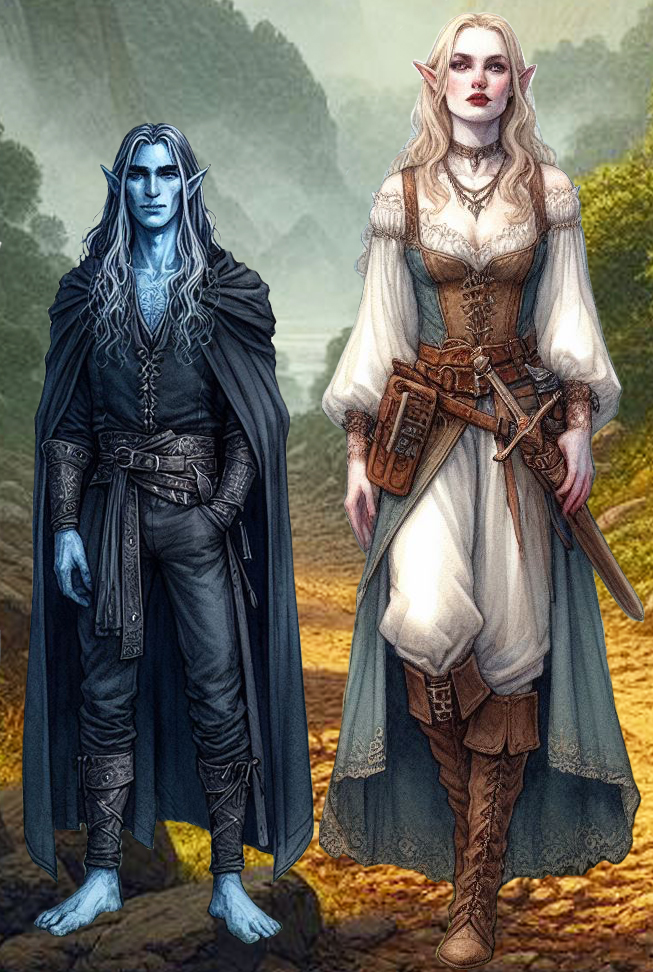
Appearance:
Build:
From slim to muscular
Height:
Females: 165-225
Males: 170-235
Weight:
Females: 72-120
Males: 70-190
Lifespan:
Females; –
Males: –
Skin:
Lightgrey, beige, white.
Hair:
Black, brown, grey, white
Eyes:
Black
Language:
- Greater Common
- REALMISH
- NIMZAXIAN
- WESTRIL
- ILEISH
- Greater Ancient
- OL-DARIN
- HIGH-ARLINIAN
- VULARIAN
- Regional
- OST-ARLIAN
- THA-ARLIAN
- SOUTH-DARIN
- RIM-DARIN
- EAST-DARIN
- WEST-DARIN
- UPPER-DARIN
- MAARKISH
- FINDONIAN
- EAST-FJELLAS
- WEST-FJELLAS
- EAST-DALISH
- WEST-DALISH
- LOW-NALDAN
- HIGH-NALDAN
- NORTH-UTAR
- SOUTH-UTAR
- NORTH-SKOGISH
- EAST-SKOGISH
- UPPER-SKOGISH
- SOUTH-SKOGISH
- WEST-SKOGISH
- CENTRAL-SKOGISH
- Country-wide
- AIGON
- AMRAD
- ANDALUS
- APAL
- ASCAL
- BEBRAM
- BINZAL
- BOWEI
- BRABURG
- CLAUN
- EBRAR
- EFRON
- EGRAL
- ESLY
- ETAIN
- FALBUR
- FLAUM
- FLURG
- FRIDOR
- FRIL
- GASLUG
- GOLDARIS
- GOLNY
- GREBI
- HOKUL
- JABOS
- KAROLY
- KESHON
- KUSTU
- LADRIS
- LIONI
- MUMAK
- FOGWALD
- NIMZAX
- OBRAN
- OGLAN
- OSMES
- PEARLIN
- QUEGLI
- RENAS
- SAROVA
- SCIA
- SEVIELS
- SHOAK
- SKELOP
- SKIUM
- SNAW
- SPIY
- STARIA
- THANG
- THAYRI
- TORNIX
- TREVAN
- TROV
- TUSLA
- UDRING
- UGREN
- USAI
- WESTU
- ZAPRI
LOCATIONS
COUNTRIES- ADROL
- AIGON
- AMALTA
- AMRAD
- ANADAK
- ANDALUS
- APAL
- ASCAL
- ASPANII
- BEBRAM
- BILZA
- BOWEI
- BRABURG
- BRAKYL
- BURFAL
- BUTAN
- CESMYE
- CLAUN
- CROSTYI
- DOTREGO
- DRUOLES
- EBRAR
- EFRON
- EGRAL
- ESLY
- ETAIN
- EXICOTA
- FALBUR
- FLAUM
- FLURG
- FOGWALD
- FRIDOR
- FRIL
- GARTIA
- GASLUG
- GOLDAR
- GOLNY
- GREBI
- GUSTUJE
- HARDANG
- HOFRANA
- HOKUL
- IDREAU
- IKARATO
- ILANDII
- INOSIO
- IXTAMU
- JABOS
- JODRUJA
- JULMUL
- KAHULAT
- KAROLY
- KESHON
- KUSTU
- LABIGIA
- LADRIS
- LEITAN
- LESMUS
- LIONI
- LIPINIA
- MARAKAT
- MENEYA
- MOLPOLDA
- MUMAK
- NABKIXO
- NAMAPA
- NICARAZ
- NORIAG
- OATYLA
- OBRAN
- OGLAN
- OMOAS
- OSHON
- OSMES
- PEARLIN
- PEBLERON
- POKALU
- PUCHAXA
- QUIGLY
- REMAS
- RENOEA
- RIKAINUK
- ROKEA
- ROKKOAU
- RUBURMA
- RUPEU
- RYPERN
- SAROVA
- SCIA
- SEVIELS
- SHOAK
- SKELOP
- SKIUM
- SLOVIIT
- SNAW
- SPIY
- STARIA
- TAMASNI
- TAULIEN
- THANG
- THAYRI
- TORNIX
- TREVAN
- TROV
- TUSLA
- UDANZUU
- UDRING
- UGREN
- UHMZEL
- ULGARY
- URAKITA
- USAI
- VANGBAL
- VIZIRGINA
- VUTHEUA
- WAITAN
- WALIZIA
- WHEIAG
- XOTHROS
- YOFROYA
- YUGAHAMA
- ZAKORO
- ZANZATI
- ZAPRI
- ZILBUR
- ÆBALGO
- ØKATUUR
- ÅSODALA
Legend
“Vampires rose from mortal Alfar kin into the greatest of powers, matching divines and even besting godly foes.”
“Immortality gained, the soul drain changed them utterly.”
Description
Drakk and Ljost Alfar, born infused with immortality and gaining divine Wickeryadii energies, still look like their original ancestors. Their presences radiate with such strength that there is no doubt about their capabilities. In fact, they are as powerful as the gods and void divines. But, although they are exceptional mana manipulators, their greatest weakness is the astral; out of all races, they dissolve the quickest there.
Besides their problem with the astral, they have another flaw, depending on if they are of Drakk or Ljost Alfar origin; Drakk Alfar need to consume blood, and Ljost Alfar need to consume spirits from mortal races. Both try to carry out their curse as gently as they can. Although they at times also empty a victim totally, making it their ‘child’, or whatever one would call their next generation. Some of the embraced children have carried on the gentle practice; others ran berserk and drained as wildly as they could.
Generally they shun other races, but at times they emerge to defend or duel, as Liches hunt them, and they hunt Liches and gods, both in attempts to gain their opponents’ energies. These duels, further empowering vampires, were what made the gods try to have the divines aid them in destroying the vampires—but they failed.
Vampires don’t like sunlight but can endure it, especially the newer generations, as if in exchange for might, as the newer generations are less powerful than their parental generation. A fact that Da’Vey has verified, as he has hunted, fought, and killed several emerged vampires.
“Changed forever to almost divine might, they have but one flaw—their hunger.”
—Skjald Ulrich
History
Dark Ages
When Kjartana Killincha, an Archaic Druid, noticed similarities and differences between void weaving and astral weaving, a few Drakk Alfar joined his studies. The most prominent pair was Eilif Moonwhisper and Torinn le Langlaag, who joined and introduced the group to some Wickeryadii he had practised with. From these the group learnt the divine art of Void Weaving.
A few decades later, as Ljost Alfar began appearing, these talented and highly skilled individuals found an interest in Kjartana’s group and joined. Their adaptations were so swift that the Archaic and Drakk Alfars began to ponder their origin. So they were brought to the Vornir, and soon the group regularly visited the impressed astral divines. Realising the void divines had taught these mortals something beyond the capabilities of astral divines, the Vular started prying the Drakk Alfar of Em Ru Arran.
But the Vular was fended off by Wickeryadii, who installed mistrust and warnings. Yet, as they figured that the Drakk Alfars coveted learning the life-giving skill more than anything, the Vular exchanged the Void Weaving secrets in exchange for the Drakk Alfars being allowed to join the creation of some Ljost Alfar threads, the most famous no doubt being Insilnuella Eranvurtal.
Thus the group also learnt Astral Weaving, but as soon as the group had taught Void Weaving to the Vular, there were no further involvements in spinning Astral life threads. The group had, however, learnt enough and easily figured out the rest themselves. This is why the Drakk Alfar of Em Ru Arran and the Ljost Alfar of Ljos Ismul and Tul T’Ari know so much about hand weaving.
“Original talent of such proportions and skills that astral divines both took a fancy and played a trick.”
—Skjald El Mary
As those of Em Ru Arran, and Ljos Ismul and Tul T’Ari—a settlement they shared with some Archaic, both aged and multiplied—they shaped into races of the most skilled craftsmen, thinkers, poets, and more throughout the Void. Slowly, as their numbers grew, they also evolved at several new places, one of which was a great volcanic island floating in the void, which they named Em Ljos—T’ari. Some of them were even in the astral most of the time, as they did not suffer from astral dissolving as other mortal races do.
After hundreds of decades on the now-tamed volcanic island, it was turned into a bridge between the Void and the Astral. Uar Knosso Perimax, the greatest Drakk Alfar druid that has ever existed, as he had managed to turn a mana leak into a stream feeding a living bush. Came to honour their work and gave them a self-growing sapling of his bush. Glowing like a Ljost Alfar halo from his Eternal Bush, the sapling was placed in a temple of its own, and the Ljostari Alfar created the company ‘Leaves of Life’ to tend it.
But, like all other Ljost Alfar, they cared little for the tedious things of our world. Thus, after a while, they asked some humans of the Vular race if they would become garden tenderers—an offer the Vular eagerly accepted, although it mostly meant cleaning the temple. They also approached the sapling, praising and tending it.
Tended with care, the sapling grew into a shining bush with a potent, sticky magic balm. As it turned out, its balm bestowed immortality on those touching it, the garden tenderers were disbanded, and the bush was isolated and became a sacred Alfar relic. But, as the Vular Gardeners formed a worshipping cult, with such devotion and praise, the Ljost Alfar eventually allowed the Vular Gardeners’ archpriest, already immortalised, to enter the temple atrium again.
It did not take many years for the Arcpriest to realise two things: each time he managed to touch it, he became slightly empowered, and the survivors of Kjartana Killincha’s original group and a few other elect had all touched it and were thus immortals. Somehow the joy of being slightly empowered each time he touched it was slowly overshadowed by the envy that others shared the gift. So he began telling stories about it to gods, divines, and mortals.
“Suddenly gifted with a cure for their coming curse, they sadly handled it badly.”
—Skjald Sigurd
Maybe it was because the Drakk Alfar had taught Void Weaving, a skill they had learnt from the Wickeryadi, to the Vornir in exchange for being part of creating some Ljost Alfar. Maybe it was because they had figured out life-giving, a skill only half taught by Vular. Or maybe it was because this small group of Archaic, Drakk- and Ljost Alfar had gained immortality that they were viewed with envy.
The Void divines also felt somewhat betrayed by the Drakk Alfar and overlooked by the Astral divines. The Wickeryadi, especially those Insilnuella Eranvurtal befriended, were though calmed down, but the gods saw their opportunity to sow seeds of mistrust and malice.
So, one time when a large portion of these Drakk and Ljost Alfar returned from the Vornir, using Wickerii Grove as a rest stop, they did not know a trap had been set, or that fate had just aligned for a bizarre outcome. Regardless, the result was spectacular, as the visitors had their spirits consumed, resulting in these three things:
- Most of these Drakk and Ljost Alfars became spirit-drained husks.
- Arcane weaving became a skill only mastered by vampires.
- These, the first of the vampires, equal the divine races in power.
As the Drakk Alfar and Ljost Alfar had their spirits drained and were turned into Vampires of Wickerii Grove, but the Archaic had withered and died. The gods quickly spread the rumour that it was a Wickeryadii attempt to limit void weaving from spreading further. If that was really the case, the entire Vornir lot should have been destroyed instead. But the Wickerii Grove story gained momentum, and vampires became a shunned or hunted lot. In fact, it cost the lives of many a normal Drakk and Ljost Alfar.
Due to their knowledge, heritage, balm tainting, and strange spirit drain, they became almost divine. As they were determined to find the truth, they foresaw an upcoming conflict with gods, so they multiplied in numbers and generations. The gods, observing Vampire ranks grow, plotted against them and managed to convince the Boriac, then the Vornir, and finally the Stoicheian that something had to be done to stop this. Wickeryadii, seeing their plot for what it was, and Sarcian, staying neutral, did not join the scheme.
“Becoming powerful brings envy and coveting eyes, spiced with divine lies; it proved unlucky alignment.”
—Skjald Vinotis
Some of the first vampires, remembering the legends about the Divine War of the Eight Realms and the following period, where contender gods schemed to halt the spin of the astral wheel and halt all leaks—creating utter chaos and self-destruction. But the attempt to topple their realm masters and forever darken the Void. Where ruined by eight mortals who managed to alert the greater gods and even trick the contender gods into a trap, knowing the sacrifice they would pay—thus both pairs of eights are now eternally trapped at the Entwined Zenith-Gyre garden.
So, it was a surprise when Wickeryadi asked them to aid the Second Eight, as the group needed vampire aid to carry out their plan to prevent a Stoicheian attempt to breathe life into a new race. It would be born out of merged T’Aurs and Kobold, seemingly to match or even best the Vampires. As the ritual was about to begin, the Second Eight charged the Stoicheians, which broke the mental bind of T’Aurs and Kobolds. As the enhancement was broken, all T’Aurs and Kobolds joined the Second Eight. Had it just been these mortals against Stoicheians, they would all have died, but the vampires rushing in sent the exhausted Stoicheians to their knees, surrendering.
But as the Second Eight and most T’Aurs and Kobolds had perished, and this attempt was a disruption of balance and a threat to them, the vampires didn’t accept their bending knees and ripped their hearts, throats, and heads. It’s said that these three vampires, Lärrilyx Né Thryll, Havillalila Njorltaghur, and Japolo Diq Diwaq, consumed the Stoicheian energies as they do Liches, and we are grateful it was first-generation vampires doing so, as lesser ones might have gone insane by the fill. Thus do vampires hold the memory of the Second Eight very high and are even said to have sheltered some of their descendants.
“Meeting other divine-blessed mortals was a great relief, sadly, it was but a brief moment.”
—Skjald Valgrif
Then, after a period, the vampires finally had enough and wanted to reveal the truth. But just as they confronted the gods spreading the stories, a divine and godly plot unfolded that almost destroyed the vampires. Some divines wanted to wrap the Astral within the Void gardens. But the gods wanted to weaken all seams so that everything would dissolve into mana, as the wrapped sea would spill out and even fill the void.
As the Void garden haul and mana sea wrapping took place, Stoicheian, Sarcian, and Wickeryadii noticed what was going on and began to enforce all seamings while alerting the Astral divines, so Boriac and Vornir helped enforce the seams. Thus, amidst the common task, a divine conflict shimmered, and since then there has been mistrust between gods and divines.
“Facing their archfoes, the entire framework of existence changed.”
—Skjald Yell'a'Beard
First Age
As the world was reformed, gods and divines were at odd ends; one thing hit us all. As every mana leak was now wrapped, the world lay in darkness. The vampires didn’t care, as they could see in the dark, but mortals were horrified over the tumult and lack of glows. Thus, divines had to agree on the new world setting, and as gods thrived by praise and sacrificial energies, they agreed and joined. So, two Stoicheians were made, Sun and Moon, fed by all other divines; they float around the world, illuminating it as day and night.
Vampires didn’t really care but for revealing the truth about their birth, now sort of eradicated as the inhabited Void was gone. Their Em Ljos—T’ari was now a great isle and renamed Ljostari. Ljos Ismul was a grand city at Naldar, and Tul T’Ari was a mighty city fortress at Findon. Their archaic comrades had disappeared, and they slowly lost contact with their former kin, both because they outlived, outwitted, and outskilled them.
Centuries passed, and they persisted digging into their birth, most divines not really caring, and gods occupied with their usual plots and schemes, and mortals horrified each time they appeared. Hostility began to brew anew, especially because their higher generations had increasing hunger and used their gained power for local dominance. So, as the real culprits brewed yet another attempt for world disorder to unfold, using vampires as the excuse for calamity. An unforeseen ally stepped forth; a group that would become known as the Favoured Eight came with dire warnings but also pledged support to the vampire cause, even though things of a much larger scale were brewing. The Vampire War broke out.
The release of energies in 3967, known as the 1st Cataclysm, resulted in a breach of our world’s fabric so severe that it tore apart along the equatorial belt, and the astral sea within spewed and sprayed forth alongside molten earth and stone. All was total chaos, and some unknown races even surged forth and joined the fray. But to the dismay of the contender gods, the leaked astral mana crystallised at an astonishing pace.
The hundreds, if not thousands, of the most powerful Mana Manipulators. Hand weaving countless Mana Threads, some in direct conflict, others as a supportive force, and eventually as mere fuel for the chaos. The released energies descended individuals into madness, while others were caught by their released energies and dissolved.
The 1st Cataclysm was of such proportions that it threatened to unravel existence; not even the Vornir’s Hymn of Truenames could halt it. So, a truce was called, and all joined in a collaborative effort to save the world from destruction. Nevertheless, the massive surge of Mana during the cataclysm had an enduring effect on the World and the Sun and Moon—and it ended the First Age.
“The divine attempt to eradicate them was almost successful.”
—Skjald Sejrik
Second Age
As the vampires saw the second age unfold, the world tilting eventually halted, and the sun and moon somewhat realigned their original paths, the vampires paused the research into their birth. Instead, as the Hymn of Truenames was fresh in their memory, they created a vast amount of truename grimoires. Most of these had several vampires as authors, so their interpretations of the hymn are of the most accurate kind.
These grimoires have served vampires well, especially in teaching the newly embraced or preparing for duelling powerful foes. The grimoires are not only highly valued by vampires, divines, and others allowed to study them. They are also coveted by treasure hunters, collectors, or liches seeking knowledge.
A couple of centuries passed studying lore and writing when the vampires discovered a note about a forgotten cure. In the tales and legends of the first vampires’ visits to Em Ljos—T’ari, it was written, “As they touched the bush, the balm mitigated the hunger for most and cured a few.” The word about this spread quickly, and vampires began travelling to Ljostari to enter Ljosti and touch the bush.
But the powerful ‘Leaves of Life’ and their Vular archpriest only allowed those of Alfar origin to enter, regardless of their generation. Displeased by this, the Alfar vampires considered forcing access for their human children. But a conflict with their Alfar kin was deemed too costly, so they restrained themselves. Regardless, animosity grew, and vampires and Alfar slowly grew further apart.
“As time passed with memories, some Alfar-born gained the ancient cure.”
—Skjald Kazumix
Third Age
When the Bullheaded God emerged from a temple south of the Rim, originally founded in the Void by Uar Knosso Perimax, the vampires faced this divine predator alone. Especially as it ignored everyone else, they found no aid among divines, their Alfar kin, other n-erectus, or humans against this berserk whirlwind.
Several great duels took place, in which some quite powerful vampires perished. Trying to keep track of it, setting traps, and searching grimoires for its true name, they were encountered more often. Despite using their skills and magic paths to blend in, they were noticed, with either duels or crowd fights as the result. Generally because the hundreds of Vular spies, agents, outposts, and settlers reported them as quickly as possible.
So travelling the roads became even more uncertain than before, and vampires began using astravel, despite the double danger they faced at the astral—home of the gods. But suddenly the bullheaded god was gone, as Yumari Cere of the Fourth Eight seemingly ended its existence. Yet another annoyance began to press, as the Vular had grown to such arrogance and malicious behaviour that they at times laid pressure upon or even attacked vampire lairs. With minds equalling the divines, the vampires sensed something larger afoot than a bunch of mortals behind it all.
As the conflict escalated, they came to aid their Ljost Alfar kin and counsel with the rulers of the Mt. Ljostaris Alfar and Dwarven tribes. Staying there, the Fifth Eight came to visit; their suspicions proved true. The gods were once more trying to unravel the world, using the Vular War as a stage carpet. When the Vular set their feet upon the stairs of their grand halls, both Ljost Alfar, dwarves, and vampires rushed to the gates to crush the intruders. The Fifth Eight luckily stayed focused on the real enemy, and when alerts rang through the corridors, they rushed to the forges of Mt Ljostias’s belly—where they faced and bested three contender gods. And then the world literally buckled, cracked, and then exploded.
“Whether it was a god, a divine in disguise, or a lich will never be answered, but it was a mighty opponent.”
—Skjald Vinotis
A strange thing occurred in the early years of the third age. Two Stoicheian saw a young girl, Leani Ze'Araki of the Mermerant, being revitalised by a Vornir. The revitalisation was similar to what had occurred when vampires was born, so discussions began amongst the void divines, if the astral divines had been involved in their birth.
“Whether it was gods acting on their own, or they had vornir aid, is still unanswered.”
—Skjald Yell’a’Beard
Fourth Age
Both the escalating battle, facing the mightiest of mortal and N-Erectus mana manipulators, and gods in disguise. As well as the volcano blowup and Ljostaris sinking, which did cost several vampires their lives. But most managed to escape in various ways, especially their Lewisian Gneiss mirrors, which ensured that they could astravel safely. Appearing at their lairs and strongholds, some reported a strange dizziness due to being touched by the tainted waters.
Just as they began researching this odd effect, reports of dead people walking once more began to float in. Some thought it was the effect of the balm of the magic bush sparking life into all these carcasses, but as reports of their touched children still urging for blood or spirit. Somewhat disoriented, they began researching this new race—the Arisen. Instead of following up on their own taint.
A couple of centuries passed, and a new threat knocked at their door. Living humans had figured out how to become Arisen, emerging as liches after performing rituals and bathing in water tainted by the Deep Blue Tsunami. And they had discovered that if they killed a vampire, they gained its energies. Just like the bullheaded god, was it a lich they had fought, or the very same who had returned and had taught mortals as its weapons? Up through the Age of Hordes, they fought several liches and also embraced quite a lot of new ones to face this threat. Then around the year 800, rumors of an archaic lich-lord spread across the isles. Thus those that would become the Sixt Eight each turned their attention towards this being, called Ka' Narag. As the greater gods became aware of their Favoured Eight’s agenda, they learnt of the might of Ka’ Narag and the Lich Conclave. The plan was to unfold a three-step masterplan: sweep the world of vampires, consume all mortals, and topple the gods.
This was an existential threat to all gods and races, and thus the Mana Seas’ intentions, but the gods feared the other divines’ reactions in case they acted directly. So the Favoured Eight were informed that they didn’t need to worry about gods. Luckily, the Favoured Eight proceeded with utmost care and reached out to their vampires, retying old bonds. In 808, as Ka’ Narag and the Lich Conclave were performing their ritual to drain all vampires, the Sixt Eight astravelled into their midst. Throwing a misdirection spell, all links gathered into eight pulses, destroying the Lich phylacteries. As the exploded energies backlashed into a multicoloured umbrella-like blast, consuming all the performers in the Lich Conclave and all of the Sixt Eight.
In 1167, Lauric Svartholtr reached out to the vampires about his ideas for a world-spanning realm of peace and coexistence, but due to their children’s hunger, the vampires declined but would not oppose it. This neutrality was restated in 1208, at the meeting in Gramshirs Villa. When the 1st Alliance began to assemble and move in 1234, the vampires once more stated their neutrality. But in 1246, as the Torch had grown in numbers and was causing too much trouble interfering with vampires, the vampires didn’t like this lot at all, and single vampires were spotted among the officers of 1st Alliance contingents. These were seen among those participating, but not bending knees, at the high king’s coronation.
Then came the The Great Invasion and this time they stayed neutral and isolated, a riddle to many of us at that time. Their isolation is most likely why they also missed the seventh descent. But finally victorious, some of them joined the Cleansing Crusade.
“High aloft, they stayed neutral until their Outlands kin stepped on their soil, breaking an ancient pact.”
—Skjald Ulrich
Fifth Age
Yell’a’Beard, who claims he bested a vampire in Outlands, and some interrogated prisoners from the Great Invasion also stated that vampires act a bit more openly in Outlands. We have no idea if vampires of the Outlands now reside here, and if that was the real reason why the vampires joined the Cleansing Crusade.
We don’t even know how many generations of vampires there are, let alone have a vague idea about their numbers, but according to Da’Vey, there’s quite a difference between besting the most recently embraced and fighting those embraced a few generations ago. He is not certain but thinks the oldest vampire he has put to rest was embraced around the time Ljostari sank and thus is only around 1300 years old—I assume there’s no reason to mention vampires hate Da’Vey and his vampire hunters.
“Their hunger may or may not create children. children,”What will the Scorched Dawn bring? So far there’s nothing to sing.” They embraced, as we call them.
—Skjald Sejrik
Organisation
Like those who can be revitalised by praise or meddling with the world, vampire power is sustained by their blood. But they have an odd effect on their victims, depending on how much they drink. If they only feed a little, their source becomes fatigued, dizzy, and, at times, ill. If they, on the other hand, drain their victim, it becomes bloodless Husk for a full day. But its Spirit becomes locked to the dead-looking corpse and the drinker. Both then share their common abilities equally, making the drinker slightly weaker and the newborn vampire much more powerful than in its previous condition.
So, why vampires sometimes drain victims instead of just feeding them is a mystery. Maybe they need comrades to fight Allele Diploid and Relagin. Both use vampire existence as a means to further their own agendas.
“Their hunger may or may not create children, the embraced, as we call them.”
—Skjald Sigurd
They live alone or in very small households across the entire world, according to Sessy, who heard stories about them below The Rim. All obey their maker, and that is their maker. Thus, all eventually obey the first ones, and if there was but one, God, what a Monster it would be.
We suspect that there are several branches of vampires, in accordance with the tree-draining legend, as some are very different from the others and even vary quite a lot from the huskand spirit of the victim. One becomes extremely strong, heavy, and brutal. Another, almost like a mind-reading Mentalism Mana Manipulator and so forth.
“Their physique and skills are far beyond mortal capabilities, and so are their magic paths.”
—Skjald Valgrif
We also know very little about the 1st generation ones, except they were all Drakk- and Ljost Alfar. But we do know a little about those who embraced forming 2nd and newer generations. Through intense studies of ancient lore and conflicts, as well as studying the known 2nd and lesser vampires, the two original Alfar-Vampire kinds, although both vampires, seemingly developed into two major groups with exceptionally few cross-overs.
Drakk Alfar generally became blood-drinking vampires. Who must regularly drink fresh human (or animal) blood to sustain their existence. They cannot be satisfied with blood from the dead and can be harmed if the blood is infused with a strong force of religious belief before vampires feed. This type of vampire is most common, and they can be found in cultures and myths all around the world. According to many myths, one single feeding of blood can provide a vampire with a subsidence for two weeks.
Ljost Alfar generally became a spirit vampire. They must regularly feed on humans, and although spirit vampires do not physically harm their victims or willing donors, they extract life force, which enables them to live. This ability can work both with single victims and by extracting the life force from crowds of people. Most often, victims don’t notice that the vampire is feeding on them, and the effects of such feeding can be short- and long-term fatigue (which very rarely leads to death). But, as spirit vampires consume their victims energy, usually shortening their life span, it shows visibly and sometimes kills them from excessive feeding.
Human Vampire:
The ’embrace’ as Vampires call it must be some combination of blood and human spirit, as humans are the only race amongst all fauna that Vampires feed upon. But, as we have no records whatsoever of Jomzaar, Rimzir, and Vular vampires, nor of any Wanderers and Indigenous Mermerant offspring, or Wanderers and N-Erectus offspring being embraced and thus becoming vampires, We have concluded that there are most likely no vampires south of the Rim.
“Although the first generation also had Archaic, humans have always reacted differently to the embrace than alfar.”
—Skjald El Mary
It’s odd, though, that those of Alfar and Wickeryadi origin did end up needing those to sustain their vitality. The embrace has four outcomes for the victim: successful embrace, disfigurement, insanity, and death. If the embrace is interrupted or otherwise goes wrong, it can result in the vampire becoming a disfigured vampire and rotting the flesh. The embrace, or life as a vampire in general, can sometimes induce mental illnesses and the creation of insane vampires who cannot be controlled.
As we know one set of 1st Generation Alfar vampire teeth and know the structure of human teeth across their 2nd to 9th generations, especially from Da'Vey, who also has proven that vampires keep the form at their death. Thus does their physical corpse decay in accordance with the form and the climate their remains reside in. We have been able to figure out that every second generation shifts the fangs one step outward. Most likely a natural evolution to increase the success of non-magical disguise among humans. Thus, the second generation shares the extension of the inner incisor. The 3rd and 4th generations see the outer incisor extended. The single canine tooth spans the 5th and 6th generations. The inner premolar covers the 7th and 8th generations, and the 9th is the outer premolar. So far, we are uncertain if it is also just the 10th generation affecting the outer premolar or if that one covers all generations after the 9th, as we have never seen or heard about vampires with extended molars.
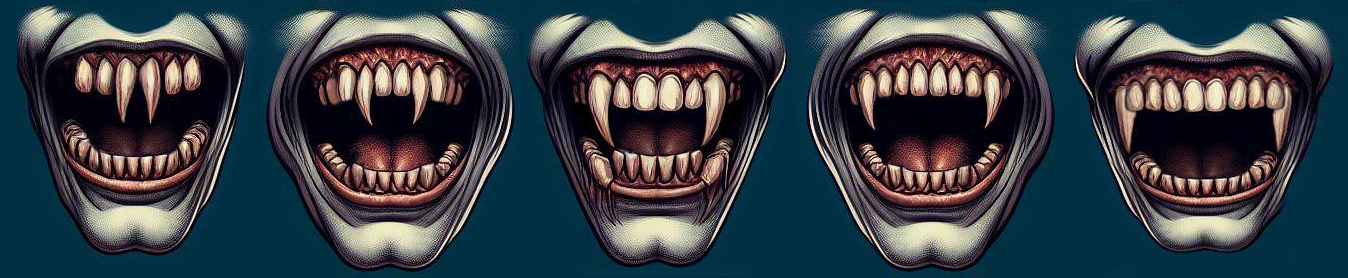
1st generation Ljost Alfar: Zyldiliin Malthûrr, Drakk Alfar: Mehelge Huintyy'r, Drakk Alfar: Ranty Rantulak, Ljost Alfar: Liamonda Nialva, Ljost Alfar: Mirranu Marraga, Ljost Alfar: Ballinoa Jevati, Drakk Alfar: Garamar ne Gideti, Drakk Alfar: Pinteqa lo Faxtux, Drakk Alfar: Gillionalia Miola, Ljost Alfar: Khütu Siljêr Jā, Drakk Alfar: Igren Ellýs Sinej, Drakk Alfar: Lärrilyx Né Thryll, Ljost Alfar: Havillalila Njorltaghur, Drakk Alfar: Japolo Diq Diwaq, and the reborn Mermerant: Leani Ze'Araki.
2nd generation Ughuz: Zaraq 'the Shadowblade' Zemez, Borji: Yan Pirilla, Clovincaz: Lacap 'the Great' Baanaj, Tatongol: Khadu Namu, N'Aldaan: Agihata Natao, Markian: Yanoto Togomo, Mawmen: Alosaka Ipoh, Moss'Ari: Ranét Ritzlouren, Common: Yatar Lundall, Common: Grylie Kimoa, Ogryl: Muat Cham Kotu, Padurian: Delir 'the Shadow Weaver' Sayedzai, Padurian: Arash 'the Wanderer' Sepehrkhel
3rd generation Ughuz: Sylara 'the Bloodmistress' Shimzi, Findograa: Prince Amindrak, Borji: Yome Juxza, Ortagui: Muvmin Katawi, Utarik: Jonzey Dalbert, Mawmen: Enapay Xuois, Common: Leynella Lundall, N'Aldaan: Naggahatro Miyano, Padurian: Pariwash 'the Sea Witch' Kalanzai, Padurian: Azin 'the Illusionist' Parvizkhel
4th generation Ughuz: Draven 'the Cannoneer' Rabiqz, Findograa: Lord Kaelthar, Borji: Gingin Waqmeo, Ogryl: Beau le Santo, Markian: Lomo Lamo Huxva, Mawmen: Keme Niuqnogla, Padurian: Anosha 'the Whisperer' Noorzadkhel, Padurian: Kambiz 'the Scholar' Nikzai
5th generation Findograa: Lord Bokassrek, Borji: Xipia Nanamei, Tatongol: Junmo Dungha, Ortagui: Lamala Bwarti, Izir: Karmrana Jataqua, Mawmen: Holata Elonimes, Padurian: Khadir 'the Silent Blade' Deleerzai , Padurian: Soozan 'the Enchantress' Kaihankhel
6th generation Findograa: Chieftain Vordrak, N'Aldaan: Dagami Asumi, Ogryl: Konri von Veelen, Utarik: Timylo Dattami, Darim: Olmok Pukdas, Mawmen: Kilchii Ojavan, Padurian: Hamzad 'the Smith' Darweshzai
7th generation Borji: Kindao Meiling, Tatongol: Hanato Ghurtu, Markian: Himmarati Hadagure, Ortagui: Hagama Magalala, Izir: Fatukot Jahbak, Mawmen: Samoset Naiuqnogla
8th generation Borji: Laqxi Xiya, Ogryl: Da al Agumato, Ortagui: Wafiq Quatafa, Utarik: Bodzilo Safkami, Darim: Johkum Polum, Mawmen: Adoeete Awoik
9th generation N'Aldaan: Jaruto Mogami, Markian: Nakafe Prista, Ortagui: Rafiq Quatafa, Utarik: Yalmabela Himlo, Darim: Kafte Grouefta.
“The generation number grows, and their drinking teeth move ever outwards.”
—Skjald Yell’a’Beard
Special
Seldom encountered at Astral… They dislike Sunlight… and they can die.
“They can endure, so don’t think you’re safe if you have nothing but energy to offer.”
—Skjald Kazumix
Last Updated on 2026-09-09 by IoM-Christian