
Homed el Rial
Legend
“Some say he equalled Setil, if not in skills, then at least in determination, for his vision never flickered until its very foundation showed flawed.”
“The curved fangs of the desert sands, who for a quarter of a lifetime searched for lost masters.”
Description
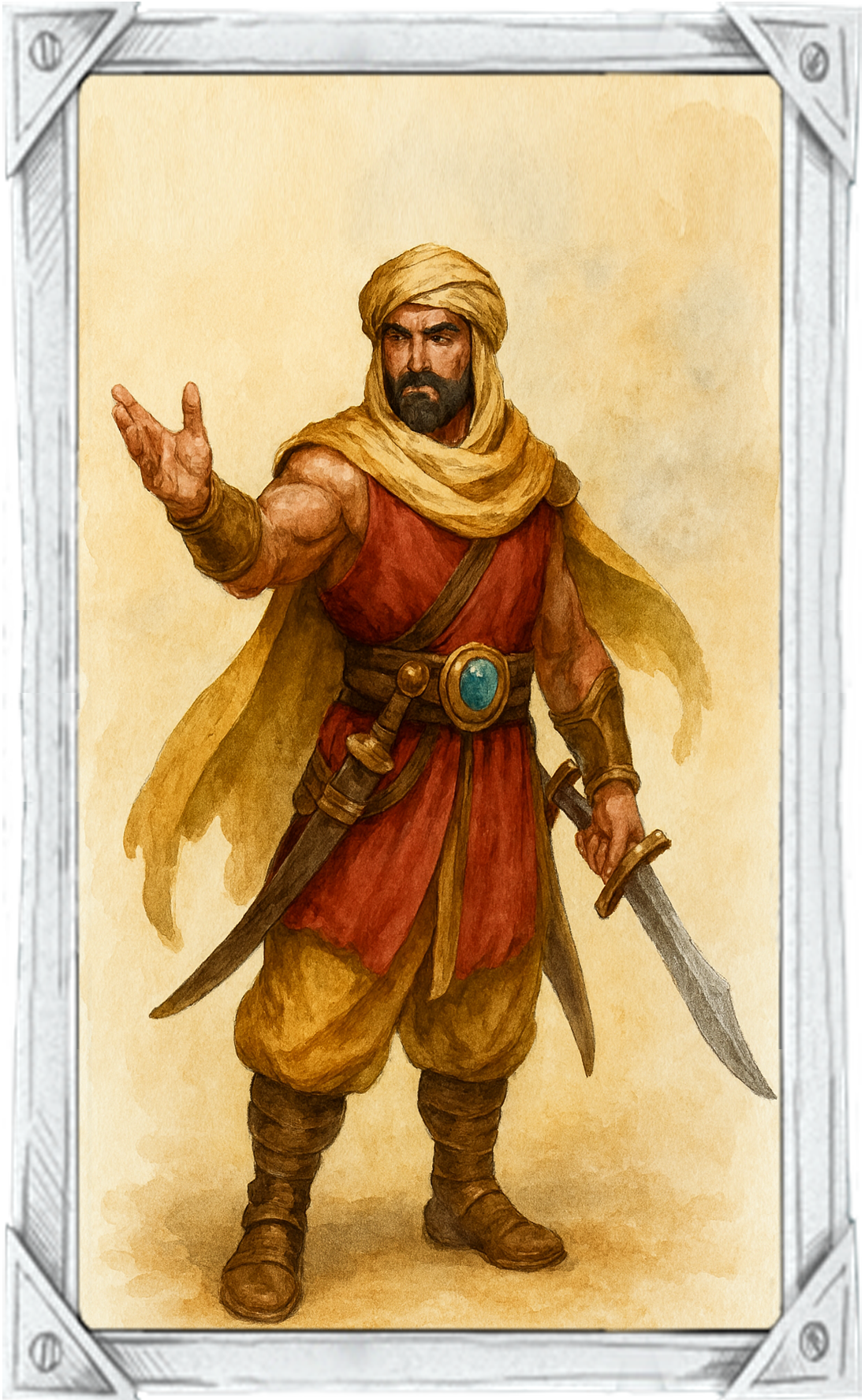
Homed possesses the lean, powerful build of a seasoned rooftop runner and master bladeweaver. His body is built on tight, athletic efficiency rather than bulky strength, carrying himself with an airy grace that allows him to leap across sun-bleached rooftops or vanish into desert shadows in the blink of an eye. His skin is weathered by years of roaming through harsh desert wind and harsh terrain, framed by a dark, neatly trimmed beard and sharp, analytical dark eyes that rarely stay still—constantly calculating trajectories, reading body language, and observing environmental patterns.
He dresses in traditional yet functional desert attire, wearing vibrant crimson and saffron robes tied around the waist with a thick leather belt set with an ornate, glowing teal jewel. A long, warm-gold cloak and matching headscarf wrap around his shoulders and face, offering protection against the shifting sands of the whispering dunes while doubling as a tool to blend into ambient light or shroud his movements.
When fully equipped, he carries custom-forged weaponry—most notably his signature twin jambiyas with interlocking brass cipher-rings integrated into their hilts, and, historically, his broad-bellied Veibyan steel grand scimitar. His hands, though nimble enough to crack complex mechanical vault locks and pick locks, bear the calluses of a life lived by the edge of steel. Trained first by Tariq in the fluid curves of scimitar geometry and later refined by the master assassin Setil, Homed treats combat as a real-time puzzle. He uses asymmetric, unpredictable angles, deliberate feints, and mechanical grip switches to break an opponent’s rhythm and defy natural combat physics.
Homed perceives the entire world through a lens of geometry, mathematics, and codes. To him, every footstep, lock mechanism, guard rotation, and blade trajectory is merely a variable in an equation waiting to be solved. Whether cornered by shadow-enforcers, surrounded by optical mirages, or standing toe-to-toe with ancient warriors, Homed remains remarkably unshakeable. He approaches danger with intense focus and a quiet, cerebral confidence. He possesses an extraordinary ability to notice the smallest physical flaws in his surroundings—such as subtle shifts in sand, lagging shadows, or mechanical weaknesses in siege weapons and minting machines
Beneath his disciplined exterior lies a witty, deeply curious individual who genuinely enjoys a clever puzzle or an unexpected challenge. He delights in discovering “glitches” in systems—be it an unbreakable code, an illusionist’s trick, or a foe’s rigid combat style. Unlike many lethal mercenaries or rogues, Homed rarely slays out of malice or bloodlust. He prefers disarming, disabling, or outsmarting his opponents, viewing enemies as potential teachers or fascinating puzzles rather than simple targets.
Whenever he travels to new lands, Homed habitually seeks out master craftsmen, weird scholars, herbalists, and legendary warriors—not just to complete contracts, but to learn their lore, study their styles, and share family stories over a pipe of combat herbs or a cup of wine. In quiet moments, Homed can often be seen absentmindedly tracing intricate geometric patterns, ciphers, or script angles in sand, dust, or on tabletop surfaces. Whenever his hands are free, he habitually cleans, rotates, or re-aligns the tiny gears of his brass mechanical cryptexes and weapon hilts.
“A gentle desert whisper that grew into a roaring storm.”
Skjald Sejrik
History
Fourth AgeHomed el Rial was born in Ziran, a vibrant oasis city connecting the major trade routes to the faraway countries of Jodruja, Zilbur, Zapri, and Puchaxa. The first years were spent playing with other kids and watching his Ortagui father and Jomzaar mother write cursive strokes in their ledger books or their sway of hands when cooking for and serving the passing caravans. As he grew, Homed began watching caravans as they approached as they told their own stories, just the way they swayed into the city through the dunes.
When he was around nine years old, it occurred to him that the sands of the whispering dunes did not just shift; the ripples left by the desert wind looked exactly like fathers and the caravans’ patterns are almost like the curves and sways of written words. Thus, while other children in the city chased brass hoops through the spice markets, Homed sat in the shadow of the great towers, tracing patterns in the dust.
His parents was master scribes and cooks, but Homed did not want to copy old histories, boil stews, or slice meat and vegetables. As he possessed a rare, restless mind that saw the hidden geometry in everything—the rhythm of a guard’s patrol, the repeating knots in a merchant’s tapestry, the complex, interlocking brass tumblers of vault locks, and the movements of any bladeweaver. He wanted to find the keys to the patterns he had discovered and unlock their secrets.
By twelve, Homed had outgrown the dusty studies and turned to other secrets. He ran with the Street Kites, a crew of agile orphans who delivered coded messages across the city’s sun-baked bleached rooftops. But he didn’t just deliver messages; he cracked the cipherscripts used by the corrupt merchant lords to hide their illegal slave tallies and smuggled combat herb routes. He could look at a page of substituted alphabets, transposed matrices, or geometric grid codes and read it as fluidly as a mother tongue.
In 1161, when Homed had turned sixteen, he opened something he shouldn’t have: a heavy, black-iron cylinder covered in rotating rings of ancient script—a legendary Sun-Cypher from the lost dynasties of Khashur. Inside was the map to the Vault of Stars, and Homed went there and took a single intriguing encrypted message. The intrusion was discovered, and the merchant lord who owned it sent Ziran’s brutal shadow-enforcers, the Obsidian Blades, to reclaim it.
Nimble at mind and fingers but unskilled at bladeweaving, Homed fled, but suddenly he found himself trapped in a dead-end alleyway beneath a canopy of drying silk and was cornered by three armed men. His only weapon was a standard utility dagger. He survived that day only because an old man named Tariq, a retired palace guard who lived in the shadows of the alley, found the numbers unjust. At first Tariq just studied Homed’s evasions, but when a cut struck deep, Tariq intervened, and he didn’t just fight; he danced. He wielded a crescent-shaped scimitar with a blade so wide and polished it caught the noon sun like a mirror.
As he had seen the boy’s potential, Tariq took him in. For the next five years, Homed’s life became a brutal symphony of physical exhaustion and mental gymnastics. “The scimitar is not a sword, Homed, Tariq would growl, parrying the boy’s clumsy strikes. “It is a curve. It is a circle. Like the scripts you always read, a blade’s path has an entry point, a fluid arc, and a resolution. Find the geometry in the steel.” Homed applied his mathematical mind to the blade. He began to view combat as a physical cypher. Every opponent had a pattern—a repeating sequence of footwork, a predictable angle of attack, and a telltale twitch of the shoulder before a strike. Homed learned to decode his enemies in real-time.
He commissioned a weapon suited to his unique style from the exotic Jomzaar bladesmith Iens the Bladesman: a massive, custom-forged grand scimitar. It was longer than standard swords; its curved belly broad enough to act as a shield, made of folded Veibyan steel that rippled like water. To anyone else, it was a heavy, unwieldy executioner’s tool. To Homed, it was weightless. He balanced the massive blade with the agile, gravity-defying footwork of a rooftop rogue.
By his twenty-first year, the boy from the dust-shadows was gone. In his place stood the Grand Cypher of the Dunes. Homed wore deep indigo robes that bled into the desert night, a linen shemagh masking his face. On his hip rested the grand scimitar, its pommel set with a rotating brass cryptex of his own design. He had become the ultimate phantom—a rogue who could slip into the most heavily fortified fortresses completely unseen, decode their deepest secrets in minutes, and, if cornered, unleash a whirlwind of devastating steel that no ordinary guard could predict.
His final test came when he finally unlocked the Sun-Cypher he had stolen years ago. The code revealed that the current Sultan's vizier had been planning to poison the oasis waters to redirect the faraway caravan connections to weaken the Sultan and seize absolute power. No wonder animals had begun falling sick. That night, the vizier’s private chambers were breached. There was no sound of shattering doors—only the whisper of silk. Homed did not kill the vizier. Instead, he bound him to his chair and shouted intruder. When the vizier’s personal elite rushed into the room, they found a phantom holding a massive, gleaming crescent of steel.
The guards attacked in a synchronised formation. Homed smiled beneath his mask. A basic grid pattern, he thought. He stepped inside the first guard’s reach, the broad flat of his grand scimitar sweeping upward to deflect a spear, using the momentum to spin a perfect, fluid circle. The heavy blade cleaved through armour with effortless grace. He moved like a dervish—part acrobat, part mathematician—calculating the trajectories of their blades before they even swung. Within moments, the guards lay disarmed and unconscious on the Padurian rugs. Then Homed yelled, “Assassination!” out the windows and left.
The city guard heard it and rushed inside to find the vizier, tied in his chair, terrified and shivering. Pinned to the desk with a small dagger was a parchment. On it was the vizier’s treasonous plot, translated from his private, unbreakable code into plain language and signed with the rogue’s calling card: a small ink drawing of a scimitar crossing a quill. By dawn, the vizier was in chains, and the city was safe again.
Homed watched the sun rise over Ziran from the highest point of the grand watch towers, his massive scimitar resting against his shoulder. The city below was a sprawl, a beautiful pattern, and he was the only one who truly could read it.
The vizier’s fall triggered a frantic panic in not only the high courts of Ziran but all of Thayri. The ruling council needed to know who had broken an unbreakable code and bypassed the palace’s legendary security. To find a phantom, they hired a ghost. So, two days later, Homed was in his hidden workshop above a spice warehouse, painstakingly cleaning the gears of a brass cryptex. The air suddenly grew cold. The smell of cinnamon and cardamom from the streets below vanished, replaced by the faint scent of ozone and dried blood.
Homed didn’t hear a footstep, but his mathematical mind registered a subtle shift in the room’s shadows. He lunged out of his chair, drawing the massive grand scimitar from its sheath in one fluid, explosive motion. Standing in the corner was a figure draped in ash-grey wrappings that seemed to swallow the ambient light. It was Setil, widely whispered in tavern myths as the world’s greatest assassin.
Homed did not hesitate. He spun into a dervish arc, his heavy Veibyan blade slicing through the air in a perfect mathematical trajectory designed to cut off all escape routes. He expected a block, a parry, or a dodge. Instead, Setil moved like smoke. The assassin didn’t try to match Homed’s geometry; he broke it. With terrifying speed, Setil stepped into a blind spot of Homed’s swing, completely bypassing the scimitar’s broad belly. Before Homed could recalculate the trajectory, a bone-chillingly cold stiletto blade was pressed firmly against his jugular, and a steady boot pinned one of his ankles to the floorboards.
Homed was completely immobilised. His flawless equations had failed against a man who defied regular combat physics. “Your angles are perfect, youngster,” Setil murmured, his voice sounding like grinding stones. “But humans are not made of straight lines and perfect circles. You fight like a scholar. I fight like a plague.” Setil withdrew the blade, stepping back into the shadows. Homed gasped for air, his pride stung, but his mind raced to analyse what had just happened.
Instead of striking again, the master assassin sheathed his weapon and looked at the complex cypher grids scattered across Homed’s desk, then back at the massive, uniquely balanced scimitar. A cold, rare smile touched Setil’s scarred face. He saw the raw, terrifying potential in the young rogue—a mind that could read the world like a book, paired with the strength to wield an executioner’s blade like a feather.
“Luckily those of the palace paid me to find you but not erase you,” Setil said, adjusting his grey attire. “So, since the world is full of boring targets, a student who can almost decode my movements before I make them? That is a rarity. Pick up your steel if you want to live. Your true education begins tonight.” Under Setil’s brutal tutelage, Homed’s rogue skills transformed from exceptional to legendary. Tariq had taught him how to dance with the blade, but Setil taught him how to blend that dance into absolute nothingness. The assassin showed Homed how to use his cypher-solving mind not just to decode traps but also to decode human behaviour, body language, and the natural flaws in any fortress’s architecture.
Homed’s grand scimitar was no longer just a weapon for an open brawl; under Setil’s guidance, he learned to use its polished, broad surface to catch and redirect light to blind opponents, and how to strike from the dark with absolute, silent lethality. But in 1169, as Setil one day looked at the massive grand scimitar leaning against the workbench, he scoffed. “That ‘Executioner’s anchor reminds me of something since you must slip through shadows to reach your target,’ the assassin rasped. In our world, bulk is death. If you cannot bend, you break.” Then, from beneath his ash-grey cloak, Setil drew a pair of twin weapons. They were longer than standard daggers but shorter than swords, featuring deeply curved blades made of a dark, light-absorbing alloy. They were jambiyas—heavy, curved daggers designed for rapid, fluid, and devastating close-quarters combat.
“These are your new nails,” Setil said, tossing them into the desk. They embedded themselves perfectly in the wood without a sound. “Two blades. Two variables. They do not fight the wind; They slip through it. “Homed picked them up. His fingers instinctively searched for the balance point. They were incredibly light, allowing his wrists a full range of three-dimensional movement. With these, his agility on the rooftops would double; there was no large scimitar slapping against his thigh or throwing off his center of gravity during mid-air leaps.
Setil’s combat philosophy was what truly captured Homed’s mind. The defeat in the workshop had not discouraged the young rogue; it had electrified him. His mathematical brain, usually obsessed with perfect order and repeating sequences, his mathematical brain had encountered a beautiful anomaly. Setil’s movements were a broken pattern. They were a visual paradox—an asymmetric code.
The training began anew, and during their gruelling midnight training sessions atop Ziran’s highest domes, Homed became obsessed with this new puzzle. “You are trying to calculate my next move based on what I just did,” Setil warned, his twin blades flickering like twin tongues of a serpent. “Stop looking for the rhythm. I am the silence between the beats.” Homed realised that a broken pattern was still a pattern; it was just a higher tier of cypher. One based on deception, where the true variable was hidden beneath intentional chaos. He began applying the technique to his twin curved daggers.
With one blade, he would create a predictable, fluid arc—a feint to trick his opponent’s mind into calculating a standard trajectory. With the second blade, he would strike from an entirely asymmetrical, broken angle that defied the natural expectation of flow. He learnt to split his focus, his left hand writing a lie while his right hand delivered the truth.
He modified the twin daggers, carving small, interlocking cypher rings into their hilts. As he spun and flipped the blades during high-speed manoeuvres, the shifting brass rings on the handles could be mechanically locked to change his grip configuration instantly, throwing off any master duellist trying to read his grip. Thus, the grand scimitar was retired to his wall, a monument to his past. The young man who once sought perfect geometry in the world had now learned the deadly beauty of the fracture. He was no longer just the Grand Cypher; he was the Broken Code Chief.
In 1173, the opportunity to test his obsession with broken patterns came in the sunken ruins of Sabra, a forgotten oasis swallowed by the dunes. Setil had sent him to retrieve a scroll of imperial bloodlines, but the ruins were guarded by a mana-manipulating thief known as Al-Hazred, the Weaver of Mirages.
As Homed slipped through the crumbling stone arches, his twin curved daggers were held in a reverse grip against his forearms. Suddenly the air grew thick and shimmered like a heatwave; the shadows stretched, and Al-Hazred materialised from the darkness—not once, but six times. Six identical mage-thieves surrounded Homed, each pulling a glowing crescent blade from the air. They moved in perfect, terrifying unison, their footsteps making no sound on the ancient stone tiles. A normal intruder would have panicked, but Homed’s mind instantly began running equations. Six targets. Identical velocity. Identical stance.
“You see what I want you to see, lad,” the six illusions hissed in an overlapping, echoing voice. They lunged simultaneously. Homed spun, his twin daggers parrying the first two strikes. But his blades met only cold mist. The illusions passed right through him, leaving frostbite on his skin. A third illusion struck from behind, and a real blade sliced across Homed’s shoulder. He leaped sideward, pressing his back against a stone pillar to eliminate his blind spots. Blood dripped from his shoulder. He closed his eyes for a fraction of a second to reset his focus. Magic is just another language, Homed thought, his heart racing with thrill rather than fear. It has rules. It has an order. And every illusionist has a glitch.
The six mirages advanced again, weaving a complex, dizzying pattern of intersecting lines. To the untrained eye, it was flawless choreography. But Homed stopped looking at the men; he started looking at the environment, and childhood memories flooded back as he noticed the dust. As the six figures glided across the floor, Homed’s trained sharp eyes caught a tiny, asymmetric detail. Five of the figures passed over the ancient sand without disturbing a single grain. But the fourth figure from the left—just for a fraction of a second—kicked up a tiny swirl of dust as its heel touched the ground. The weight variable, Homed smiled beneath his mask. An illusion carries no mass. The real one must obey gravity.
The torchlight reflecting off the ruined walls confirmed his observation. Five of the figures cast shadows that perfectly matched the flickering fire. But the fourth’s figure’s shadow was delayed by a fraction of time—a error in the sorcerer’s magical concentration. Al-Hazred was projecting a masterpiece, but he was human. Maintaining six bodies required immense mental strain, and the code was glitching.
The illusions attacked again, a whirlwind of glowing blades designed to overwhelm Homed’s senses. Homed didn’t try to block them all. He let the first three illusions cut through his torso, ignoring the phantom cold. He focused entirely on the fourth figure—the one that disturbed the dust. Just as the real Al-Hazred brought his blade down, expecting an easy kill, Homed executed a broken-pattern manoeuvre Setil had taught him.
He feinted left with his left dagger, halting Al-Hazred’s cut into an upward guard, then instantly altered his grip using the mechanical cypher rings on his hilt. With a lightning-fast twist, Homed dropped low, completely breaking the expected physical trajectory. His right hand whipped forward. The dark, light-absorbing, curved dagger sliced cleanly through the sorcerer’s wrist.
Al-Hazred screamed. The illusion shattered instantly like cracked glass, leaving only the lone, bleeding sorcerer on the stone floor, clutching his arm. “How?” the sorcerer gasped, looking up at the young rogue in terror. “The Mirage of Sabra is flawless!” Homed wiped the blood from his twin blades and sheathed them effortlessly. “Nothing is flawless,” he murmured, looking down at Al-Hazred. “Your magic is beautiful, path-walker. But you forgot to calculate the dust.”
Instead of delivering a finishing blow, Homed extended a hand to the bleeding sorcerer. Al-Hazred looked up in disbelief, but accepted the help. “You broke my perfect code,” the sorcerer muttered, wrapping a cloth around his wounded wrist. “Why spare me?” “A dead man cannot teach me how the illusion works,” Homed replied with a sharp smile, “Your magic path was beautiful. It just had a few glitches.”
Impressed by the young rogue’s genius and grateful for his life, Al-Hazred handed over the imperial scroll. Over the next three weeks, the ruined oasis of Sabra became an unconventional classroom. An odd, deeply respectful friendship formed between the logical mathematician and the eccentric manipulator. Al-Hazred taught Homed the basics, magic was not about brute force; it was about tricking the viewer’s perception. Because Homed already understood how to read human body language and environmental shadows, he absorbed the lessons at a terrifying speed.
With limited time, the danger of overcasting, and as Homed didn’t have the vast magical reservoir to create six full-body clones like Al-Hazred. Homed instead adapted the magic to fit his agile, twin-blade style. He learned to cast petty-illusions:
The Ghost Step: Forcing an enemy’s eyes to see him a handswidth to the left or right of where he actually was.
The Phantom Blade: Making his curved daggers appear to strike from above, while the real steel swept low.
The Shadow Bleed: Briefly turning his grey cloak into absolute, shifting darkness to vanish mid-stride.
Al-Hazred found himself fascinated by Homed’s analytical approach, while Homed deeply enjoyed the illusionistr’s chaotic wit. When it was time to leave, they exchanged a firm grip of brotherhood. Homed returned to Ziran not just as a master of physical broken patterns but also as a rogue who could now weave literal glitches into reality itself.
When Homed stepped into the dark workshop, the air was thick with tension. Setil stood in the shadows, expecting a report on a cold body and a retrieved artefact. Instead, Homed slid the imperial scroll across the table, intentionally wrapping it in a faint, shimmering illusion that made the parchment appear to rest a hand’s width from where it actually lay. And when Homed calmly explained that Al-Hazred was not only alive but now a trusted ally—and then demonstrated a subtle glitch step that blurred his silhouette—Setil froze.
The legendary assassin was deeply annoyed. An absolute order had been broken. In Setil’s line of work, leaving a target alive was a breach of contract, a dangerous variable left unchecked and the penalty was death. Yet, beneath that rigid professionalism, a fierce surge of pride took over. Homed had not just survived a most dangerous illusionist; he had reverse-engineered his magic, defeated him, and turned an enemy into a powerful asset. It was a double victory that required a level of strategic genius Setil had never seen before. Setil looked at the rotating cypher-rings on Homed’s twin daggers, and then at the faint, artificial delay in the boy’s shadow – and decided on the reward.
A quiet, rare sigh escaped the master assassin. He realised the mathematical truth of the situation: he had nothing left to teach the lad. Homed had fused physical geometry, asymmetric combat, and optical magic into a lethal style entirely his own. He was no longer a student. He was a peer. Without another word, Setil reached out to where the imperial scroll actually lay, swept it into the folds of his ash-grey cloak and gave Homed a long, silent look of absolute respect. Then, stepping backward into the deepest corner of the room, Setil melted into the darkness and was gone, leaving Homed completely independent.
With Setil gone, Homed went to find his old benefactor Tariq. But Tariq was nowhere to be found, which those of the alleys found strange, as he had been seen just days prior. Eventually Homed came to the conclusion that his former master had collected a certain debt from his first master. And he began travelling the isles to find Setil.
When Homed came to Jodruja in 1174, he only found hints that led him to believe Setil was located elsewhere. So he travelled to Shoak and crossed that border in the spring of 1175. While searching through its underworld, he met Samia el Rial and was surprised by her surname. It turned out that their great-grandfathers’ fathers had been brothers, and their sharing of family legends became a cherished break from routine pattern studies. A few days later, Homed travelled on, eager to also return home one day and tell his relatives about their kin’s history.
He spent the entire year of 1176 roaming through Molpolda, only discovering that all hints about Setil suggested east from where he came. Convinced that the information was planted, he continued his search westwards. So as 1176 turned into 1177, he rode into Keshon, still searching; he also took on bounty hunter tasks and mercenary jobs. It was during one of these bounty hunter tasks that he met Jadob le Wils, a similarly aged and imposing bladeweaver. Homed stayed at Jadob’s for a month before leaving again. He was glad that he had learnt martial arts using a heavy scimitar, since Jadob favoured a gigantic double-bladed battle axe.
Homed went further west, into the dense woodlands of the rugged terrain of Fogwald, and in the summer of 1179 he visited Deepminded. Initially, Homed was just treated a normal guest who quickly left, but as Deepminded gained insight into his pattern-reading mind and petty magic paths, her respect evolved. She decided to teach him more about the paths. So it was late that year when Homed finally said farewell and rode towards Oatyla. A land that in the summer of 1180 made Testiculas cross Homed’s path in a rather obscure situation.
Homed had accepted a quick hunt down of a troll that was killing sheep. Testiculas was in the area collecting herbs and was charged by that very same slimy troll. As Testiculas struck the troll in the face, stunning it so he could impale it. Homed, had focused on the troll, and not noticed Testiculas. So when Homed jumped the jogging monster from behind, landed on its shoulders, and sank both his daggers through its ears into its small brain – it halted due to Testiculas’ smack. Homed’s momentum and the troll’s gooey back and abrupt halt lunged Homed over its head. As Testiculas’ broad hat covered the lobbing load, Homed crashing full-body on top of him surprised the herbalist.
Sprawling to their feet, facing each other, they began to laugh. Their few bruises quickly mended by some of Testiculas’s combat herbs, and as they smoked a pipe of some other herbs, a thought struck Homed. Setil used these; that was his secret. Asking if Testiculas knew someone called Setil le Ozz, Testis’s mood immediately shifted, and he said he could not tell anything about anyone who bought herbs from him or not.
But he had heard that name before, and if Homed searched for that man, he needed to learn about some abilities and stat-boosting combat herbs for sure. Thus, most of Homed’s time in Oatyla was spent wandering with Testiculas and learning about combat herbs.
Eventually they parted, and Homed travelled into Cesmye in 1181. Travelling back and forth, he eventually came across Zoe Egrn, and they became equally impressed with the other’s abilities. A lot of lore and the secret shadowy networks were discussed before Homed left to continue his search. Ever eastward, he made him cross the border to Staria in 1182. Searching low and high, far and wide, his mount one day stumbled. It turned out it had gotten ill, and Homed had to get another. Asking the locals, he was guided to Zan Feldstad, already a renowned horse breeder despite her being just slightly older than him. When he met her, something about her intrigued him, most likely her mind, as it was that which guided her movements, words, and conclusions.
At some point, she thought that Homed’s interest was not just in the mounts, but he interrupted her to ask about a certain dapple mare, which he liked for its behaviour and movement pattern. Looking at the one mentioned, Zan realised this was no ordinary pass-by haggler. So, she asked him to stay and test whatever mount he liked. As he slowly turned his head, Homed smiled. He stayed there for two months and, in the end, settled for the dapple brown mare. Then he took the road again, and that winter saw him crossing into Urakita.
Urakita turned out to be a mess but also a heaven for a skilled bounty hunter. The almost empty saddle bags became stuffed with copper and silver again as 1183 grew old. And as he criss-crossed the country, he met Amarti Ansin a couple of times. But as such, Homed shared no adventures with him. But when he, in 1184, rode into Zilbur and met Kanziganthir, he was in for a surprise. Homed couldn’t read him at all. It turned out that this man was almost a millennia old, an impossible age for any kind of human Homed had ever read or heard about. ‘But I’m right here, so that proves it’s possible,’ said the living relic. Homed stayed with Kanziganthir for a week, but then Kanziganthir had urgent matters to attend to, so Homed rode on.
Zilbur had offered an unreadable puzzle and no trace of Setil, so as 1185 dawned, Homed hoped Zapri and maybe those Ye Olde Zephyrs he had heard about could shed light on Setil’s wereabouts. Zapri turned out to be the opposite of Urakita: no chaos but order everywhere. Homed felt a chilling, uncomfortable sensation, as the pattern seemed somehow off. When he met Ye Olde Zephyrs, their king Black Oak, and Kanziganthir once more, he realised why. This horde lived by a 4000-year-old codex and had covered their lands with it.
When he asked about Setil, most of the Zephyrs looked puzzled, while some simply grinned. Eventually Aragon said, “He’s further away than you think, lad.” As he saw they were both about the same age and heard the tone of that ‘lad’. Homed knew what they wanted, so he accepted the gauntlet. “To blood or death?” he asked. He immediately regretted his words, realising that they were too sharply formulated. But to everyone’s surprise, the king Black Oak stepped in front of Aragon and said, “Our apologies for being too jestic towards a guest, but I, as leader,better accept that equally harsh behaviour, lad.”
Not a single one of Ye Olde Zephyrs laughed, jested, or grinned as their king took this risk. And Kanziganthir, who had studied Homed more than the rest, knew there was a frustration building over years within Homed, which could trigger some of Setil’s most deadly moves. And to those Aragon would surely fall, but the ‘oak’ could as well. “To either than, relic,” was Homed’s reply as he surged forward with his ‘fangs’ sliding from sheaths. Seldom had the men seen their king unleash, but he had to, as Homed’s skills were outstanding. But neither of them could land a blow that spilt even a drop of blood. As the wind-bent oak kept avoiding the slashes, stabs, and pokes. Meanwhile, delivering slashes and stabs with increasing force. Homed could feel the impact inflicted by parrying in his wrists, and he realised this foe could not be bent but had to be broken. and as those thoughts crossed his mind, his vision exploded in a pink flash with red and violet splutter, and he fainted.
As Black Oak noticed Homed’s eyes turn into a pinkish kaleidoscope and Homed’s bones suddenly become able to bend and curve, he released his Fylgin. Just at the same time, Kanziganthir broke duel laws and cast a shielding spell. The mighty bear felt two strong stabs at its throat, stabs that would have pierced even the Fylgin’s fur and Black Oak’s own protections. Kanziganthir’s shield also prevented the gasping fylgin from ripping Homed’s arms off and biting through his skull.
Two days later, Homed had recovered from the Fate Awakening and woke. A hoarse Black Oak explained what had happened. As Homed apologised for the outright death stabs, Black Oak simply remarked that this was the essence of Fate Awakenings and that he was fortunate Kanziganthir had a hunch and was present. Homed left as soon as he had recovered, and as he felt revitalised beyond belief, he now understood even better why Setil had bested him so easily.
The year 1186 saw his search through Puchaxa, and then he entered Goldar in 1187. At some point during the summer, he met Jutai Fereira, who also travelled all over Goldar. Though Jutai’s destinations were various N-erectus places. Homed spent the year visiting strange places with Jutai and gained insight into some very remote and unusual cultures, habits, and lore. But in the winter he sailed to Markeoy.
In 1188, after a not-so-pleasant travel, Homed, quite relieved, set foot on a pier in Exicota and began criss crossing the land, more out of habit than actually searching for Setil. There he one day met Thōm Dūihol, who had arrived from Bhang’s Towers in Vizirgina to an Astral Site/Gate nearby and now was heading the last way home on foot. Intrigued by Astravel, Homed enquired about it and accompanied Thōm to his hometown, returning with Thōm to Thōm’s hometown and back to the astral site a month later. As Thōm operated the Astravel site and left, Homed spent the rest of the year learning more about Astravel. And not until early spring of 1189 did he enter Anadak.
Anadak was a tense experience as agents of the green king had the country’s lid rattle like a two-hander on skeleton ribs. His travel through it became an unpleasant haste, and the only light was when he met Elu Frantsi. As he had somewhat hastened into Skium, it was almost as if he could breathe again. And when he, in the autumn of 1190, entered Muldum, he met Zoe again. He also met some of Zoe’s associates: F.F. Jaeger, Sang Marsol, Iaspa Roullo, and Trikzy Kizvik. Although he found it strange to meet people of the West so far east, it didn’t take him long to figure out they worked on machines to automate something. Asking Zoe directly, he was invited to see for himself at Mino's Owing, and as he studied the devices and machines, his mind saw patterns that could connect some key elements.
A few days later they had been implemented, and most of them went home. Although Homed stayed for a few more weeks, as he had discovered F.F. Jaeger had also studied under Frazier in Fogwald. And he had this idea about weapon enhancements. F.F. found it fascinating but did not at all have the abilities to craft such a thing but suggested that Homed should return and talk to Frazier. Homed said he might just do that and left the next day.
Both the blade-weaving skills displayed against Black Oak and the swift solutions to the minting machines had raised the 1st alliance's interest in him. And Homed became one of Black Oaks’ most-used mercenaries. Several, in his view, mundane tasks and a decade later, Homed was in 1202 asked to escort Sahnsnot, The'D' Fish, Strelagin, and Lord Nam to West Fjella. They were to meet Mermerants, Archaic, Indigenous, Confluents, Scions, Wanderers, and N-Erectus at Iaspa’s workshop. As the meeting unfolded, Homed studied the workshops’ shelves.
In 1204 homed set out once more to try to locate Setil, now not just for revenge but more to discuss things. So he astravelled to Ugren, bought a mount and began to search. In the town of Arabubure, as he mistook her for Zan Feldstad, he met Pawa Zacula. However, Pawa turned out to be one of the talented bladeweavers who, like Homed, were always interested in foreign melee styles, and they practised together for days. Eventually, the sparring, wine, and company had nothing more to offer. Homed travelled on to Brakyl, where he met Holli d'Ay, a scholar with quite a large collection of ancient scrolls, and then Homed travelled to Rupeu, where he met Krokus.
After a quite exciting time with Krokus, Homed travelled to Skelop, where he met Dogil, and then Trevan, where he met Latinoor. That encounter became quite the experience, as Latinoor was a master of the blade and offered Homed quite a few teachings about defensive duelling. In 1206 he entered Namapa and, as usual, criss-crossed the country until he met Ze'o Lobio in Sanedar Guimard. That encounter turned into a 3-month-long stay at Ze’s place where Homed studied a lot of ancient Clovincaz scripts. Finally, in the spring of 1206, Homed left for Gartia, and while roaming its dusty roads, he one day met Giry Tusmez in Booyurp Broak, from whom he learned about the combat herbs of Findon. In the late summer he travelled into Andalus, Where he looked for not only Setil but also a man named Da'Vey, who he heard was a formidable vampire hunter. Homed was quite interested in hearing more about this. As he found neither, he
eventually sailed to Mealis.
Landing at Mealis in 1207, he stood on the docks of Matharim in Thang, and as he was walking ashore, he noticed someone with a familiar coat of arms on their cape. It turned out to be Herdsman, working at Mino’s in Muldum, who was home for a brief visit. They spent a few days talking about how things were at Mino’s in Muldum and crafting in general. Then Homed roamed the country and travelled to Osmes, where he met Sho Sahanna, and the pair joined up to see the country. Then he went into Udanzuu and met Toorpe Thot, but as the summer that year just kept getting hotter and hotter and the sand felt like lava, his travel, guided by Toorpe, became more astral than mounted. Then he went into Rokkoau, where he did the same with Eradol Flint through those gargantuan hot valleys.
Not until late that autumn, as he had passed into Zanzati, where he met Ewia Ewitz, did he again turn to mounts, this time camel, across those burning sands. Reaching the southern parts The climate turned slightly cooler, and he passed into Burfal. First, he turned north, but the inland deserts soon made him turn south again into the damp jungles and marshlands. At some point he met the Skjald Vinotis. Homeds travelled through Pearlin quickly as he felt uncomfortable in those dense jungles, and he only stopped for a week as he metGizmo – a dwarven bladeweaver. He finished his tour with a brief visit across Meneya, where he briefly met Strah Redek at the jungle’s northern borderlands and the steppes. Finally he had enough of the jungle. Homed decided to travel home.
In 1208, as he had no running contracts, he took the time to pursue some questions that had lingered in his mind for more than a handful of years. Homed returned to Iaspa to discuss the mechanisation of certain patterns. As it turned out, the situation around Iaspa was boiling, and a bladeweaver’s hand was extra welcome. Thus Homed stayed in Trigea, sparring with Iaspa whenever they found some spare time. The crushing momentum of Iaspas’s hammer reminded Homed of his scimitar, so he taught how he had adapted defensive weapon swings into redirected attacks. Their anticipations came true in 1209 as they slew a large gang of saboteurs. Message delivered, things calmed down and Homed went home.
Homed spent the rest of the year brewing on some weapon improvements, and as he had begun to suspect Setil deliberately avoided him, he took a break from inventions and went out to visit the last of the Northern Isles. After all, the trips were both exciting and educating, and they kept him alert. So in 1209 he sailed to Utari. Landing at the shores of one of Tamasni‘s smaller isles and jumping a couple of them, he decided to go to the mainland and went inland, where he met Gilion Ewitz, and as they both shared an interest in mechanics and devices, Homed stayed for a month. Then as 1209 grew old, he continued the tour through Omoas, where he met Hebra Hargi.
Then he entered Bilza and had some intriguing duels with Polski and toured the country rather hastily. However, in Quigly, he stayed for several months because Wrekazi was someone he had never met before. More than 200 years old, she still looked young, and her knowledge about the age of hordes was formidable. She also seemed quite interested in Homed – he never figured out why. Eventually he left for Inosio, and although criss-crossing, he aimed for the hometown of Sang Marsol, whom he had met in Muldum. But Sang was away, so Homed travelled into Leitan, The World’s Mouth, as the indigenous call it due to its rivers and the damp, moist valleys they create; it welcomed him in the spring of 1211. There he met Siim Svollur, and as she found him intriguing, she volunteered to guide him through the valleys. He then went into Hokuland criss crossed it just for exploration and finished his tour by poking through Remas in 1212. In Remas he heard about the Altwalders and met Woodmaster, who told the story about the berserk dryad and the monster slayers Atallanti and Wilson.
In 1214, at a market in Molpolda, Homed noticed a pair of slim, curved scimitars hanging on a booth stall. Even at a distance their silvery ornamentations intrigued him, and he closed in for a haggle and buy. But just as he reached out, a towering figure reached over and grabbed the pair as well. The merchant rushed in as the customers faced him. Homed stared up into the face of the towering figure, and it was Sang. “So you also like these,” Sang said. Homed replied, “Yes, I do like these blades. What are they to you?” Sang said, “Interesting.” A bidding race started, getting ever more theatrical by the parts of Sang. When suddenly another man interrupted, “Well, good day to you two; it’s quite a spectacle, but finish it, and I’ll treat you mugs and meat – all of you.” Said Zoe, with a large grin. Sang backed out; Homed secured the pair of blades, to some exceptionally thankful prayers from the vendor, who finally got rid of those Rimzir ‘toys’ for a very high price and even had treatment thrown in as well. Homed noticed a change of expression in Zoe’s face and tone and paid extra attention as Zoe pried the best he could into the blades’ history from an eagerly talking vendor.
The trio talked long into the night, as they had no rush. Zoe said the blades might indeed be Rimzir blades, and those patterns were similar to what he had seen King Black Oak wear. Sang burst in laughter as he noticed a shake of hands with Homed and that his face was pale as the silvery moon. Homed simply stated that he had met Black Oak, and it was quite an experience. So, they decided to go visit Ye Olde Zephyrs, and if Black Oak’s eyes didn’t pop again when he saw Homed, they did when he recognised his father’s first curved blade crafts. Sang almost fainted when Homed offered them as a gift to Black Oak. Black Oak declined the outstanding gift offer and said he thought they would fit perfectly in Homed’s bendy hands.
During a trip down south to Ebrar in 1220, he took a couple of mercenary jobs. One evening at a tavern, he saw a most illogical thing unfold for his eyes. Across the room, a tall, lean male paid for his meal by plucking out coins from a pouch that, from Homed’s angle, seemed totally flat. A thing he had glanced back at when he, with Jutai, visited some Drakk Alfar but never enquired about. As there’s only one way to solve pattern riddles, he stood, walked over and asked if he could sit in Sinonstra, the language of the Drakk Alfar. Looking at him for a while, Jiakob Burne then replied with a welcome at the table, also in Sinonstra, although far more fluent. That week, Homed learned about ‘void rooms’, which are spaces where items can be stored inside paintings using Drakk Alfar magic paths.
In 1226, Homed went to Iaspa, and then they went to meet Da’Vey. Da’Vey had travelled to Remas, up at Utari, to visit Woodmaster the Herbalist. As Homed needed Da’Vey, they decided to travel there. But unnerved to perform astral travel, they went to the shore and then chartered a vessel northwest and made landfall six months later. Three more weeks, and they entered Woodmaster’s yard. There they experienced a tense standoff, as a loaded group was preparing to leave. Homed looked at Iaspa, rolled his eyes and muttered, “Again, just our luck, typical, huh?”
Atallanti mistook the comment for a bounty-hunting confirmation, so he charged, only for his strike to be easily parried by Homed’s curved scimitars. Mid-swing at Atallanti’s next blow, Iaspa’s boom of a voice halted the fight: “Stop; we aren’t here for your blood.” Atallanti glanced at Woodmaster, who recognised Homed and gave a nod of confirmation, prompting him to stand down. Atallanti offered a swift apology, reasoning he was far too jumpy when around Da’vey due to the persistent vampire threats. With introductions made, Homed still faintly glowing, Iaspa calmly explained their business.
Davey was on his way to Andalus and invited them to travel along, noting they could first go to Cypril to attend to their request. When Iaspa and Homed groaned loudly about another long boat ride, Da’vey grinned: “Long? Boat? Oh no—we take the quick path.” As Atallanti was explaining about astral travel, Homed suddenly interrupted, “I think I’ve heard about you, slaying a crazed dryad.” As Atallanti looked on Homed, Woodmaster began to tell about magical shards and elaborated on their practical uses as well. As they walked to the nearest travel site, Da’Vey was seemingly already pondering a solution for their request. After Atallanti and Woodmaster had left through the astral gate. Da’Vey fed the pillars, and when Da’Vey started the Astravel, Iaspa and Homed had a very nasty first experience with Astravel.
Mid-transit through the Astral Veil, Da’Vey, Iaspa, and Homed did not enter standing at the astral sea; they had been thrown into a localised aetheric pocket rupture caused by a severed ley line. As the portal glitched, it dumped them into a pocket overrun by astral parasites. Da’Vey had never seen such things before as he worked frantically to get them on track. Homed used his scimitars to sweep the astral beasts. Da’Vey yelled to Iaspa to try to reach out again using his physical weight and hammer to anchor the party to the shifting stone tiles. Eventually Da’Vey managed to re-align the ley patterns, snapping them back to material reality—shaken but uncorrupted. Looking at them, Da’vey asked if they had any divine enemies.
Eventually, they sailed a short distance to Drakk Alfar land, the fabled Axni Island. At first treated as any other human visitor, although slightly more unfriendly, as Drakk Alfar knew what Da’Vey did to vampires. But finally Da’Vey managed to talk to a summoned elder. He showed him the tokens he had been given by the Drakk Alfar and Yürriathrull. The gates to Axni opened wide, and they were led to forge after forge, unable to complete the task ahead. At the third forge, a group of lord crafters believed they could create what was requested.
Homed and Iaspa then drew out two small paintings from their bags. As both held the paintings tilted slightly face down, they uttered the enchantments they had been taught. Da’Vey noticed A pair of the Drakk Alfar lords, standing wide-eyed and gaping, began to talk aboutThe Void, Sarcian, and Stoicheian in Sinonstra. And then his eyes almost fell out as the elements in the two small images began to pour out as full-size bars, ingots, and gems. Seeing the looks on Da’Vey’s face, Homed and Iaspa said they had no clue how Jiakob Burne had made the void rooms. “Void rooms – no wonder the astral malfunctioned – you crazy lot, you.” Da’Vey almost shouted with an undertone of Sinonstra just to let the Drakk Alfars know he had understood their talk.
The Drakk Alfars grinned; Da’Vey and Iaspa left, and Homed gave them Lauric Svartholtr's scimitars and the daggers from Setil. Then, they began their work, reforging the scimitars into legendary artefacts. Homed used the opportunity to study the Drakk Alfar language, magic, and lore connected to vampires. 2 months later the blades were complete, and Homed left. It had been costly, but Homed was sure it was worth the price.
In the autumn of 1241 the 1st alliance wanted him at a meeting at Castle Yahagoto in Ruburma. It was his first visit to Naldar. At that meeting he met Zoe Egrn, Iaspa Roullo, Hebra Hargi, Sang Marsol and Ann Feldstad again. But also Raul D’Bridge, Kitusr, Mayor Tri-M, Ze Muff, and Myth. After the meeting Mayor Tri-M pulled Homed to the side and told him that the Bulls Order could use a mercenary like him, swift at mind and, as they had heard, even able to bend the old oak. Seeing a chance to once again run encrypted messages, Homed accepted the offer.
In 1247, as Homed had found Raul D’Bridge skilled and heard news about his position shift, Homed went to Nagghathol for a visit. It became a few intriguing weeks of practice and talk. about the world’s factions.
Years passed, and the 1st alliance became the Realm. Black Oak became the first high king, and then Methil Maiur took over as the oak retired. And slowly, as Homed decoded the messages that passed through his hands, he began to realise that the realm was crumbling. And as Methil was couped and Kjertil Ninch took over in 1274, it imploded. Culminating with the emptying of the royal treasury at Grimsborg and the capture of Niellu Muhuaela just the day after he had secured a rushed overnight loading of three waggons and a hasty farewell to Iaspa, Zoe, Hebra, Elge a'Gintyr and Homed. As they travelled, they began unloading the heavy crates, boxes, and barrels at certain safe houses. Eventually they hid a whole waggon inside a cave, and when the last load was safely
tucked away Homed when home.
Then came the great invasion: Anurai, Pigryn, Sproblin, Gaji-Kulat, Romasai, and the nastiest of all – the Kinoblin – swarmed ashore and poured from astral sites and hideouts. And Homed began to shine; ploughing through enemies, he cut a path across countries as he surged on a solo mission. Then one day, as he was surging through Jodruja, he suddenly saw not only one, but two familiar figures. Rushing to them, he aided them in destroying the invaders they had engaged, and as he faced both men, he stood slack-jawed—the old, worn-looking Tariq spoke first. “Well, if it isn’t our former student. How fares ye, Homed?” As homed just stood shaking, looking back and forth between them Setil said, “This is how those of us shape the sharpest of blades; good to see you again!” Homed finally stammered, “But I thought…” As both men grinned, they yelled, “Dodge,” and jumped aside as well. Homed barely managed to avoid being trampled by the Gaji-Kulat, and the trio defeated it somewhat easily. Then, they had a very long talk.
As Trigea was still not attacked in the late winter of 1277, Homed, although battle-fatigued, decided to visit his friend Iaspa in Trigea and see how things were going there. Arriving, he found Iaspa frantically working on a gargantuan mechanical siege engine, attempting to get the void-driven, shard-consuming engine operational and connected to the ancient ley-line device he had secured years earlier. Since Trigea was not attacked, Homed also provided assistance along with other great minds who visited briefly. But in 1278, the invaders came, and as Iaspa jumped into his engine, Homed rushed to prepare the city militia for what was to happen – if all went as planned. Then he paused and just stood watching as Iaspa, inside his gargantuan engine, stomped through the enemies like a giant minotaur wading in miniature sproblins.
As Iaspa astravelled to the other side of the city, Homed and the militia sallied out and slayed whatever they could reach to the distant yelling of Iaspa, and then suddenly in a
gargantuan multicoloured flash; they saw Iaspa’s engine duplicate. I’ll be damned. So Iaspas’s hunch about reaching both origin and destination held true, thought Homed as he cut through the now fleeing invader force. As the invaders fled, the two gargants became one again, and then Iaspas’ gargant halted completely. Homed ran to it, was hewed up, and found Iaspa sprawled, unconscious, in the seat. Later that day, Iaspa woke and could only recall crashing into the wall. “Well, your fate awakening came late but just at the right time,” my friend Homed said.
As Iaspa began to travel to different locations to provide assistance, Homed started searching for the Black Oak. He finally found him at the Battle of Weeping Plains. After that grand battle, Homed went home and began securing the rebuilding of his homeland. It’s rare these days, but he can be met on the roads and bends of all the isles.
“One of the few that ever experienced an astral bend and survived it.”
Skjald Ulrich
Organisation
Technically hes still with both the Street Kites, the 1st alliance, and the Bulls Order. And full fledged member of the Shadow Exchange -now known as “The Empty Ledger Order.
“What cage can hold the sand? What net can hold the wind? No order can shackle a ghost.”
Skjald El Mary
Special
When extremely pressed Homed become able to bend bones.
“As the astral bend touched his husk and mind, he became able to fold.”
Skjald Valgrif
Last Updated on 2026-08-03 by IoM-Christian